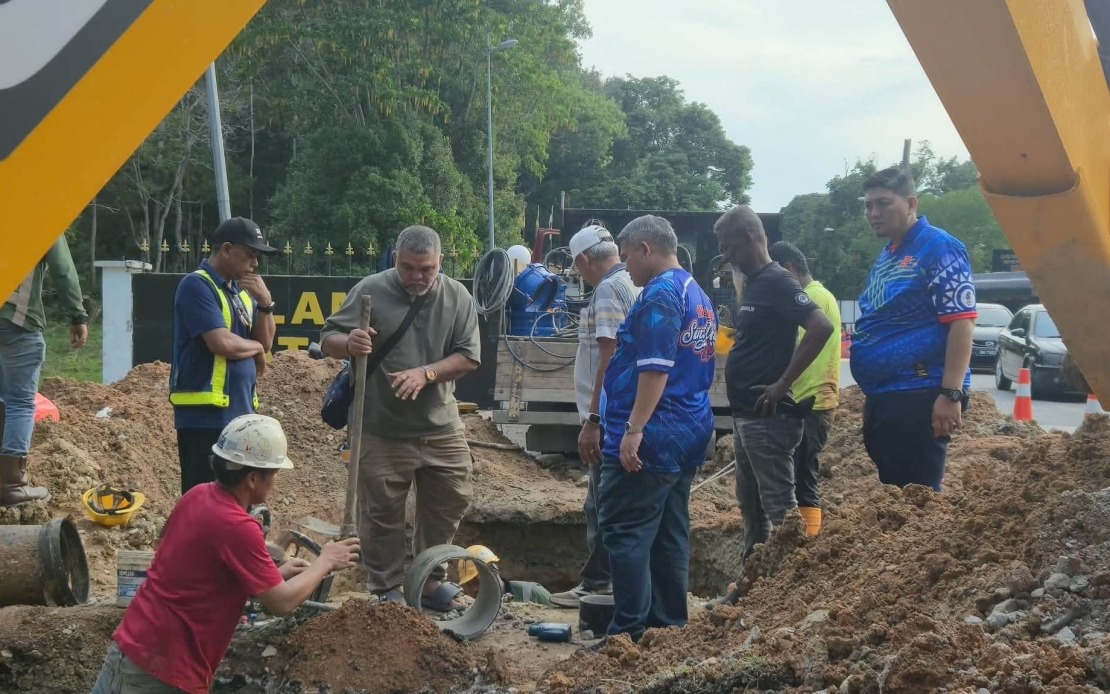
The Melaka state government has unveiled a stopgap measure to relieve ongoing water supply troubles at Kem Terendak in Sungai Udang, with Syarikat Air Melaka Berhad preparing to build a temporary storage tank at the military installation. The proposal forms part of an immediate response strategy designed to mitigate the impact of recurring disruptions that have severely inconvenienced residents and service personnel at the camp. Senior state executive councillor Datuk Rais Yasin, who also represents the Sungai Udang state assembly seat, confirmed the initiative during a site visit on July 20, explaining that such provisions are essential as the camp awaits completion of a comprehensive water system redevelopment scheduled for April 2028.
The underlying water crisis at Kem Terendak stems from a substantial pipe fracture along Jalan Kampung Payasum in Sungai Udang, which triggered a cascade of supply failures affecting approximately 2,000 military personnel, their families, and five educational institutions within the garrison, including a MARA Junior Science College. This particular incident disrupted service provision over a five-day period and exposed the fragility of the camp's existing water infrastructure. While repair crews were expected to have the immediate damage rectified by the evening of July 20, full operational restoration would require an additional one to two days, leaving affected parties in a vulnerable position during the interim period.
The Melaka authorities have mobilised emergency water distribution as a temporary coping mechanism, deploying twenty-five tanker lorries to ferry approximately 25,000 gallons daily since the crisis began. Despite these efforts, officials have acknowledged that such emergency supplies fall short of genuine demand given the scale of the affected population. The state government has also arranged delivery of water containers to schools to ensure that educational activities continue uninterrupted. However, Datuk Rais expressed regret over the inconvenience caused to residents and military families, signalling the administration's recognition that current emergency measures represent only a partial solution to a systemic problem.
The proposed permanent upgrade project, titled the Development and Upgrade of the Water Reticulation System project, represents a long-term strategic investment intended to modernise and fortify the entire water distribution framework serving Kem Terendak. With completion anticipated in April 2028, this initiative addresses fundamental capacity and reliability shortcomings that have plagued the camp's utilities. The temporary tank scheme effectively bridges the gap between immediate crisis management and the realisation of this comprehensive infrastructure renewal, preventing a recurrence of severe disruptions in the interim years. This phased approach reflects practical constraints in executing major defence facility upgrades whilst maintaining ongoing operational demands.
Critically, the temporary tank proposal remains contingent upon formal approval from the Ministry of Defence, as Kem Terendak falls under federal military jurisdiction rather than purely state administrative oversight. The water infrastructure at military installations traditionally falls within the purview of both the Public Works Department and Defence Ministry, creating a multi-agency coordination requirement. Datuk Rais signalled that the state government, operating through its water utility SAMB, is prepared to navigate this bureaucratic landscape and submit the necessary approvals documentation to unlock the project. This intergovernmental collaboration underscores how state-level service providers must work within federal frameworks when addressing challenges at defence establishments.
The involvement of Syarikat Air Melaka Berhad as the implementing agency demonstrates the state's capacity to mobilise its own water infrastructure resources in support of federal installations. SAMB's leadership, represented by chief executive officer Datuk Mohd Saleh Jusman, has taken an active role in both emergency response and infrastructure planning. The state utility's readiness to design and execute the temporary tank project, alongside its sustained emergency water delivery operations, reflects institutional commitment to resolving the supply crisis. This model of state-federal cooperation on essential services, with the state utility serving as operational facilitator, offers a template for addressing similar infrastructure vulnerabilities elsewhere in the region.
The Terendak Garrison Headquarters commanding officer Lt Col Annuar Kaliman's presence at the water tank handover ceremony signified military acknowledgement of the severity of the situation and acceptance of the proposed remedies. Military installations across Malaysia and Southeast Asia frequently encounter aging infrastructure challenges, and the willingness of defence leadership to engage constructively with state authorities on utilities matters suggests pragmatic problem-solving. The provision of two 5,000-litre water tanks, delivered by SAMB during the ceremony, represents immediate supplementary capacity even as longer-term solutions progress through approval processes.
For Malaysian policymakers and regional observers, the Kem Terendak episode illustrates broader infrastructure resilience challenges facing defence establishments throughout Southeast Asia. Military camps typically house concentrated populations with intensive water demands, yet funding cycles for infrastructure renewal frequently lag behind actual deterioration rates. The Melaka government's multi-layered response—combining emergency tanker distribution, supplementary storage tanks, temporary facility installations, and long-term system upgrades—demonstrates how states can maintain service continuity whilst pursuing structural solutions. However, the protracted timeline for the comprehensive reticulation upgrade, spanning from 2024 to 2028, suggests that defence facility infrastructure planning must anticipate such extended transitions and pre-emptively deploy interim measures.
The water crisis at Kem Terendak carries implications extending beyond the immediate affected population. Supply disruptions at military installations can potentially compromise operational readiness and impact morale within the armed forces community. Recognising this, the state government has framed its intervention not merely as a service provision matter but as support for national defence through ensuring that military personnel and their families maintain reasonable living standards. This framing reflects understanding that comprehensive governance encompasses protecting the welfare dimensions of defence sector employment. For civilian populations in surrounding areas and other state residents, the Melaka government's demonstrated capacity to mobilise resources and coordinate across jurisdictional lines offers confidence in institutional responsiveness to infrastructure emergencies.
Looking forward, the temporary tank installation depends upon Mindef's approval and the state government's identification of suitable installation locations within the confined garrison environment. The identification process must balance technical requirements for water supply effectiveness with security and operational considerations that typically constrain construction activities within military facilities. Once approved, the temporary tank would provide meaningful buffer capacity against acute shortages whilst SAMB's ongoing emergency tanker operations continue. This layered approach—combining fixed supplementary storage with mobile distribution capability—represents pragmatic infrastructure management within the constraints of an extended upgrade timeline.
The resolution of Kem Terendak's water challenges hinges ultimately on timely execution of the 2028 reticulation project. Engineering and project management capacity to deliver complex water system upgrades on schedule remains a critical variable, particularly for defence facilities where construction activities must accommodate operational continuity requirements. State officials have committed to sustained engagement throughout this multi-year process, signalling that the temporary measures represent genuine interim solutions rather than permanent abandonment of the broader infrastructure renewal imperative. For military personnel and families currently enduring supply disruptions, the announced timeline offers reassurance that systematic improvements are advancing, even as temporary tank installations and emergency tanker operations provide essential relief in the nearer term.

