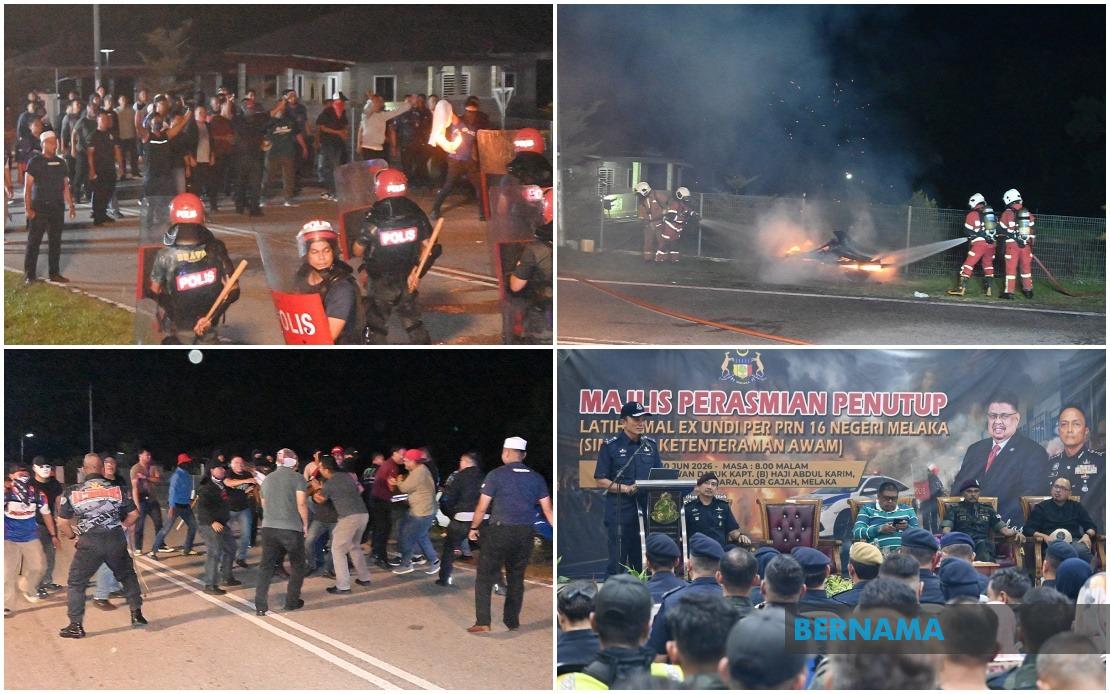
The upcoming 16th Melaka State Election represents a critical moment for the southern state to demonstrate its commitment to orderly democratic participation, according to Chief Minister Datuk Seri Ab Rauf Yusoh, who cautioned against attempts to weaponise the electoral process for divisive ends. Speaking at a comprehensive security simulation exercise in Alor Gajah, Ab Rauf underscored that while voters retain full freedom to support competing parties and express diverse political perspectives, the maintenance of peace and social cohesion must supersede any partisan agenda.
Democratic elections, Ab Rauf emphasised, constitute a legitimate arena for peaceful competition between political movements and the expression of differing ideologies. However, this freedom carries corresponding responsibilities for all participants to respect boundaries that protect community safety and governmental stability. The Chief Minister's remarks reflect growing concern among Malaysian state administrations about maintaining electoral integrity while preventing the polarisation that has characterised recent national and regional polling cycles. His framing distinguishes between legitimate political disagreement and the deliberate incitement of disorder designed to undermine institutional legitimacy.
The security apparatus in Melaka has moved beyond verbal assurances, conducting an extensive two-day simulation exercise that tested responses to multiple crisis scenarios anticipated during the September election. The operation, named Latih Amal Ex-Undi Per PRN Ke-16 Negeri Melaka, drew participation from nearly 400 officers and personnel representing an array of federal and state agencies. This comprehensive approach signals recognition that modern election security extends far beyond ballot box protection to encompass crowd management, intelligence gathering, and coordinated inter-agency communication.
Melaka Police Chief Datuk Dzulkhairi Mukhtar outlined the scope of preparedness measures, detailing protocols for escort operations protecting ballots, specialist riot control formations, fire incident management, and techniques for dispersing large gatherings. The simulation environment specifically incorporated provocation scenarios, allowing security personnel to refine responses to incitement attempts that might emerge during the actual electoral period. Dzulkhairi's disclosure that preliminary intelligence suggests Melaka remains tranquil provides some reassurance, though he acknowledged that simulation exercises reveal operational weaknesses requiring remediation before voting commences.
The scale of the electoral undertaking underscores why comprehensive security planning proves essential for Melaka. The 16th state election will engage 685,455 registered voters across 264 polling centres operating 1,198 individual voting streams throughout the state. Managing this logistical complexity while preventing disruption demands meticulous coordination, which explains why the simulation included representation from the National Security Council, Election Commission, Fire and Rescue Department, Civil Defence Force, and Health Ministry. Each agency's participation reflects the multifaceted nature of contemporary election administration in Malaysian states.
Police deployment projections indicate the scale of security commitment Melaka intends to mobilise. More than 3,300 police officers and personnel will be positioned throughout the state during voting, supplemented by specialist Public Order Riot Unit formations and Federal Reserve Unit troops. These numbers testify to determination to maintain order while respecting voter freedom, though they also raise questions about whether such visible security presence might itself influence voter behaviour or generate tension in certain communities. The establishment of four dedicated operations rooms at contingent and district levels demonstrates hierarchical command structure designed to enable rapid decision-making should emergencies arise.
The Deputy Director of Bukit Aman's Internal Security and Public Order Department, DCP Datuk M.V Srikumar, participated in the simulation oversight, indicating federal-level interest in Melaka's electoral security arrangements. This federal engagement reflects understanding that state-level electoral disruptions can carry broader implications for national political stability and international perceptions of Malaysian democratic governance. The involvement of senior federal security personnel in planning also suggests that lessons learned in Melaka may inform security protocols for future elections in other states.
Ab Rauf's commendation of the Melaka Police Contingent for initiating the simulation represents an important institutional acknowledgment that security agencies function most effectively when they proactively identify vulnerabilities rather than responding reactively to crises. The Chief Minister's characterisation of the exercise as unprecedented in Melaka suggests previous state elections proceeded without such elaborate preparatory scenarios, indicating evolving threat assessments and an apparent shift toward more comprehensive security architecture in Malaysian state electoral processes.
The explicit mention that no riots are anticipated, paired with emphasis on thorough preparation regardless, reflects sophisticated risk management thinking. This approach recognises that complacency poses as significant a danger as overestimation of threats. By conducting extensive drills without presupposing disorder, security planners position themselves to respond swiftly should unexpected developments occur while simultaneously signalling to potential troublemakers that the state possesses capacity and determination to suppress disruption.
For Malaysian voters and observers across Southeast Asia, Melaka's approach represents a broader model for conducting elections in polarised environments. The state's emphasis on separating legitimate political competition from attempts to generate disorder through provocation offers a framework applicable to other jurisdictions grappling with similar challenges. As regional democracies confront increasing sophistication in disinformation campaigns and organised incitement tactics, Melaka's integration of simulation exercises, inter-agency coordination, and explicit political messaging about electoral norms may provide valuable precedent for other states and nations managing contested elections.
The identification and refinement of standard operating procedures resulting from simulation findings will likely shape how Melaka's security forces manage the actual election period. Dzulkhairi's commitment to addressing weaknesses uncovered during exercises suggests an iterative improvement process rather than static security planning. As voting approaches in September, the extent to which this preparation translates into genuinely peaceful, secure electoral administration will test whether Malaysian states can sustain democratic processes despite deepening political fragmentation and evolving security challenges.

