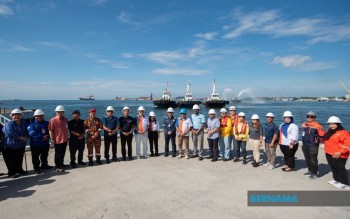
Megah Port Management Sdn Bhd formally inaugurated its marine services division at Labuan Port on July 29, marking a significant operational milestone for the facility's new management team. The launch was underpinned by a substantial capital commitment: four purpose-built tugboats acquired at a combined cost of RM23 million, signalling the company's resolve to establish comprehensive port safety and efficiency infrastructure. The vessel acquisition represents one of the most visible manifestations of Megah Port's transition into full operational stewardship following the signing of its Operation, Facility and Management Continuation Agreement with the Labuan Port Authority.
Managing director Datuk Seri Patrick Tiong framed the tugboat investment as a strategic demonstration of the company's obligations under its operational mandate. Beyond mere compliance, he characterised the procurement as evidence of organisational commitment to elevating standards across the port ecosystem. The marine services unit now bears responsibility for ensuring that all vessel movements—whether during arrival, departure, berthing or unberthing procedures—occur under controlled, safe conditions. This encompasses navigation through confined waters where precision manoeuvring becomes critical, particularly given Labuan's geographic constraints and heavy chemical cargo operations.
The tugboat fleet will undertake diverse operational functions across multiple terminal facilities within Labuan Port's jurisdiction. Primary responsibilities include assisting vessels with directional control, particularly when weather deterioration or adverse current conditions compromise a ship's manoeuvrability. The vessels serve as mechanical intermediaries, capable of towing, pushing or pulling larger ships into position, and providing escort services for vessels transiting through port waters. Critically, the tugboats extend their utility to vessels experiencing mechanical distress—whether through propulsion failure, loss of steering capability or other navigational emergencies—enabling rapid assistance before situations escalate into potential maritime casualties.
Beyond routine port operations, the marine services capability substantially enhances Labuan's emergency response posture. Tiong explicitly highlighted the tugboats' role in maritime crisis management, describing their capacity to provide immediate firefighting support should cargo vessel incidents occur. The vessels can relocate at-risk ships away from densely populated or strategically sensitive areas, thereby containing potential environmental or industrial damage. This emergency dimension carries particular significance given that Labuan Port handles substantial volumes of dangerous goods, including the operations of major petrochemical terminals operated by Petronas and Shell. The DG Terminal, Asian Supply Base Fuel Terminal and Shell Timur facility all fall within the marine services operational perimeter.
The operational scope extends across chemical transport and petroleum product handling facilities that represent the economic lifeblood of Labuan's port sector. Petronas Chemicals Methanol Labuan Terminal constitutes one of the region's strategically important chemical distribution hubs, making the availability of rapid emergency tugboat response a crucial safeguard against supply chain disruption and environmental catastrophe. By positioning tugboats as integral components of integrated port emergency management, Megah Port Management has created layered defences against the cascading failures that characterise major maritime incidents. The demonstration exercise conducted during the July 29 launch explicitly showcased these firefighting and emergency containment capabilities, allowing port stakeholders to visually confirm the vessels' readiness.
Interoperability with existing maritime law enforcement and security agencies emerged as a central theme in Tiong's remarks, underscoring that tugboat operations cannot function in isolation from broader port governance frameworks. Coordination with the Malaysian Maritime Enforcement Agency and Marine Police Force ensures that vessel movements comply with established maritime regulations and safety protocols. The company's openness to guidance and feedback from these authorities suggests a collaborative approach to continuous operational improvement rather than a defensive posture toward regulatory oversight. This cooperative stance carries significance for Malaysian ports more broadly, as it models the integration of private port operators into comprehensive government maritime security and safety architectures.
The marine services initiative reflects wider industry trends toward vertical integration within port operations. Historically, tugboat and marine assistance services frequently operated as separate commercial entities, contracted on demand by port authorities or individual shipping companies. By internalising these capabilities, Megah Port Management achieves direct control over response times, service quality standards and operational consistency. The approach mirrors practices at major regional ports including Singapore and Port Klang, where vertically integrated marine services have become competitive advantages in attracting international shipping traffic. For Labuan, a secondary port competing for niche cargo operations and chemical industry business, such integration becomes particularly important in demonstrating operational sophistication to potential users.
The RM23 million expenditure represents a substantial commitment relative to Labuan Port's current traffic volumes and historical operational scale. The investment decision suggests management confidence in the port's growth trajectory and confidence in the viability of the operational agreement framework. Such capital commitments by concession operators typically reflect confidence in policy stability and revenue generation potential. For Malaysian stakeholders, the scale of investment offers reassurance regarding Megah Port Management's financial capacity and operational seriousness. The company's willingness to deploy capital before achieving full operational stabilisation indicates either substantial financial backing or genuine conviction in emerging market opportunities within the Labuan commercial ecosystem.
Looking forward, the marine services infrastructure positions Labuan Port to compete more effectively for cargo operations requiring high-specification safety and emergency response capabilities. Vessel operators and cargo owners increasingly demand documentary evidence of robust contingency planning and emergency infrastructure as insurance and liability protection. The visibility of dedicated tugboat capacity and demonstrated emergency response capabilities directly influences shipping companies' port selection decisions. For Southeast Asian shipping markets, where competition among secondary ports remains intense, such operational enhancements translate into tangible competitive positioning improvements. The Australian and PNG-bound chemical and petroleum trades that currently utilise Labuan represent precisely the market segments most sensitive to safety infrastructure quality and emergency response preparedness.
The formal launch of marine services constitutes an early indicator of how Megah Port Management intends to distinguish itself operationally over the coming years. Investment in fundamental infrastructure—tugs, emergency equipment, trained personnel—precedes more sophisticated service offerings such as integrated logistics, bonded storage expansion, or specialised cargo handling. By establishing these foundational capabilities first, the company creates the operational platform upon which competitive service offerings can subsequently be built. For Malaysian ports policy observers, the marine services launch demonstrates how concession arrangements can incentivise private operators to invest in infrastructure improvements that would otherwise require direct government expenditure, while maintaining public control through regulatory oversight and safety compliance frameworks.

