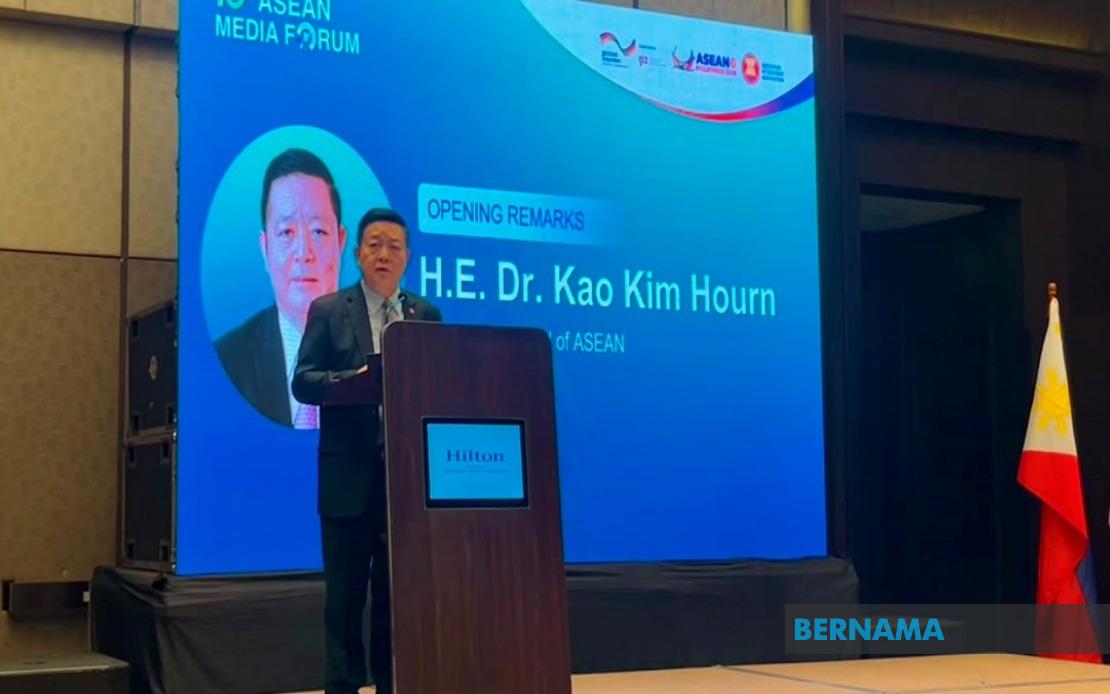
The media landscape's transformation over the past decade presents both remarkable opportunities and serious risks for Southeast Asia's collective identity and governance. Speaking at the 10th ASEAN Media Forum in Manila, ASEAN Secretary-General Dr Kao Kim Hourn underscored the irreplaceable role journalists must play as the bloc pursues its ASEAN Community Vision 2045. Digital platforms, social media and generative artificial intelligence have fundamentally reshaped how information travels across borders, but this same technological revolution has created pathways for falsehoods to spread with alarming speed, complicating efforts to build a cohesive regional consciousness.
Kao's remarks reflect growing anxiety within ASEAN leadership about information integrity at a critical juncture. The Secretary-General acknowledged that while technological advances enable newsrooms to operate more efficiently and serve multilingual audiences in real time, they simultaneously introduce new vulnerabilities. Deepfakes, synthetic media, manipulated content and coordinated disinformation campaigns now pose threats that transcend national boundaries. For a regional bloc of ten diverse nations with distinct languages, political systems and media traditions, the challenge of maintaining a shared factual foundation becomes exponentially more complex. When false narratives can spread instantaneously across the region, the traditional gatekeeping role of professional journalism becomes increasingly valuable rather than obsolete.
The implications for Malaysia and other ASEAN members are substantial. As regional integration deepens through economic initiatives, security arrangements and people-to-people exchanges, the quality of public discourse directly affects whether ordinary citizens support or resist integrationist policies. A Malaysian consumer may not immediately understand how an ASEAN economic decision impacts their household finances, or how a regional security mechanism protects their family. Professional journalists capable of translating complex multilateral policies into comprehensible local contexts serve as essential interpreters between institutional ASEAN and the street-level realities of ASEAN peoples. Without this explanatory function, regional initiatives risk appearing distant, technocratic or imposed rather than collaborative.
Kao drew particular attention to the escalating challenge posed by generative AI in newsrooms. Large language models can now draft stories, analyze data and identify patterns at unprecedented scales. Yet these tools also enable the rapid production of convincing false narratives at minimal cost. The Secretary-General stressed that credibility represents the media's most valuable yet most fragile asset. Once public trust erodes, rebuilding it requires years of consistent, demonstrable integrity. This observation carries special weight in Southeast Asia, where trust in institutions remains unevenly distributed and historical grievances sometimes intersect with contemporary media narratives. A single viral false story about an ASEAN policy or cross-border issue could potentially inflame tensions or undermine diplomatic gains achieved through years of negotiation.
The Philippines, currently holding the ASEAN chair, reinforced this message through Undersecretary for Foreign Affairs Leo M. Herrera-Lim, who positioned journalism as integral to all three pillars of the ASEAN Community Vision 2045: political-security cooperation, economic integration and socio-cultural development. His framing was notably ambitious. Rather than casting journalists merely as observers documenting ASEAN's evolution, he proposed they function as active architects shaping the region's trajectory. This elevation of the media's status reflects recognition that Vision 2045 cannot succeed if regional populations remain disconnected from or sceptical of ASEAN's work. Economic decisions, security protocols and cultural exchanges all depend ultimately on public acceptance and participation.
For Malaysia specifically, the forum's emphasis on credible journalism resonates with ongoing national conversations about media standards and public information quality. Malaysian readers contend daily with competing narratives about domestic and regional issues. When they encounter ASEAN-related reporting, the coherence and accuracy of that coverage influences their understanding of Malaysia's regional position and responsibilities. A Malaysian journalist who lacks clarity about ASEAN's institutional structures or Vision 2045's strategic objectives may inadvertently reinforce public confusion. Conversely, journalists equipped with contextual knowledge can help Malaysian audiences grasp why particular regional decisions matter to them personally.
The ASEAN Media Forum itself represents an institutional response to these interconnected challenges. First convened in Manila during August 2017 to mark ASEAN's golden anniversary, the forum has evolved into a structured platform where journalists, editors, publishers and policymakers encounter one another directly. This annual gathering creates space for frank discussion about shared professional standards, ethical boundaries and strategic communication priorities. Through such forums, the region gradually establishes informal consensus about what constitutes responsible reporting on sensitive regional matters. German government support through GIZ reflects the international community's recognition that ASEAN's internal information environment affects broader regional stability.
Yet structural obstacles remain. ASEAN comprises nations with divergent media freedom traditions, regulatory frameworks and political sensitivities. What a Thai journalist can investigate freely may constitute restricted territory for counterparts in other capitals. How Vietnamese media frames cross-border trade agreements may differ fundamentally from Malaysian or Indonesian approaches. Creating genuinely shared standards without imposing hegemonic values requires sustained dialogue and mutual respect. The forum provides that conversational space, but its recommendations carry no enforcement mechanism. Journalists ultimately answer to their home governments, proprietors and audiences rather than to regional institutions.
The generative AI question deserves deeper examination. Kao correctly identified that these tools offer genuine productivity benefits for newsrooms operating under resource constraints common throughout Southeast Asia. Smaller outlets in less-resourced ASEAN nations could theoretically use AI to expand their reporting footprint and compete with larger institutions. Yet the same technology enables state actors or well-funded interest groups to flood the information space with convincing fabrications. The editorial accountability challenge becomes acute precisely when traditional editorial verification processes strain under resource limitations. A Malaysian news organization might deploy AI to translate stories efficiently into multiple regional languages, but how does it authenticate sources, verify facts and maintain ethical standards across that expanded output? The forum's ongoing discussions should address such implementation questions beyond generalist statements about professional standards.
Kao's emphasis on verification, context and ethical standards reflects understanding that ASEAN's credibility gap represents a genuine strategic vulnerability. When citizens across the region distrust information about ASEAN's initiatives, they become susceptible to manipulation by actors with no interest in regional stability. Whether external powers seeking to undermine integration or domestic politicians weaponizing regional decisions for parochial advantage, malign actors exploit information vacuums. Professional journalists grounded in rigorous verification practices represent a countervailing force. They cannot prevent deliberate disinformation campaigns, but they can establish sufficiently robust information ecosystems that false narratives gain less traction than they would in environments characterized by chronic journalistic underfunding and institutional weakness.
The regional implications extend to Malaysia's particular geopolitical position. As a relatively advanced economy with significant media resources and professional journalism traditions, Malaysia bears some responsibility for helping establish regional standards. Malaysian newsrooms have capacity to cover ASEAN comprehensively and contextually in ways that some smaller ASEAN media cannot. When Malaysian journalists cover ASEAN decisions, their reporting shapes understanding not only domestically but throughout the region, as outlets in smaller markets sometimes reference or republish quality reporting from more resourced neighbors. This informal regional influence suggests Malaysian media institutions have both opportunity and responsibility to model rigorous standards in ASEAN coverage.
Looking toward Vision 2045, the challenge crystallizes around whether ASEAN can develop sufficient information coherence to support deeper integration without imposing editorial control. The bloc's strength has always rested on its commitment to non-interference in member states' internal affairs, but this principle becomes complicated in an interconnected information environment where one member's media narrative affects neighboring nations' public opinion. The ASEAN Media Forum represents ASEAN's attempted solution: fostering voluntary alignment around professional standards rather than mandating conformity. Whether this approach proves sufficient to build the public engagement and regional identity consciousness that Vision 2045 requires remains an open question that will unfold over coming years as technological disruption accelerates.

