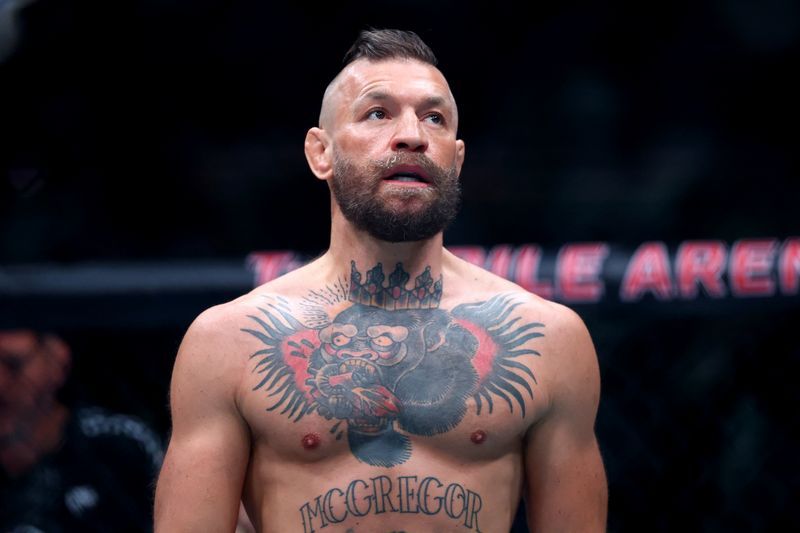
Conor McGregor's eagerly anticipated comeback to professional mixed martial arts competition proved painfully brief. The 37-year-old Irish fighter faced defending champion Max Holloway at UFC 329 in Las Vegas on Saturday, but the much-promoted bout effectively concluded within 70 seconds when McGregor suffered a serious knee injury that forced him to retire from the opening round. What should have been a marquee event that captured global attention instead became a cautionary tale about the perils of extended layoffs in combat sports, where timing and physical conditioning are paramount.
The injury occurred early in the first round when McGregor attempted an ambitious flying kick intended to set the tone for the contest. The kick landed awkwardly, causing immediate and visible damage to the fighter's knee. McGregor attempted to continue competing despite the evident pain and instability, but within seconds he gestured toward the referee to indicate that he could no longer safely participate in the bout. The premature conclusion meant that fans who had waited years for this rematch witnessed less than two minutes of action before the fight effectively ended.
McGregor had not stepped into the octagon in professional competition since July 2021, when he suffered a severe leg fracture during a bout against Dustin Poirier. That three-year absence from actual fighting had already raised questions about whether the Irishman could regain his explosive form and competitive sharpness. The rapid nature of Saturday's injury suggested that a lengthy layoff from professional fighting, combined with the demands of returning at a high competitive level, may have left him physically unprepared for the rigours of elite-level combat sports.
The path back to competition had been anything but smooth. McGregor had been scheduled to fight Michael Chandler in June 2024, but that promotion was cancelled when the fighter suffered a broken toe sustained during training sessions. That setback exemplified the fragility of comeback attempts, where even routine preparation can become derailed by unexpected injuries. Beyond physical setbacks, McGregor had also faced significant personal challenges that complicated his return to the sport. An Irish civil court jury determined in 2024 that he bore liability for allegations relating to an incident in 2018 involving Nikita Hand, a matter that had overshadowed his comeback narrative.
Additional complications emerged from anti-doping violations. McGregor accepted an 18-month ban in October 2025 for failing to comply with anti-doping sample collection procedures. The fighter had missed three collection attempts by Combat Sports Anti-Doping officials during 2024, prompting the sanction. However, the ban was retroactively applied and expired in March, theoretically clearing the path for his return. Nevertheless, the cumulative effect of these various obstacles—injuries, legal matters, and regulatory violations—had created substantial doubt about whether McGregor could mount a viable comeback to elite-level competition.
Holloway, the former featherweight champion competing at lightweight, handled the situation with professionalism befitting a seasoned competitor. Rather than celebrate a technical victory, Holloway expressed interest in staging a rematch once McGregor had recovered from the current injury. He acknowledged the significant promotional investment and anticipation surrounding their contest, and suggested that the fighter community deserved a properly contested fight between both competitors at full health. Holloway's willingness to return for a third meeting with McGregor reflected the financial and marketing value that the Irish fighter maintains within professional mixed martial arts, regardless of recent setbacks.
This represented the second encounter between the pair. McGregor had defeated Holloway by unanimous decision in 2013, establishing what many regarded as his first high-profile victory en route to becoming one of sport's biggest draws. That victory launched McGregor toward championship status and mainstream celebrity. The prospect of a rematch carried significant commercial weight, as both fighters had evolved substantially since their initial meeting more than a decade earlier. A properly contested bout between them would have generated substantial viewership across multiple markets and revenue streams.
McGregor's career trajectory since his 2021 leg injury has been marked by setback after setback, suggesting that the window for his return to elite competition may be closing. The Irish fighter achieved unprecedented fame and financial success in mixed martial arts, but injuries, legal complications, and regulatory issues have conspired to prevent him from capitalizing on that legacy. The injury sustained against Holloway highlights the particular vulnerability of athletes attempting comebacks after extended absences, particularly in sports demanding explosive physical movements and precise timing.
The fight also featured a notable co-main event that provided excitement despite brevity. Paddy Pimblett, a British lightweight, achieved victory in less than a minute against French opponent Benoit Saint-Denis at the T-Mobile Arena. Pimblett forced Saint-Denis to submit through choking, demonstrating the kind of explosive finishing ability that remains valuable in modern mixed martial arts competition. The rapid conclusion of both headline bouts suggested that Saturday's card produced memorable moments for reasons entirely unintended by its promotional architects.
For regional observers across Southeast Asia and Malaysia, McGregor's struggles illuminate broader challenges facing aging athletes attempting high-level returns after extended layoffs. The incident raises practical questions about rehabilitation, training protocols, and the realistic timeline for meaningful comebacks in weight-class combat sports. While McGregor remains a globally recognized figure who commands broadcasting attention across Malaysia and neighbouring markets, his recent trajectory suggests that sustained absence from competition creates nearly insurmountable obstacles for even the most accomplished fighters, regardless of previous achievements.

