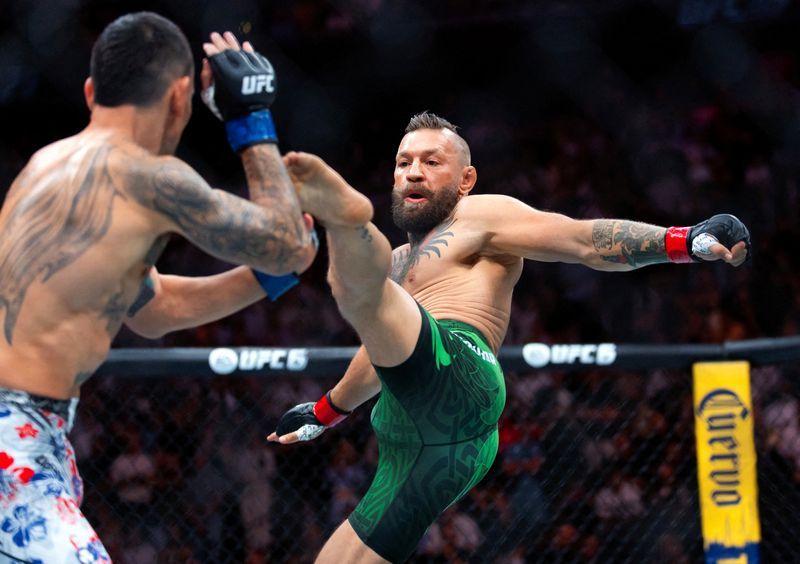
Conor McGregor's long-awaited return to mixed martial arts competition lasted barely over a minute. The former two-weight UFC champion suffered a significant knee injury in the opening moments of his Saturday night clash with Max Holloway in Las Vegas, an unfortunate development that cut short what many had hoped would be a triumphant comeback. McGregor remained on the canvas for only 69 seconds before signalling to the referee that he could not continue, ending the fight almost as quickly as it had begun.
The injury occurred when McGregor attempted an ambitious jump kick early in the opening round, landing awkwardly as he executed the technique. The Irishman managed a few more seconds of fighting, clearly attempting to push through the pain, before recognizing he needed to withdraw from the bout. The premature conclusion to the highly publicized encounter will have disappointed the significant audience that had tuned in to witness McGregor's competitive return after an extended absence from the octagon.
In the aftermath of the setback, McGregor took to social media to address his supporters and outline his path forward. His Instagram message conveyed a defiant and philosophical tone, emphasizing his faith and determination. "All things work out for my good! All things are possible for me because I am a believer!" he wrote, before detailing his recovery plan: surgery, pre-rehabilitation work, gradual return to martial arts training, and ultimately another fight opportunity. The reference to "the final fight of the contract" suggests McGregor may be approaching the conclusion of his current agreement with the UFC.
For Malaysian and Southeast Asian readers following combat sports, McGregor's injury carries broader significance beyond the immediate sporting disappointment. The 37-year-old has become one of the sport's biggest global ambassadors, and setbacks in his career trajectory influence broader conversations about athlete longevity, injury recovery protocols, and the physical toll of professional fighting. His prominence in mainstream sports culture has helped elevate mixed martial arts' profile across Asia and the broader international market.
McGregor's career has been marked by a troubling pattern of interruptions extending well beyond the physical demands of competition itself. A fracture to his leg sustained against Dustin Poirier five years ago triggered a lengthy rehabilitation process. More recently, a scheduled June 2024 bout against Michael Chandler was cancelled when McGregor sustained a broken toe during training camp, highlighting how injuries outside competitive settings can derail carefully laid plans for comeback fights.
Beyond the athletic injuries, the Irish fighter has confronted serious legal and personal challenges that have complicated his career narrative. In 2023, an Irish civil court determined that McGregor was liable in a rape case involving Nikita Hand dating back to 2018. This verdict carried significant reputational consequences and became another factor contributing to the complications surrounding his return to active competition.
Additionally, McGregor faced regulatory complications with anti-doping authorities. In October 2025, he accepted an 18-month suspension from competitive fighting following what the Combat Sports Anti-Doping agency termed "whereabouts failures." McGregor had missed three separate testing attempts in 2024, a violation that resulted in the ban being imposed. However, because the suspension was backdated to account for the period of non-compliance, the ban technically expired in March of this year, technically clearing the way for his recent return attempt.
The convergence of these factors—physical injuries, legal proceedings, and regulatory issues—has created a complex backdrop for McGregor's attempted comeback. Each obstacle has contributed to a narrative of a fighter battling circumstances both within and outside the sport's controlled environment. For fans and analysts assessing his prospects, these broader contextual elements matter considerably when evaluating whether he can successfully return to the competitive form that made him one of combat sports' biggest draws.
The question now facing McGregor, his medical team, and the UFC organization centres on the severity of the knee injury sustained against Holloway and the realistic timeline for recovery and return. Knee injuries in combat sports often prove particularly problematic because they fundamentally affect an athlete's mobility, striking stability, and defensive capabilities—elements absolutely central to mixed martial arts performance. The quality of his surgical repair and subsequent rehabilitation will substantially determine whether another meaningful return becomes feasible.
McGregor's expressed optimism about fighting again demonstrates his psychological resilience despite the disappointment. The fact that he is already framing the injury within a narrative of recovery and ultimate triumph suggests he remains mentally committed to competition. However, the practical reality of whether his body can withstand the demands of high-level mixed martial arts at 37 years old, combined with the accumulated wear from previous injuries, presents a genuine sporting question that only time and medical evaluation can definitively answer.
The situation also raises questions about the UFC's decision-making in selecting Holloway as McGregor's comeback opponent. Holloway ranks among the most formidable strikers in the sport's history, and some observers questioned whether a fighter returning after extended absence should have faced such an elite competitor. Nevertheless, the injury occurred so early that the quality of the opponent became largely academic to the outcome.

