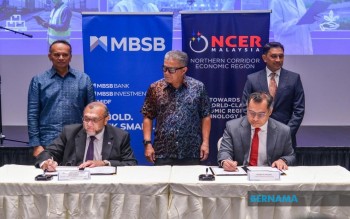
MBSB Bank Bhd and the Northern Corridor Implementation Authority have formalised a strategic partnership aimed at channelling substantial capital toward small and medium enterprises across Malaysia's northern states. The two organisations inked a memorandum of understanding at a ceremony in Petaling Jaya on July 17, establishing a financing facility with a ceiling of RM1 billion designed to catalyse economic expansion throughout the Northern Corridor Economic Region (NCER), which encompasses Perlis, Kedah, Penang and Perak.
The initiative reflects growing recognition among policymakers and financial institutions that targeted capital deployment remains essential for unlocking growth potential in Malaysia's regional economies. Speaking at the signing ceremony, MBSB Bank chairman Datuk Wan Kamaruzaman Wan Ahmad outlined the strategic rationale for the partnership, noting that the financing framework would enable businesses to broaden their operational footprint within the northern region while strengthening their capacity to compete at scale. The RM1 billion fund will permit participating enterprises to expand manufacturing capabilities, integrate into global supply chains, and contribute meaningfully to the corridor's trajectory toward long-term economic prosperity.
The agreement was formally executed between MBSB Bank group chief commercial banking officer Noor Mohamed Amin and NCIA chief operating officer Hasri A Hassan, underscoring institutional commitment from both parties to operationalise the arrangement. This structured approach to partnership execution suggests that the financing facility will feature clearly defined mechanisms and eligibility criteria designed to ensure efficient capital allocation and measurable outcomes for the participating enterprises.
From MBSB Bank's perspective, the collaboration represents an expansion of its strategic positioning within Malaysia's regional development framework. Group chief executive officer Rafe Haneef articulated the bank's intention to attract high-potential companies, particularly export-oriented SMEs, by leveraging the financing facility alongside complementary services. The bank has previously established connections with Santander Group, a major European banking institution, creating a platform through which Malaysian enterprises can access guidance and support for internationalising their export activities to overseas markets. This layered approach—combining domestic capital provision with international market facilitation—addresses a critical gap in the SME ecosystem, where many promising businesses possess growth capacity but lack integrated financing and market access solutions.
The NCER's focus sectors, as articulated by NCIA chief executive Datuk Mohamad Haris Kader Sultan, span industries fundamental to Malaysia's economic diversification agenda. Electrical and electronics manufacturing, advanced production techniques, agri-food processing, logistics infrastructure, digital economy enterprises, and green technology ventures represent the priority areas where NCIA anticipates the financing facility will catalyse meaningful investment and expansion. These sectors align with broader national economic priorities outlined in the 13th Malaysia Plan, reflecting coordination between regional development authorities and financial institutions in pursuit of coherent long-term growth strategies.
The partnership addresses a recurring structural challenge within Malaysia's SME landscape: the financing gap between small enterprises' capital requirements and traditional banking sector risk assessments. By embedding the RM1 billion facility within a framework administered by NCIA—an entity possessed of deep sectoral and regional knowledge—the arrangement creates potential for more nuanced evaluation of enterprise potential and more appropriate risk-pricing than conventional banking criteria might permit. This targeted approach to capital allocation represents an evolution in development finance thinking, moving beyond standardised lending protocols toward assessment frameworks grounded in regional economic fundamentals.
MALAYSIA's northern corridor has demonstrated resilience and growth capacity despite regional competition for investment capital. The NCER has established itself as one of the nation's fastest-expanding economic zones, consistently attracting domestic and foreign investment across sectors including electrical and electronics, advanced manufacturing, logistics, agri-business, and the digital economy. The region's strategic positioning—proximity to Thailand, relatively developed infrastructure, and established industrial clusters—creates genuine competitive advantages that this financing initiative aims to amplify by removing capital constraints that inhibit business expansion.
For Malaysian SMEs seeking growth capital, the initiative offers both direct and indirect benefits. Beyond the immediate availability of up to RM1 billion in financing, the arrangement signals institutional confidence in northern corridor enterprises, potentially influencing investment decisions by suppliers, partners, and customers. Additionally, the linkage to Santander Group's international platforms creates pathways through which participating enterprises can access export financing, foreign market intelligence, and cross-border transaction infrastructure that would otherwise require expensive bilateral negotiations or remain unavailable entirely.
The emphasis on strategic partnerships within the 13th Malaysia Plan framework indicates that policymakers view regional development as dependent upon coordinated engagement across government agencies, financial institutions, and private sector entities. NCIA's role as a statutory body planning and driving economic growth across its constituent states positions it as a natural convening entity, capable of identifying high-potential sectors and enterprises worthy of capital deployment. By partnering with a domestic banking institution possessing commercial lending expertise, NCIA gains access to deployment mechanisms and risk management capabilities that pure government entities typically lack.
Implementation success will depend substantially upon MBSB Bank's ability to streamline application processes and communicate facility terms to dispersed SME populations across four states. The financing initiative must compete for attention within a crowded landscape of government and institutional programmes targeting SME development, suggesting that marketing and outreach will constitute critical success factors alongside capital availability. Enterprises operating in Penang and Perak, where industrial clusters and business infrastructure tend toward greater sophistication, may rapidly absorb available financing, while enterprises in Perlis and northern Kedah may require additional facilitation to access capital and expertise.
The partnership also reflects sectoral priorities that align emerging industries with infrastructure and human capital that the northern corridor possesses. Green technology and digital economy enterprises, for instance, represent strategic growth areas where Malaysian companies can potentially compete globally, whereas advanced manufacturing in electronics builds upon established industrial ecosystems and supplier networks. By targeting these sectors through a dedicated financing facility, NCIA and MBSB Bank concentrate capital where existing advantages exist, potentially amplifying returns to investment and accelerating the corridor's transition toward higher-value-added economic activity.
Looking forward, this arrangement may establish a template for additional financing partnerships involving regional development authorities and financial institutions elsewhere in Malaysia. Should the NCER initiative demonstrate measurable success in enterprise expansion, employment creation, and economic diversification, comparable programmes might be replicated across other regions, including Iskandar Malaysia, East Coast Economic Region, and Sabah and Sarawak Economic Corridors. Such replication would require adaptation to regional economic realities but could systematically enhance SME access to growth capital across Malaysia's geography, contributing to more inclusive and distributed economic expansion.

