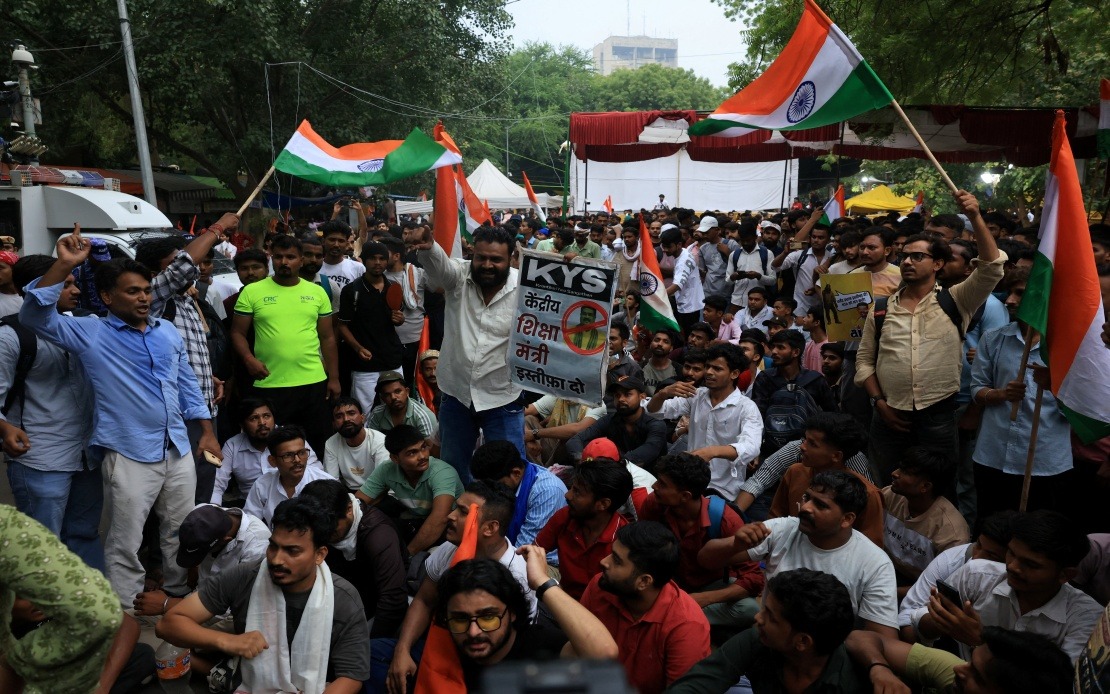
A youth-driven movement mobilized thousands of demonstrators in New Delhi on Monday to press for comprehensive changes to India's academic framework, drawing a forceful police response as the Indian Parliament convened for its Monsoon Session. The so-called "Sansad Chalo" rally—literally meaning "march to parliament"—saw protesters attempt to breach police cordons surrounding the legislative complex, triggering the deployment of crowd-control tactics to prevent them from reaching their destination. The confrontation underscored simmering discontent among India's younger generation regarding the structure and content of the country's educational institutions, a concern that has increasingly animated political discourse across South Asia.
The protest movement, which organizers characterize as newly established but already commanding substantial digital presence, drew participation from what witnesses described as several thousand individuals determined to voice their grievances directly to lawmakers. Police authorities had instituted strict limitations on public assemblies in the vicinity of parliament ahead of the session's opening, leading to the deployment of barrier systems and personnel to manage the anticipated crowds. As demonstrators pushed forward across multiple points around the legislative precinct, law enforcement officials employed standard crowd-dispersal methods to maintain security perimeters and prevent what they characterized as an unauthorized approach to sensitive government installations.
The timing of the demonstration coincided with Prime Minister Narendra Modi's arrival at parliament for the commencement of the legislative session, a high-security occasion that typically sees heightened protective measures throughout the national capital. Modi's departure from the parliament complex took place amid ongoing police management of protester movements in surrounding areas, illustrating the scale and persistence of the demonstration despite official restrictions. The coordination required to manage both parliamentary operations and public order presented Delhi authorities with a complex operational challenge that played out across multiple zones of the capital.
Education system reform has become an increasingly salient issue for Indian youth, reflecting broader concerns about curriculum relevance, examination pressure, and alignment between academic training and employment prospects. The protesters' focus on academic structure suggests dissatisfaction with what many students perceive as an outdated pedagogical model that prioritizes rote memorization over critical thinking and practical skill development. This criticism mirrors concerns articulated across several Southeast Asian nations, including Malaysia, where education stakeholders regularly debate the balance between standardized testing frameworks and 21st-century competency development.
The movement's organizers claim to have mobilized millions of digital supporters, indicating that the Monday demonstration represents only the visible manifestation of a substantially larger network of engaged youth leveraging social media and online platforms to coordinate activism. This capacity to translate online sentiment into street-level action demonstrates the increasing facility with which younger generations can organize around policy grievances, circumventing traditional institutional channels that may appear unresponsive or ineffective. For regional observers in Malaysia and elsewhere in Southeast Asia, this pattern reflects a broader phenomenon of youth-driven political engagement that extends beyond India's borders.
Authorities responded to the disruption by implementing heightened security protocols across multiple zones of the national capital, signaling official concern about the mobilization capacity demonstrated by the youth movement. The decision to restrict public gatherings in parliament vicinity reflected advance assessment that the planned march would generate substantial participation and potentially disruptive confrontations. The police response, while maintaining order, also highlighted tensions between government efforts to preserve legislative security and citizens' constitutional rights to public assembly and petition.
The Monsoon Session of parliament carries particular symbolic weight in the Indian political calendar, marking the resumption of legislative work following the monsoon period and typically featuring significant policy announcements and debates. The decision by protest organizers to schedule their demonstration at this juncture suggests strategic intent to maximize visibility and pressure lawmakers at a moment when they are convened and legislative agendas are being set. This tactical approach reflects sophisticated understanding of India's political rhythms and media landscape.
For Malaysian policymakers and education stakeholders, the Delhi protests offer instructive perspective on youth mobilization around curriculum and pedagogical concerns. While Malaysian education policy involves distinct institutional and cultural contexts, the underlying student anxieties about academic relevance and reform transcend national boundaries. The apparent ease with which Indian organizers mobilized digital-first audiences into street-level activism suggests that education dissatisfaction, when sufficiently acute and channeled through emerging platforms, possesses significant mobilization potential across South and Southeast Asia.
The incident also illuminates the operational challenges facing security agencies in managing peaceful assembly rights while protecting government institutions in densely populated capital cities. The balance between enabling constitutional expression and maintaining public order represents an enduring tension in democratic governance, one that India's police confronted directly as they managed the Monday demonstration. How authorities ultimately resolve such encounters—whether through dialogue mechanisms, policy responsiveness, or restrictive enforcement—shapes long-term public confidence in both government institutions and security services.
Moving forward, the outcome of this protest moment may influence whether education reforms gain traction in India's legislative agenda, and whether the youth movement consolidates its mobilization capacity into sustained political influence. The Monsoon Session agenda and subsequent parliamentary activity will likely reveal whether lawmakers respond substantively to the reformist demands articulated by demonstrators, or whether the protest recedes without catalyzing policy adjustment. For Malaysia and regional counterparts observing Indian political trends, this episode demonstrates the growing political salience of education system governance among youthful populations and the institutional challenges this poses for governments across the region.

