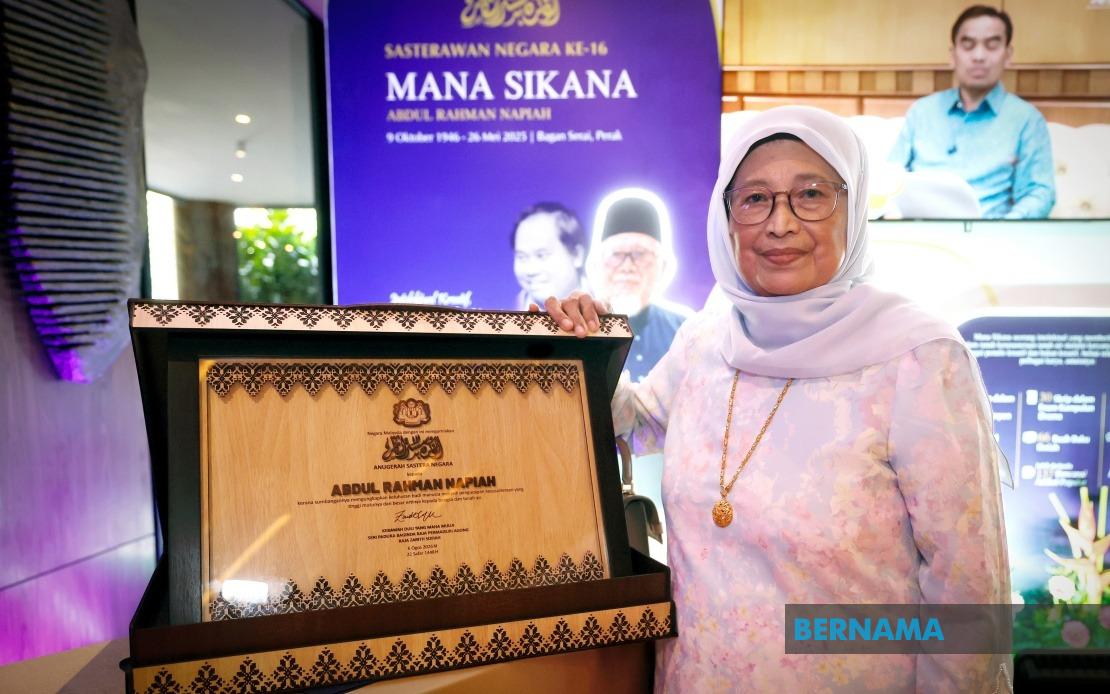
Malaysia's literary establishment has bestowed its highest honour on the late Dr Abdul Rahman Napiah, better known by his pen name Mana Sikana, recognising a career spanning multiple decades and disciplines. The conferment of the 16th National Laureate title came during a ceremony in Kuala Lumpur on August 6, with Her Majesty Raja Zarith Sofia, Queen of Malaysia, presenting the award. Salmah Ali, the 82-year-old widow of the renowned writer, received the accolade on her husband's behalf, describing it as recognition that arrived too late for him to witness but not without profound significance.
Salmah's account of her late husband's final days underscores the bittersweet nature of posthumous recognition. Mana Sikana had been informed before his death in May at age 80 that he might receive this distinction, a prospect that evidently mattered deeply to him. On the very day he experienced the fatal health crisis that would lead to his hospitalisation, he had been engaged in professional work, presenting a paper for Dewan Bahasa dan Pustaka, the nation's premier language and literary institution. The timing lends poignancy to his widow's statement that she felt simultaneously proud and heartbroken to accept an honour her husband had earnestly hoped to receive.
The literary career that culminated in this national recognition began in childhood and extended across multiple creative mediums. Beyond his accomplished work as a novelist and essayist, Mana Sikana established himself as a significant force in Malaysian broadcasting, producing drama works for both Singaporean and Malaysian radio and television during his years in Johor Bahru. This multimedia approach to storytelling distinguished him from writers who confined themselves to print, reflecting a pragmatic understanding of how literature could reach broader audiences through emerging media technologies.
His academic trajectory represented another dimension of his influence on Malaysian letters. After establishing himself as a writer and broadcaster, Mana Sikana pursued higher education at Universiti Kebangsaan Malaysia, eventually attaining the rank of professor. His scholarly contributions spanned creative writing, literary theory, and critical analysis, positioning him not merely as a practitioner but as an intellectual voice shaping how Malaysian literature was theorised and taught. His academic appointments ranged from UKM to Universiti Pendidikan Sultan Idris, and his influence extended across borders through visiting positions at Indonesian universities, demonstrating the regional respect commanded by his work.
Education Minister Fadhlina Sidek's remarks during the ceremony situated Mana Sikana's selection within a broader framework of national cultural development. She characterised the National Laureate honour as recognising his pivotal role in strengthening Malaysian literature through the convergence of creative writing, literary theory, criticism, and academic discourse. This multifaceted assessment captures how Mana Sikana operated simultaneously as artist, scholar, and cultural ambassador, contributing across domains that collectively constitute a nation's literary infrastructure.
Born in Bagan Serai, Perak, on October 9, 1946, Mana Sikana emerged from a generation of Malaysian intellectuals who navigated the country's early post-independence decades. His career trajectory from classroom teacher to university professor reflected the expansion of Malaysia's higher education system and the growing professionalisation of literary studies. His longevity in the field—spanning from his school days through to his final months—provided continuity across transformative periods in Malaysian publishing, broadcasting, and academic life.
The personal dimension of Salmah's acceptance speech reveals how cultural achievement and family life intertwined in Mana Sikana's world. His passion for literature and writing extended to his domestic sphere, where he influenced four children and twelve grandchildren through direct knowledge transmission. This pattern of mentorship within the family echoes his broader role as a professor and academic guide, suggesting that his commitment to developing Malaysian literary culture operated at multiple scales simultaneously—from national institutional contexts to intimate family settings.
For Malaysian readers and literary observers, Mana Sikana's belated recognition carries implications about how national honours acknowledge contributions to culture and letters. The National Laureate award system represents one of few mechanisms through which a nation formally recognises literary achievement at the highest level. That Mana Sikana received this distinction posthumously, rather than during his final years when he remained active and aware, underscores questions about timing and recognition cycles in literary establishments. His widow's emotional testimony that he had hoped for this honour before his passing adds weight to these broader questions about how quickly contemporary literary contributions receive formal institutional acknowledgment.
The awards he accumulated throughout his lifetime, beginning in his school days and continuing through his decades of professional work, had clearly not satisfied his aspiration for the National Laureate honour. This suggests that within Malaysia's literary hierarchy, the National Laureate distinction holds particular significance, representing a culminating validation that earlier awards did not provide. Salmah's repeated emphasis on her husband's desire for this specific recognition indicates that it represented something qualitatively different from other honours he had received.
Mana Sikana's death from heart complications at eighty marked the conclusion of an unusually productive and multifaceted career. His simultaneous engagement with creative writing, academic scholarship, broadcasting work, and mentorship across multiple generations created a layered legacy that any single genre of contribution would not fully capture. The National Laureate award attempts to encompass this complexity, recognising not merely his published works or teaching record in isolation, but the cumulative impact of his creative, intellectual, and institutional influence on Malaysian literature.
For Southeast Asian literary culture more broadly, Mana Sikana's recognition reflects how accomplished writers in the region often operate across borders and languages, serving as visiting lecturers and intellectual ambassadors. His regional mobility through posts in Singapore and Indonesia positioned him within networks of literary exchange that transcended national boundaries, contributing to conversations about literature, criticism, and cultural identity across multiple contexts. This transnational dimension of his career became more visible through the posthumous award, which encouraged public reflection on his regional significance.
The ceremony's presence of high-level officials, including the Queen and the Education Minister, signals official commitment to honouring literary achievement at state functions. These ceremonial aspects matter for establishing cultural legitimacy and signalling what societies value. Through such recognitions, nations communicate their understanding of literature's role in national development and identity formation. Mana Sikana's posthumous elevation to National Laureate status thus becomes not merely a personal recognition but a statement about what Malaysia officially values in its literary culture.
Moving forward, Mana Sikana's bequest encompasses published works, academic contributions, broadcast dramas, and the students and family members he mentored throughout his life. Salmah's role in receiving this award on his behalf ensures that his memory enters official record alongside the formal recognition of his achievements. While she expressed sadness that her husband could not witness the ceremony himself, the award itself preserves his contribution within Malaysia's cultural memory, ensuring that future generations will recognise Mana Sikana's name alongside the nation's highest literary honour.

