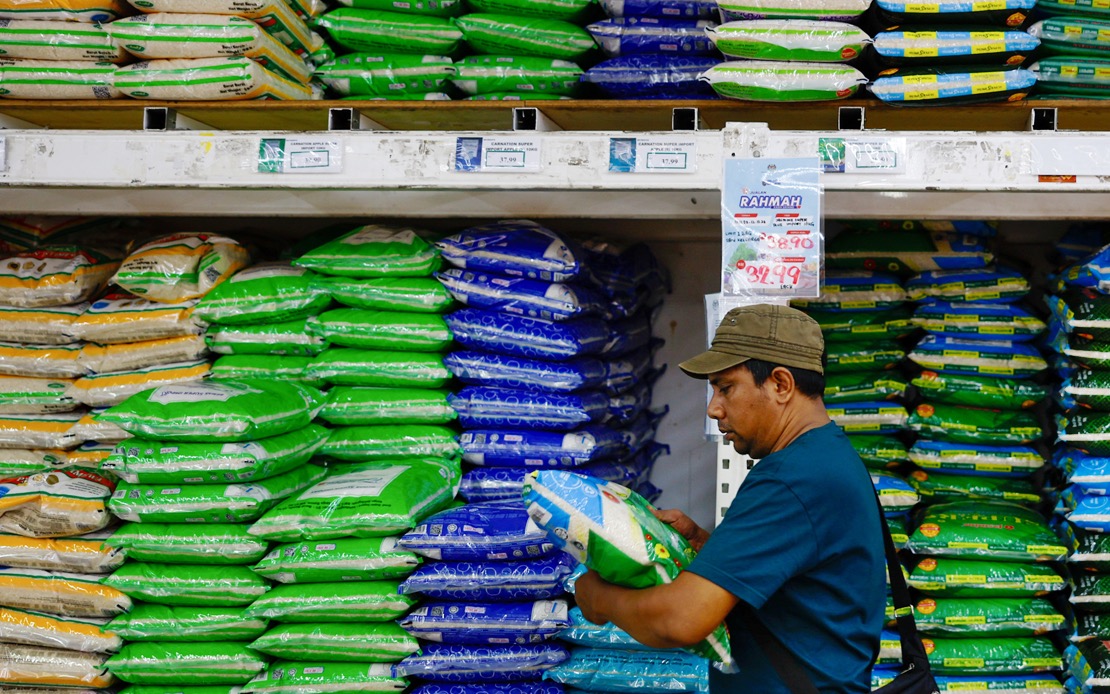
Malaysia's food security framework has proven resilient amid escalating geopolitical tensions in West Asia, with the country maintaining substantial rice reserves that officials say can meet domestic demand for a minimum of six months without external supplies. During a parliamentary session in Kuala Lumpur on August 4, Deputy Agriculture and Food Security Minister Datuk Chan Foong Hin informed the Dewan Negara that the nation's current physical rice inventory stands at 1.237 million tonnes, comprising both strategic reserves and commercial stocks. This dual-layer storage system reflects Malaysia's recognition that unexpected global disruptions—whether from conflict, trade barriers, or supply chain breakdowns—could severely impact a country reliant on rice imports for roughly 30 per cent of domestic consumption.
The composition of Malaysia's rice buffer reveals a carefully calibrated approach to food security. The national reserve managed by Padiberas Nasional Berhad (BERNAS) holds 200,000 tonnes, while the private commercial sector maintains an additional 1.037 million tonnes. This combination ensures that even if one supply channel faces disruption, alternative sources remain available. The strategy mirrors practices adopted by other Southeast Asian nations facing similar vulnerabilities, though Malaysia's explicit six-month buffer exceeds the minimum emergency reserves mandated in some neighbouring countries. By maintaining this cushion, policymakers are essentially purchasing stability in an increasingly uncertain global marketplace, where events thousands of kilometres away can translate into empty shelves and inflation at local markets.
Beyond physical stockpiling, Malaysia's food security architecture incorporates price stabilisation mechanisms that complement its inventory strategy. Government subsidies on locally produced white rice create a pricing floor that insulates consumers from international commodity volatility. When global rice prices spike—as occurred during the 2008 food crisis and again during recent pandemic-related disruptions—Malaysian households benefit from regulated domestic pricing that prevents sudden shocks. This approach differs from neighbouring Thailand and Vietnam, which depend more heavily on export revenue and therefore allow prices to fluctuate with global markets. For ordinary Malaysians, the subsidy system means that even when competing commodities experience double-digit price increases, rice remains comparatively stable, reducing inflationary pressure on household budgets.
However, Malaysia's medium-term rice security depends critically on expanding domestic production rather than perpetually relying on imports and reserves. The government has set an ambitious target of achieving 80 per cent self-sufficiency in rice by 2030, a goal that requires reversing years of declining agricultural yields. The El Niño phenomenon and prolonged droughts have already constrained harvests in recent seasons, exposing the vulnerability of relying on monsoon-dependent farming patterns. To address this challenge, the Ministry of Agriculture and Food Security is systematically rolling out drought-resistant paddy varieties designated MR 380, MR 381, and MR 382. These genetically improved strains represent technological adaptation rather than crop substitution, allowing farmers to maintain rice production even during water stress periods that would devastate conventional varieties.
Complementing crop variety improvements, the ministry is introducing advanced irrigation and cultivation techniques across key farming zones. The Alternate Wetting and Drying (AWD) method and System of Rice Intensification (SRI) approach both reduce water consumption while maintaining or increasing yields, addressing two fundamental constraints in Malaysian rice farming: water availability and land scarcity. These techniques have demonstrated success in other Asian countries facing similar ecological pressures, particularly in India and the Philippines, though implementation requires farmer training and investment in monitoring infrastructure. The five-season rice cultivation project concentrated in the Muda Agricultural Development Authority (MADA) zone over two years will serve as a pilot programme, potentially expanding to other growing regions if results justify scaling.
Farmer economics remain a critical but often overlooked determinant of rice self-sufficiency. Rising input costs—particularly for fertiliser, pesticides, and fuel—squeeze profit margins and discourage production expansion. The government is addressing this through multiple support mechanisms. A temporary exemption from the Sales and Service Tax for agricultural fertilisers including rock phosphate and magnesium sulphate, effective from January 1, 2026 through December 31, 2027, reduces production costs directly. More significantly, the government increased ploughing incentives for the 2026 season from RM160 to RM300 per hectare, an increase that distributes approximately RM40 million across nearly 200,000 farmers. These payments function as both compensation for increased input expenses and encouragement for expanded cultivation, essentially subsidising the path toward greater self-sufficiency.
The broader context of Malaysia's rice strategy extends beyond domestic agriculture. The nation imports substantial quantities of rice from Thailand, Vietnam, India, and Pakistan, making it vulnerable to export restrictions implemented by those countries during supply shortages. Recent history demonstrates that major rice exporters have periodically banned or restricted sales to protect domestic populations, fundamentally disrupting import-dependent nations. Myanmar's internal instability and Myanmar's traditional role as a regional exporter further complicates Southeast Asia's collective food security. By pursuing self-sufficiency targets, Malaysia is essentially reducing its exposure to decisions made in foreign capitals, trading dependence on importers for dependence on its own agricultural sector's performance.
The geopolitical dimension highlighted by the parliamentary questioning adds urgency to these discussions. West Asian tensions create complex ripple effects through global shipping routes, insurance costs, and supplier reliability. While rice itself may not face direct disruption from Middle Eastern conflicts, the broader economic uncertainty and potential energy price spikes create secondary effects on agricultural productivity and input costs. Malaysia's strategy acknowledges that food security in an interconnected world requires both emergency reserves for acute disruptions and structural improvements to production capacity for sustained resilience.
Looking forward, Malaysia faces a delicate balancing act. Pursuing aggressive self-sufficiency targets requires significant agricultural investment and farmer support at a time of constrained fiscal resources. Yet the alternative—continued high import dependence—exposes the country to uncontrollable external shocks. The parliamentary discourse suggests policymakers recognise this tension and are attempting to navigate it through incremental improvements rather than revolutionary change. Whether the combination of reserve maintenance, subsidy mechanisms, technological adoption, and targeted farmer support proves sufficient to achieve the 80 per cent self-sufficiency goal by 2030 will depend partly on global commodity markets and partly on the effectiveness of agricultural implementation at the farm level.

