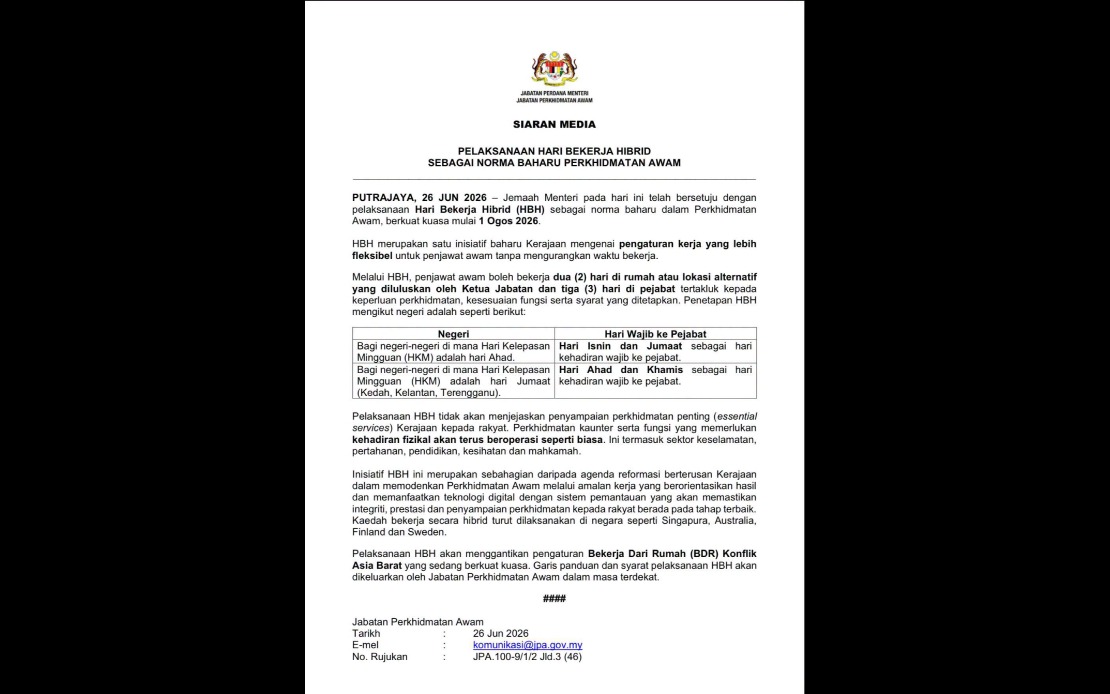
Malaysia's government has taken a significant step in modernising its public sector workforce by endorsing a structured hybrid work arrangement that will reshape how civil servants operate across the country. The Public Service Department announced on June 26 that the Cabinet had formally approved implementation of the Hybrid Work Day framework, effective August 1, marking a transition from the pandemic-era work-from-home model to a more balanced dual-location approach.
Under the new structure, Malaysia's 1.6 million civil servants will operate on a two-three split system: two days working remotely or from alternative locations sanctioned by their departmental heads, combined with three mandatory days at physical office locations. This framework replaces the existing Work From Home arrangement that has governed public sector operations since the COVID-19 pandemic began reshaping workplace norms globally. The arrangement remains subject to individual service requirements, functional suitability assessments, and departmental conditions that departments will establish during implementation.
The hybrid model reflects a deliberate government strategy to maintain productivity gains achieved during the remote work era while restoring in-office collaboration and institutional presence that Malaysian officials argue strengthens public service delivery. The PSD framed this initiative as part of broader public service reform targeting modernisation through results-oriented work practices and expanded digital technology adoption. Rather than simply reverting to traditional office attendance, the government is attempting to construct a middle ground that acknowledges changing workforce expectations while preserving core operational effectiveness.
Critically, Malaysia's geographic and administrative diversity has shaped the implementation timeline. States observing Sunday as the Weekly Rest Day—including most peninsular states—will designate Monday and Friday as mandatory office attendance days. Conversely, the northern states of Kedah, Kelantan, and Terengganu, which observe Friday as their weekly holiday, will require Sunday and Thursday office presence. This calibrated approach reflects Malaysia's federal structure and religious observance patterns, ensuring the framework accommodates existing state-level protocols.
Essential public services will remain unaffected by the transition, according to departmental assurances. Counter services, security operations, defence functions, educational institutions, healthcare facilities, and judicial systems will maintain standard operating patterns since these sectors require consistent physical presence. The PSD acknowledged that functions demanding direct public interaction cannot readily accommodate remote arrangements, positioning hybrid work as applicable primarily to administrative and support functions rather than frontline service delivery. This distinction suggests the government recognises legitimate operational constraints that prevent universal implementation across all civil service roles.
The department signalled that detailed implementation guidelines would follow the initial announcement, indicating the June 26 statement represents a policy framework awaiting operational specification. Malaysian departments will need to establish clear criteria determining which roles qualify for hybrid arrangements, specify approval processes for alternative work locations, and develop monitoring mechanisms ensuring compliance and performance standards. This phased approach provides organisational time to prepare systems while allowing for adjustments based on initial implementation experiences from pilot departments.
Monitoring mechanisms assume particular importance given Malaysian public administration's historical emphasis on oversight and accountability. The PSD committed to introducing surveillance infrastructure tracking integrity, performance metrics, and service delivery quality during the hybrid work transition. These safeguards appear designed to counter potential scepticism about remote work productivity, a concern that has dominated public sector reform debates throughout the region. Malaysia's approach attempts to balance workforce flexibility with institutional accountability—a tension characterising hybrid work policies across Southeast Asia.
The government positioned this initiative within international precedent, citing adoption in Singapore, Australia, Finland, and Sweden. This comparative framing carries particular resonance for Malaysian policymakers seeking to project the public service as contemporary and globally competitive. Regional readers will recognise Singapore's influence here, as Malaysia frequently benchmarks administrative practices against its smaller neighbour. The reference suggests Malaysian officials perceive hybrid arrangements as legitimised international practice rather than experimental policy, potentially easing implementation among conservative bureaucratic institutions.
For Malaysian workers and employers, the policy carries broader implications extending beyond government operations. Private sector adoption of hybrid arrangements has accelerated throughout Malaysia and Southeast Asia, creating competitive pressure on government employment as a talent proposition. By formalising flexible work options, the Cabinet signals responsiveness to workforce expectations reshaping labour markets across the region. This positioning matters for attracting skilled professionals to public service roles, particularly in technology and knowledge-intensive functions where private sector alternatives increasingly offer comparable flexibility.
The transition also reflects evolving attitudes toward work-life balance and productivity measurement in Malaysian society. Departure from rigid office-based attendance models acknowledges generational workforce preferences and recognition that output-based assessment may prove more sustainable than time-and-presence management. However, implementation success depends substantially on departmental leadership capability—whether managers can effectively supervise hybrid teams and whether accountability systems adequately measure outcomes rather than merely tracking office attendance. Malaysian civil service capacity to manage this cultural and operational shift remains a crucial implementation variable.
For Malaysian businesses and employees observing this policy, the government's approach provides a template and legitimisation for private sector hybrid arrangements. Government employment typically establishes precedent throughout Malaysia's formal economy, suggesting this framework may accelerate hybrid adoption across banking, insurance, technology, and professional services sectors. The policy thus carries significance transcending the public sector itself, potentially reshaping Malaysian workplace expectations more broadly as the private sector follows government precedent.
The August 1 implementation date provides approximately five weeks for departmental preparation, a compressed timeline that may challenge organisations requiring extensive system modifications. Departments must establish remote work technology infrastructure, revise performance management systems to accommodate distributed teams, and communicate implementation details to hundreds of thousands of employees. Success depends on PSD providing adequate guidance while permitting sufficient departmental flexibility to accommodate sector-specific operational requirements.

