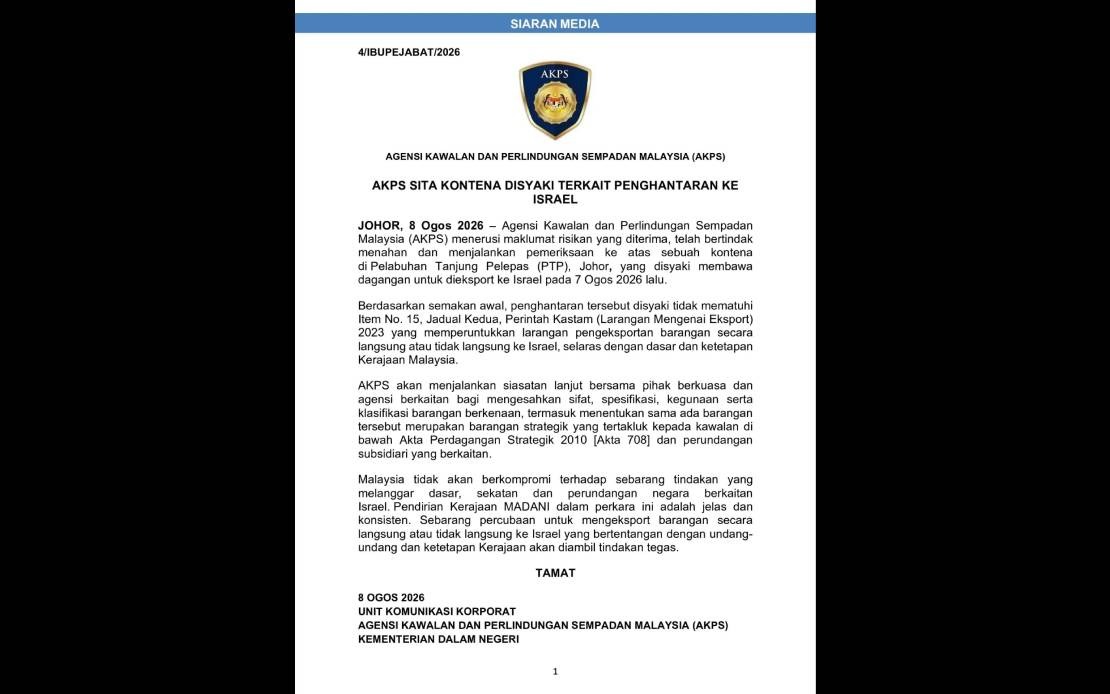
Prime Minister Datuk Seri Anwar Ibrahim has commended the Malaysian Border Control and Protection Agency (AKPS) for its interception of a container believed to hold strategic commodities intended for Israel at the Port of Tanjung Pelepas in Johor. The seizure, announced through a social media statement, reflects intensifying efforts by the federal government to prevent the country's infrastructure from facilitating commerce with the Israeli regime.
The confiscated shipment represents what officials characterise as a violation of Malaysia's export restrictions framework. The container was detained and inspected after authorities determined it likely breached Item No. 15 of the Second Schedule of the Customs (Prohibition of Exports) Order 2023, a regulatory instrument that prohibits both direct and indirect shipment of goods to Israel. The specifics of the cargo's contents and intended destination remain undisclosed by the authorities, though the categorisation as "strategic goods" suggests items with potential dual-use or military applications.
Anwar's statement emphasises Malaysia's determination to prevent its ports and infrastructure from becoming conduits for trade that could sustain what the government describes as atrocities perpetrated by Israel against Palestinian populations. This framing positions the enforcement action within a broader moral and diplomatic narrative that has increasingly shaped Malaysian foreign policy and domestic political discourse since the escalation of regional tensions.
The government's stance aligns with Malaysia's participation in The Hague Group, a multilateral coalition focused on addressing violations of international humanitarian law. By invoking this membership, Anwar situates Malaysia within a framework of nations committed to accountability and adherence to international legal standards regarding armed conflict and civilian protection. This positioning carries significance for Malaysia's regional standing and its role as a voice for developing nations within international forums.
The December 2023 ban on Israeli vessels and cargo-carrying ships represents a significant escalation of Malaysia's trade enforcement mechanisms. Prior to this directive, Malaysia maintained various restrictions on Israeli commerce, but the comprehensive port prohibition marked an unprecedented measure that extended beyond selective goods to encompass an outright denial of maritime access. This regulation effectively closes one of the region's major shipping hubs to Israeli-flagged vessels and neutrally-flagged ships transporting Israeli cargo.
The AKPS seizure demonstrates active implementation of these restrictions rather than mere regulatory posturing. Port authorities across Southeast Asia have faced considerable pressure to enforce trade barriers against Israel, particularly following recent escalations in the Israeli-Palestinian conflict. Malaysia's public enforcement actions serve both as deterrence against future attempted transshipments and as demonstration of governmental commitment to constituent expectations regarding Middle Eastern policy.
For Malaysia's business community and logistics sector, such enforcement actions create operational complexity. Shipping companies and freight forwarders must undertake enhanced due diligence to verify cargo destinations and ultimate beneficiaries, a process that increases compliance costs and requires sophisticated supply chain transparency mechanisms. The seizure illustrates that containerised shipments routed through Malaysian ports face heightened scrutiny, potentially affecting the competitiveness of Malaysian port facilities against regional competitors less committed to trade restrictions.
The incident also carries implications for Malaysia's relationships with trading partners. Nations whose companies utilise Malaysian ports for re-export or transshipment activities must navigate these restrictions carefully. The enforcement action signals that Malaysia will not provide a loophole for companies seeking to circumvent their own governments' export controls or international sanctions regimes through strategic use of Malaysian infrastructure.
Anwar's emphasised commitment to defending Palestinian rights and dignity reflects the integration of this issue into Malaysia's national identity and foreign policy positioning. For a nation with substantial Muslim population and deep historical involvement in Palestinian advocacy through international organisations, consistent enforcement of trade restrictions serves both principled and strategic purposes. The public commendation of AKPS operatives amplifies the message that such enforcement aligns with governmental values and receives leadership endorsement.
The broader context reveals Malaysia's navigation of complex geopolitical terrain. While maintaining trade relationships with numerous international partners, including nations with significant Israeli economic ties, Malaysia has adopted increasingly assertive positions on Palestinian issues. This apparent contradiction reflects domestic political pressures, regional solidarity considerations, and Malaysia's self-perception as a leader of Muslim-majority nations advocating for justice in international affairs.
Looking forward, the AKPS seizure establishes precedent for continued monitoring of containerised cargo at Malaysian ports. Shipping industry participants and logistics companies will need to strengthen their compliance frameworks and due diligence processes to avoid entanglement in enforcement actions. The incident underscores that Malaysian port facilities, despite their strategic importance to regional commerce, operate within an increasingly defined geopolitical landscape where certain trading relationships face institutional barriers.
The government's handling of this matter demonstrates its commitment to translating policy declarations into operational enforcement. Rather than treating the December 2023 ban as a symbolic gesture, Malaysian authorities are demonstrating capacity and willingness to intercept and detain non-compliant shipments. This approach distinguishes Malaysia from nations that maintain restrictions in theory while permitting circumvention in practice, reinforcing the credibility of Malaysian policy positions within both regional and international contexts.

