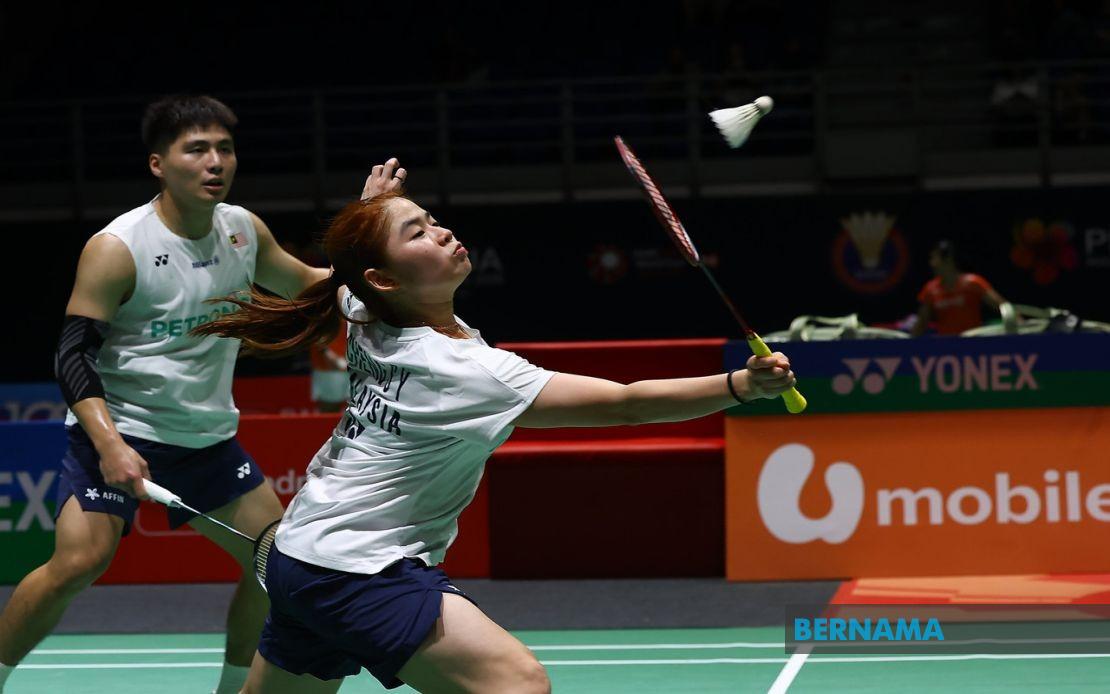
Malaysia's challenge at the 2026 Japan Open came to an end on Thursday when the nation's two remaining pairs bowed out of the tournament in the semi-final stage. The exits in Tokyo mark the completion of what had been a respectable run by the Malaysian contingent, though hopes of advancing further were ultimately dashed by higher-ranked opponents. The back-to-back defeats underlined the competitive depth at international badminton's elite level, where even strong performances often fall short against established contenders.
In the mixed doubles draw, the unseeded combination of Jimmy Wong and Cheng Su Yin saw their impressive tournament run halted by Hong Kong's Tang Chun Man and Tse Ying Suet. The Malaysian pair fought hard throughout the encounter, which stretched to 69 grueling minutes before the experienced Hong Kong duo secured victory with a 17-21, 21-18, 21-15 scoreline. Despite the loss, Wong and Cheng Su Yin demonstrated they belong at badminton's highest echelon, having eliminated several seeded pairings en route to the semi-finals through what observers characterized as giant-killing displays of resilience and tactical acumen.
The performance of the mixed doubles pair deserves recognition within Malaysian badminton circles, as their path through the draw showcased genuine competitive potential. Unseeded players who advance to semi-finals of prestigious tournaments often gain invaluable experience that shapes their development as international competitors. For Wong and Cheng Su Yin, the Japan Open campaign provides a benchmark for future tournaments, demonstrating that with continued refinement and consistent training, they can sustain challenges against established top-ten combinations in the mixed doubles landscape.
On the men's doubles court, Goh Sze Fei and Nur Izzuddin Rumsani encountered a seemingly insurmountable challenge in the form of South Korea's Kim Won Ho and Seo Seung Jae, the world's number one ranked pair. The Malaysian duo mounted a valiant effort throughout their 58-minute encounter, though they proved ultimately unable to overcome the Korean partnership's technical superiority and experience at the sport's pinnacle. The match saw the Malaysians start poorly, conceding the opening game 12-21 in a display that suggested the weight of facing the world's best was telling on their performance early.
Yet Goh Sze Fei and Nur Izzuddin responded impressively in the second game, demonstrating the mental fortitude required at this level of competition. Their commanding 21-11 victory in the middle set forced a decisive third game and momentarily suggested a stunning upset might be possible. However, the South Korean pair's experience at close matches proved decisive, as they regained control in the decider to prevail 21-13. This was a learning experience for the Malaysian pairing, who have now faced the Kim-Seo combination five times previously, losing three of those encounters overall.
The head-to-head record against Kim Won Ho and Seo Seung Jae illustrates the structural challenge Malaysian men's doubles faces at the world championship level. With a 2-3 record against the top-ranked pair, Goh Sze Fei and Nur Izzuddin have shown they can compete with world leaders, yet consistency remains elusive. The tournament's conclusion provides crucial data for the Badminton Association of Malaysia's coaching staff to analyze tactical approaches, physical conditioning, and match psychology when facing elite opponents. Each encounter against top-ranked pairs offers diagnostic value that extends beyond the immediate tournament result.
Malaysia's overall showing at the 2026 Japan Open reflects broader patterns within Southeast Asian badminton. While the region produces skilled players capable of reaching tournament semi-finals, converting those appearances into titles or medal finishes remains difficult against the established powerhouses of China, Indonesia, South Korea, and Japan. The Malaysian pairs' performances in Tokyo demonstrated technical competency and strategic awareness, yet they encountered opponents with deeper competitive experience at this pinnacle level.
The departure of both Malaysian pairs also concludes what had been a tournament of mixed fortunes for the contingent. Earlier rounds had seen several other Malaysian players and pairings exit, making the sustained presence of Wong-Cheng Su Yin and Goh Sze Fei-Nur Izzuddin into the semi-finals a relative success. However, the inability to convert semi-final appearances into finals berths highlights the incremental improvements still required to compete consistently for tournament wins on the international stage.
Looking forward, these results will inform Malaysia's badminton development pathway as the national program seeks to narrow the gap with leading nations. The mixed doubles category appears to offer particular opportunity for Malaysian growth, given Wong and Cheng Su Yin's impressive run against higher-seeded combinations. Similarly, Goh Sze Fei and Nur Izzuddin's competitive displays against world number one Kim Won Ho and Seo Seung Jae suggest the men's doubles pairing possesses the foundation for sustained improvement with targeted preparation. Tournament experiences at events like the Japan Open serve as crucial milestones in athlete development, providing benchmark data for performance analysts and coaches designing future training methodologies.

