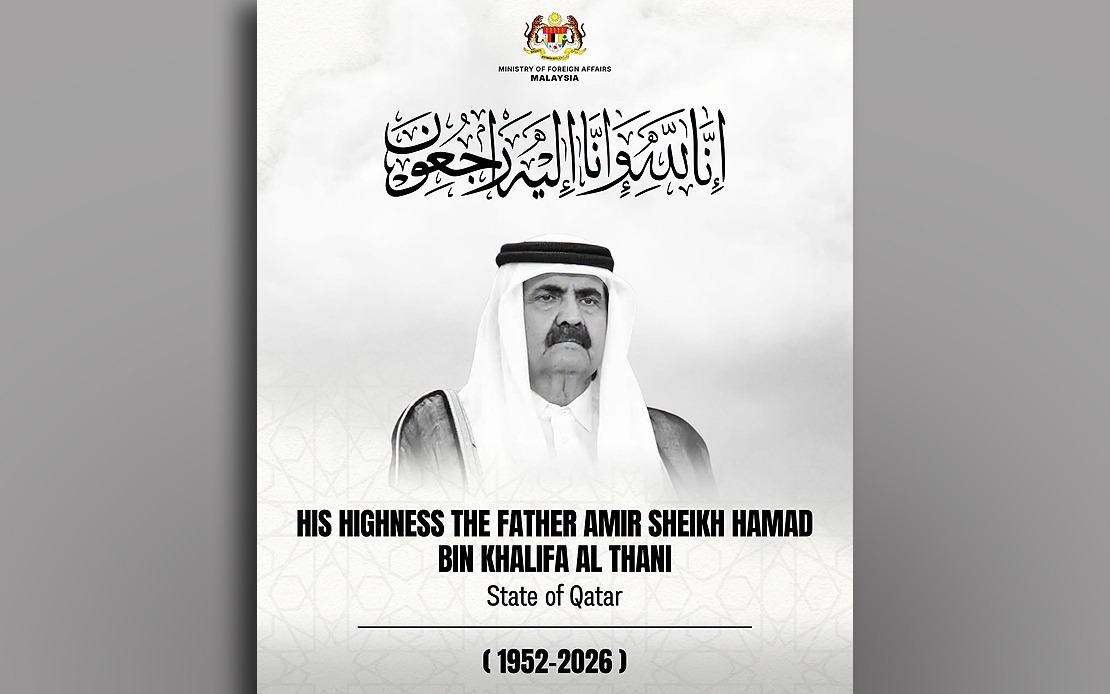
Malaysia is sending a high-level delegation to Qatar to participate in the state funeral of Sheikh Hamad bin Khalifa Al Thani, the country's late Father Amir, with Higher Education Minister Datuk Seri Dr Zambry Abdul Kadir leading the Malaysian contingent during the mourning period from July 13 to 14. The formal condolences reception will take place at Lusail Palace, where Qatar's current Amir, Sheikh Tamim bin Hamad Al Thani, will receive delegations from foreign governments, members of the royal family, and officials from July 13 through 15.
The Malaysian government has conveyed its formal condolences through the Foreign Ministry, which issued a statement expressing profound sadness at the passing of the elder statesman and emphasising the nation's solidarity with the Qatari leadership and people during this period of national mourning. This diplomatic gesture underscores the significance Malaysia places on its longstanding relationship with Qatar, one of the region's most strategically important and economically influential Gulf states. The decision to send a cabinet minister rather than a lower-ranking official signals the depth of respect and the diplomatic importance Malaysia attaches to honouring this occasion.
Qatar has declared an official four-day period of national mourning beginning on Sunday, July 12, reflecting the tremendous esteem in which Sheikh Hamad bin Khalifa Al Thani is held across the emirate and the wider Arab world. During this time, all government ministries, public institutions, and civil service entities throughout Qatar have been instructed to cease normal operations, allowing the nation to collectively pay tribute to a figure who played a defining role in Qatar's modern development and transformation.
Sheikh Hamad bin Khalifa Al Thani served as Amir of Qatar for nearly two decades before stepping down in 2013, a period that witnessed the nation's extraordinary economic growth, strategic positioning, and emergence as a global power player despite its modest geographic size. His reign coincided with the discovery and exploitation of vast natural gas reserves, which fundamentally reshaped Qatar's economy and influence. The late Amir's progressive policies and diplomatic acumen helped establish Qatar as a mediator in regional conflicts and a hub for international diplomacy, hosting organisations and hosting major global events.
The passing of Sheikh Hamad represents a significant moment not only for Qatar but for the broader Middle Eastern geopolitical landscape. As a founder and architect of modern Qatar's international standing, his legacy extends beyond the nation's borders and touches the interests of many countries, including Malaysia, which maintains important trade, investment, and cultural ties with the peninsula emirate. Qatari sovereign wealth funds and enterprises have substantial investments across Southeast Asia, while Malaysian workers and businesses have significant presence in Qatar.
This diplomatic representation also reflects the broader strategic partnership between Malaysia and Qatar, which encompasses economic cooperation, educational exchanges, and cultural engagement. Higher Education Minister Dr Zambry's participation in the mourning ceremonies demonstrates Malaysia's commitment to maintaining strong governmental relationships in the Gulf region, a priority that takes on added significance given the economic importance of Gulf states to Malaysia's trading networks and the large Malaysian expatriate community working in the region.
The ceremonial protocols being observed at Lusail Palace follow Islamic traditions and formal state procedures befitting a founding figure in Qatar's modern history. International delegations are expected to participate in formal condolences rituals that will take place over the three-day reception period. The choice of Lusail Palace, an iconic location symbolising Qatar's contemporary development, underscores the stature of the occasion and the prominence of those being honoured.
Malaysia's formal mourning delegation represents one among many international participants paying respects to Sheikh Hamad bin Khalifa Al Thani. The scale and composition of visiting delegations often reflect the depth of bilateral relationships and the international standing of the deceased. By dispatching a senior cabinet minister, Malaysia has positioned itself prominently among nations honouring the late Amir, signalling both respect for his legacy and Malaysia's own commitment to its partnership with Qatar.
The timing of this state funeral also coincides with broader discussions within the Islamic world and the Middle East about succession, leadership transitions, and the consolidation of political authority in Gulf monarchies. Sheikh Tamim bin Hamad Al Thani has led Qatar since 2013 and continues to guide the nation through evolving regional dynamics, including the resolution of the 2017-2021 Gulf diplomatic crisis in which Qatar was blockaded by neighbouring states. The expression of international solidarity during this period of bereavement carries symbolic weight in reinforcing Qatar's standing and its Amir's legitimacy.
For Malaysia specifically, this gesture of respect and formal representation contributes to the maintenance of diplomatic goodwill that is essential for ongoing bilateral cooperation across multiple sectors. The relationship between Malaysia and Qatar encompasses not only political dialogue but also business investments, labour migration, educational partnerships through Malaysian institutions operating in Doha, and cultural exchanges that benefit citizens of both nations.
The funeral ceremonies also provide an opportunity for Malaysia to reaffirm its position within the broader community of Islamic nations and to strengthen its credentials as a responsible member of the international diplomatic system. By participating visibly and at the ministerial level, Malaysia demonstrates its alignment with core values of respect for elder statesmen and acknowledgement of historical figures who have shaped their nations' destinies. Such diplomatic courtesies, while ceremonial in nature, carry substantial weight in the careful calculus of international relations and contribute to the trust and mutual respect that underpin bilateral cooperation.

