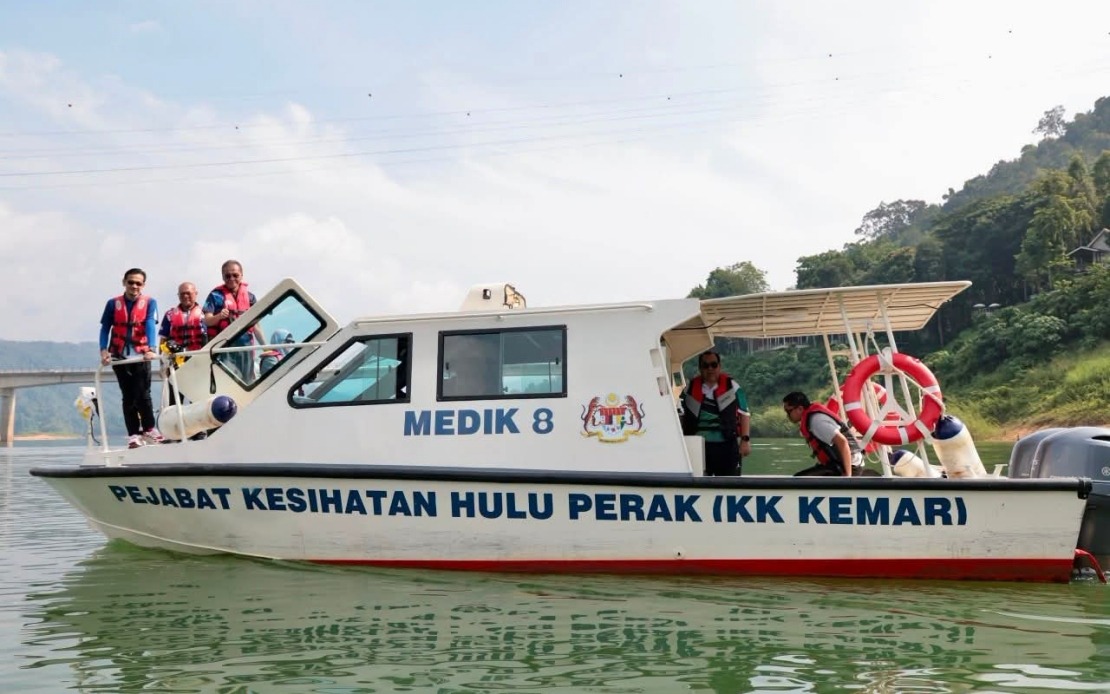
The Ministry of Health has taken a significant step towards bridging healthcare inequities in Malaysia's interior by introducing the Medic Boat 8, a RM350,000 vessel designed specifically to serve the waterborne communities of Hulu Perak. Health Minister Datuk Seri Dr Dzulkefly Ahmad launched the 12-passenger multipurpose boat at the Belum Rainforest Resort jetty during an official visit to the region, marking an important expansion of the ministry's fleet dedicated to remote service delivery. The initiative directly addresses the fundamental reality facing more than 4,500 Orang Asli residents in the Kemar Resettlement Scheme near Gerik: for these communities, waterways are not merely an alternative transport route but their primary and often only lifeline to essential services.
The geographical isolation that characterises Hulu Perak's interior presents persistent challenges to healthcare provision that conventional land-based infrastructure cannot adequately solve. Dense rainforest, rugged terrain, and the intricate network of rivers mean that emergency response times for medical crises can stretch to hours, potentially rendering the difference between life and death in critical situations. By augmenting the existing fleet of six boats with this additional vessel, the ministry acknowledges that providing equitable healthcare requires tailoring solutions to match the distinctive circumstances of each population. The Medic Boat 8 represents not merely an acquisition of equipment but a recognition that Malaysia's commitment to universal healthcare coverage must extend meaningfully to those living in the nation's most remote territories.
Dr Dzulkefly Ahmad emphasised that the sophistication of government assets holds limited value without corresponding commitment from frontline workers. His remarks underscore a reality often overlooked in infrastructure announcements: vessels are inert without the doctors, nurses, and boat operators who crew them and navigate challenging conditions to deliver care. Healthcare workers serving these communities face extraordinary occupational demands, regularly confronting powerful river currents, unpredictable weather, and the physical and mental toll of operating in isolation. The minister's public acknowledgement of their contributions reflects broader efforts to valorise the sacrifices made by personnel who enable healthcare delivery in circumstances most urban-based Malaysians rarely encounter.
The launch exemplifies the Malaysia MADANI governance framework's stated commitment to ensuring healthcare accessibility transcends geographical and socioeconomic barriers. This principle resonates particularly in Peninsular Malaysia, where pockets of indigenous populations remain substantially disconnected from mainstream health infrastructure. The Orang Asli communities of Hulu Perak, like other interior populations throughout the peninsula, have historically experienced disparities in health outcomes, maternal and child mortality, infectious disease prevalence, and access to preventive services. Targeted interventions addressing their specific transportation and logistical constraints represent an evidence-based approach to reducing these persistent health inequities.
The expansion of boat services carries implications extending beyond immediate healthcare provision. Enhanced medical access influences broader social outcomes, enabling pregnant women to reach birthing facilities, allowing chronically ill individuals to maintain medication regimens, and facilitating early intervention when infectious diseases emerge. In communities where infant and maternal mortality rates exceed national averages, reliable access to emergency obstetric care becomes a determinant of fundamental life chances. Similarly, capacity for rapid disease surveillance and response—particularly relevant given Malaysia's tropical disease burden—depends on communities' ability to communicate with and access health systems promptly.
Investment in aquatic healthcare infrastructure also reflects lessons learned from previous gaps in service delivery. Hulu Perak's terrain had historically made it difficult for the health ministry to maintain consistent personnel presence or rapid medical response. The boat fleet approach acknowledges that establishing permanent brick-and-mortar facilities in every remote settlement may prove economically unfeasible or impractical, but that mobile, community-based service delivery remains viable and cost-effective. The RM350,000 investment in Medic Boat 8, while significant, must be contextualised within the broader calculus of preventing mortality and morbidity across diverse populations.
The challenges facing healthcare workers in these settings extend beyond operational logistics to include cultural competency and building community trust. Orang Asli communities have experienced historical marginalisation from national institutions, and healthcare access depends partly on whether medical personnel demonstrate genuine commitment to understanding local health beliefs, languages, and social structures. The sustained presence enabled by expanded boat services creates opportunities for relationship-building and culturally appropriate health communication that episodic or emergency-only interventions cannot achieve. Regular, predictable access to health workers facilitates health education, preventive service uptake, and integrated care approaches addressing social determinants.
Southeast Asia more broadly faces similar challenges in extending healthcare to geographically dispersed and culturally distinct populations. Malaysia's approach to aquatic healthcare provision offers instructive lessons for neighbouring countries grappling with comparable obstacles. Indonesia, Thailand, and the Philippines all contain indigenous and remote populations whose healthcare access is constrained by waterborne geography and limited terrestrial infrastructure. Initiatives like Medic Boat 8 demonstrate practical solutions appropriate to tropical Southeast Asian environments where riverine transport remains fundamental to community life.
The sustainability of such services requires sustained budgetary commitment and workforce planning. Recruitment and retention of qualified healthcare personnel willing to serve in demanding field conditions remains perpetually challenging. The health ministry must couple infrastructure investment with competitive compensation, professional development opportunities, and rotation systems preventing burnout among personnel stationed in isolated posts. Additionally, ensuring adequate boat maintenance, fuel provision, and spare parts availability demands bureaucratic systems functioning reliably despite limited local commercial infrastructure. Success ultimately depends on institutional frameworks supporting long-term commitment rather than time-limited initiatives.
The Medic Boat 8 deployment demonstrates that healthcare access remains contingent on reimagining service delivery models for populations occupying spaces where conventional health infrastructure proves impractical. As Malaysia advances its development trajectory, the principle articulated by the health minister—that terrain and geography cannot justifiably limit healthcare access—warrants sustained institutional commitment. For the 4,500 Orang Asli residents of Hulu Perak's Kemar Resettlement Scheme, this single boat represents tangible government acknowledgement that their health and their lives matter equivalently to those living in urban centres with comprehensive medical facilities. Whether this symbolic gesture translates into sustained, adequate healthcare access depends on continued political will and budgetary priority beyond the launch ceremony.

