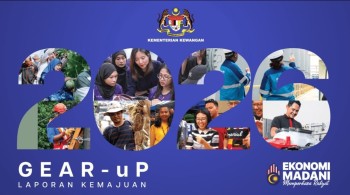
Malaysia's government-linked investment companies have dramatically escalated their commitment to national economic transformation, deploying RM20.3 billion in 2025—a threefold increase from the RM6.6 billion deployed in the previous year. The acceleration marks a pivotal moment in the GEAR-uP initiative, a five-year programme launched in 2024 by the Ministry of Finance to mobilise RM120 billion in strategic investments across the economy. Prime Minister Datuk Seri Anwar Ibrahim, who doubles as finance minister, emphasised that this capital represents far more than passive financial returns; rather, it constitutes national wealth deployed with deliberate national purpose to benefit ordinary Malaysians amidst a volatile global economic landscape.
The GEAR-uP framework harnesses the financial firepower of six major GLICs: Khazanah Nasional Bhd, the Employees Provident Fund, Permodalan Nasional Bhd, Kumpulan Wang Persaraan (Diperbadankan), Lembaga Tabung Angkatan Tentera, and Lembaga Tabung Haji. Together, these institutions command unprecedented pools of capital that can be coordinated toward strategic objectives beyond traditional investment mandates. The programme reflects a broader philosophical shift in how Malaysia approaches economic development—moving away from ad-hoc interventions toward a systematised approach where state-backed entities function as agents of deliberate, measured economic transformation aligned with national priorities.
The momentum established in 2025 is expected to continue through the first quarter of 2026, suggesting the acceleration is not a temporary spike but reflects sustained commitment to execution. This trajectory becomes particularly significant when evaluated against Malaysia's external operating environment, which continues to experience disruption from geopolitical tensions, trade policy shifts, and evolving global supply chains. By demonstrating the capacity to scale capital deployment rapidly while maintaining strategic discipline, Malaysia positions itself as a jurisdiction capable of managing macroeconomic headwinds through coordinated state action.
Infrastructure projects are anchoring much of this capital movement. Tenaga Nasional Bhd's grid modernisation initiatives under Regulatory Period 4 represent a foundational commitment, with investments climbing from RM12 billion in 2025 toward RM15 billion by 2027. These investments directly support Malaysia's ambitious renewable energy transition, targeting 70 per cent renewable capacity in the national energy mix by 2050. Simultaneously, Malaysia Airports pursues a RM11 billion five-year upgrade programme that will position Kuala Lumpur International Airport to handle more than 100 million passengers annually, addressing capacity constraints that have historically limited aviation-driven economic activity and tourism revenue.
Data centre development represents a frontier area where GLIC-backed initiatives are positioning Malaysia within the global artificial intelligence and digital infrastructure buildout. A KWAP-backed Google data centre project in Selangor will contribute an additional 320 megawatts of capacity and generate an estimated 26,500 jobs through 2026 and 2027. This venture exemplifies how the GEAR-uP framework enables GLICs to attract world-class foreign investment by committing patient capital to foundational infrastructure—a role private investors often find unattractive due to extended payback periods. Alongside this, Empyrion Digital's phased development in Johor signals that Malaysia is attracting multiple anchor projects simultaneously, creating clusters rather than isolated investments.
Capital markets development remains central to the programme's logic. GLIC-administered investment funds—Dana Impak, Dana Perintis, Dana Pemacu, and Ekuinas—are systematically advancing Malaysian companies from venture-stage through growth phases toward maturity and public listing. Khazanah's planned Dana Ciptawan will inject a further RM200 million into Bumiputera enterprises and mid-tier Malaysian firms, acknowledging that inclusive growth requires deliberate mechanisms to ensure wealth-building opportunities reach beyond existing corporate networks. The government projects that GLCs will generate RM100 billion in additional market value by 2028, underpinning an expanded capital markets ecosystem that supports Malaysia's Vision 2050 aspirations.
The initiative also catalyses broader capital markets expansion through the MY Value Up discipline, which extends rigorous corporate governance and value-creation expectations to Malaysia's 88 largest listed companies. This systemic approach contrasts with episodic interventions; by embedding operational excellence requirements across the corporate landscape, the programme aims to generate compounding improvements in governance quality and investor confidence. The Capital Markets Masterplan's target of RM5.8 trillion to RM6.3 trillion in market capitalisation by 2030 depends critically on maintaining the pipeline of companies advancing toward public listings and on sustaining shareholder returns—a discipline that Finance Minister II Datuk Seri Amir Hamzah Azizan noted must deliver concrete improvements in worker compensation, graduate employment, and local supply chain development.
Bumiputera wealth creation has received particular emphasis within GEAR-uP's design. The programme targets ten Bumiputera company listings during 2026-2027, building on the 10 Bumiputera Champions Programme that concentrates support on firms with realistic scaling potential. Zakat Wakalah, a mechanism for faith-based wealth redistribution, is projected to reach RM100 million in 2026, up sharply from RM28 million in the prior year. These initiatives acknowledge that equitable economic participation requires attention not only to capital availability but to the institutional frameworks—including religious and community-based mechanisms—through which different demographic groups access investment opportunities and wealth-building tools.
The GEAR-uP philosophy, articulated consistently by senior officials, prioritises translating capital deployment into tangible improvements in lived experience. Minister Amir Hamzah emphasised that capital serves no purpose if it merely circulates within financial systems; true success emerges when deployed capital creates sustainable employment, funds skill development, establishes local supply chains, and generates living wages. This represents a philosophical departure from earlier periods when foreign direct investment was sometimes accepted with minimal conditions regarding employment quality or technology transfer. The current approach imposes implicit expectations that GLIC-backed investments must deliver not only financial returns but measurable improvements in human capital development and economic opportunity distribution.
The external environment remains contested and volatile, yet Malaysia's capacity to accelerate GEAR-uP deployment suggests the 2023 economic reforms created sufficient institutional and fiscal resilience to enable counter-cyclical investment during periods of global turbulence. Rather than retreating into defensive postures during uncertain times, Malaysia is deploying capital aggressively toward long-duration infrastructure and capability-building projects. This counter-intuitive strategy reflects confidence in Malaysia's structural positioning and a determination to ensure that global volatility does not derail the socioeconomic transformation ambitions embedded in the MADANI Economy framework.
Looking forward, the momentum established in 2025 positions Malaysia to reach meaningful milestones during 2026-2027, with most major initiatives already in motion. Data centres, airport modernisation, renewable energy infrastructure, and company listings form an interconnected ecosystem where success in one domain creates enabling conditions for progress in others. The government's repeated characterisation of GEAR-uP as a marathon rather than a sprint suggests realistic expectations about the timeframe required for capital deployment to generate economy-wide transformations. However, the acceleration of deployment rates and the coordination of activity across multiple GLICs and GLCs indicate that Malaysia's policymakers believe the critical window for establishing competitive advantages in emerging economic domains—artificial intelligence infrastructure, renewable energy transition, high-value manufacturing—requires immediate and sustained action. The coming three years will reveal whether this ambitious framework translates capital into the enduring capabilities and broadly distributed prosperity its architects envision.

