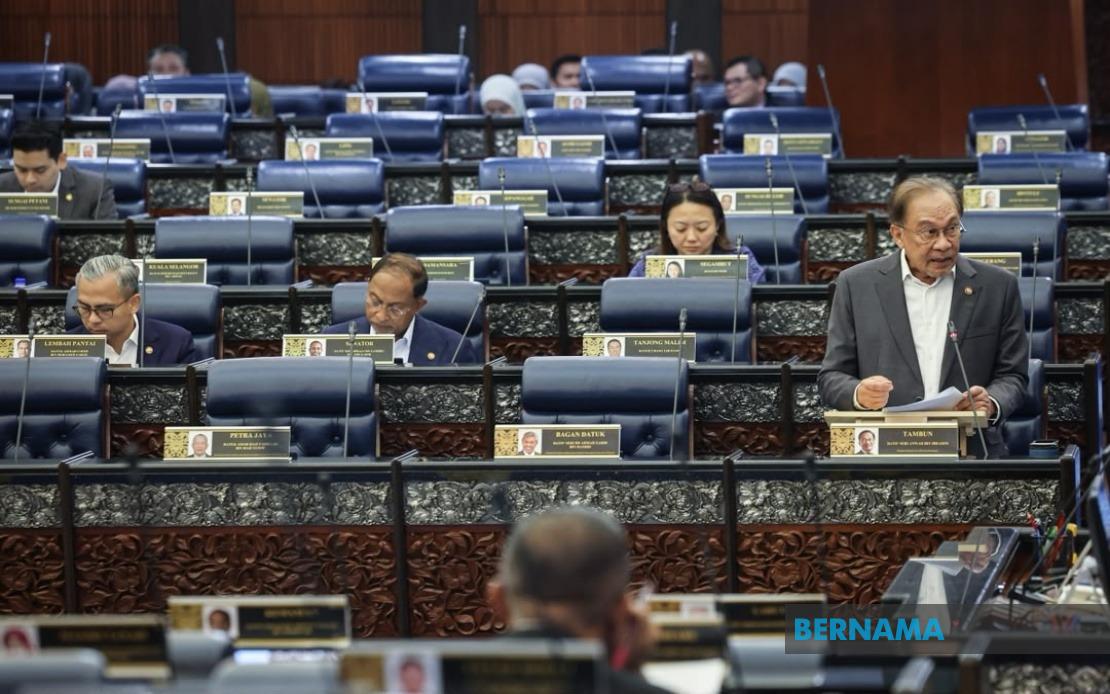
Prime Minister Datuk Seri Anwar Ibrahim moved to counter criticism of Malaysia's fuel pricing structure by drawing direct comparisons with major oil-producing nations in the Gulf region. Speaking in parliament on July 14, he maintained that domestic petrol prices under the government's BUDI MADANI subsidy scheme remain favourable relative to those charged in neighbouring oil-rich economies, a point he emphasised as evidence of his administration's commitment to affordability for Malaysian consumers.
The centrepiece of Anwar's defence is the pricing of RON95 petrol, which continues to be offered at RM1.99 per litre under the BUDI MADANI framework. By positioning this against Saudi Arabia's current retail price of over RM2.40 per litre, the Prime Minister sought to reframe the narrative around Malaysia's fuel competitiveness. This comparison carries particular weight given Saudi Arabia's status as the world's largest oil exporter and a benchmark for global energy pricing. The differential of approximately 41 sen per litre underscores the subsidy burden Malaysia continues to absorb to maintain domestic prices within reach of ordinary households.
Anwar's remarks were prompted by parliamentary questioning from Datuk Rosol Wahid, the PN-backed representative for Hulu Terengganu, who raised the contentious subject of fuel price differentials across different political administrations. The query implicitly referenced the tenure of Datuk Seri Najib Razak, whose government maintained fuel subsidies as a cornerstone of social policy, alongside Anwar's own pre-election pledge to reduce fuel prices to RM1.50 per litre when he was in opposition. These historical touchstones remain politically sensitive in Malaysian discourse, where fuel costs directly affect household budgets and perception of government performance.
Beyond Saudi Arabia, the Prime Minister widened his comparison to encompass Qatar and the United Arab Emirates, both significant regional oil and gas producers. He asserted that Qatar's fuel prices exceed Malaysia's current retail rates, and highlighted that the UAE—despite possessing substantial petrochemical reserves—had raised fuel prices just two months prior to his statement. This broader regional context serves to illustrate that even resource-rich nations are passing higher costs to consumers, a tacit acknowledgment that global market pressures constrain the ability of any single nation to indefinitely shield its population from commodity fluctuations.
The invocation of the RM1.50 pledge represents a delicate political balancing act. When Anwar called for that price point while in opposition, Saudi Arabia's retail petrol cost was approximately 50 sen per litre, a fraction of current levels. This historical baseline underscores the dramatic appreciation in crude oil valuations over recent years and the exponential increase in subsidy costs required to maintain any fixed or below-market price domestically. By acknowledging this context, Anwar implicitly argues that his current administration's stewardship of fuel pricing reflects pragmatic adaptation to material economic conditions rather than abandonment of pro-consumer principles.
The BUDI MADANI initiative itself represents a targeted subsidy mechanism distinct from blanket fuel price controls. Rather than subsidising all fuel consumption equally, the scheme provides discounted pricing for regular Malaysian consumers while allowing prices to adjust for high-volume users and commercial applications. This bifurcated approach aims to balance fiscal sustainability with social protection, a framework that differs markedly from the universal subsidy regimes of previous decades. The structure reflects accumulated lessons from earlier fuel subsidy policies that proved increasingly costly as global oil prices surged.
From a Malaysian perspective, the competitive positioning of domestic fuel prices carries implications extending beyond simple consumer welfare. Petrol and diesel costs influence transportation, manufacturing competitiveness, and agricultural productivity across the region. By maintaining prices below those in similarly positioned oil-exporting nations, Malaysia retains a minor but measurable advantage for logistics-dependent sectors. However, this advantage comes at the cost of sustained government expenditure, a trade-off that becomes more acute as oil prices remain elevated by historical standards.
For Southeast Asian readers observing Malaysia's approach, the comparison with Gulf producers offers instructive contrast. While Saudi Arabia and Qatar possess vastly larger oil reserves and export revenues that could theoretically subsidise domestic consumption indefinitely, Malaysia's smaller reserve base necessitates more constrained fiscal allocations. The implicit message in Anwar's parliamentary intervention is that Malaysia has achieved respectable affordability within realistic budgetary constraints, rather than pursuing unsustainable pricing that would eventually necessitate sharp adjustment.
The timing of these remarks also merits consideration within Malaysia's broader political economy. With inflation concerns and cost-of-living pressures dominating public discourse, the government continues to emphasise its protective stance on essential commodity pricing. By positioning Malaysia favourably against wealthy Gulf states, the administration attempts to redirect criticism away from the gap between current prices and pre-election pledges, instead constructing a narrative of responsible stewardship relative to regional peers. This rhetorical strategy acknowledges that absolute price levels matter less to voters than relative performance and the impression of governmental concern for household economics.

