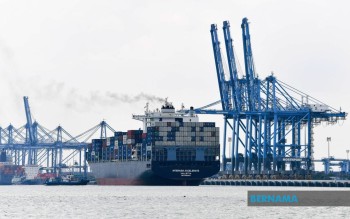
Malaysia's export trajectory has become considerably more promising, with leading investment banks revising their growth forecasts upward following stronger-than-expected trade performance in the first half of 2026. RHB Investment Bank Bhd has raised its export growth projection to 21.7 per cent for the full year, a substantial increase from its previous estimate of 15.3 per cent. This upgrade reflects the solid foundation laid by year-to-date exports that have expanded by 27.5 per cent, signalling that Malaysia's trade sector is firing on multiple cylinders as global economic conditions shift in the country's favour.
The revision carries particular significance for policymakers and investors tracking the Malaysian economy's resilience. The improved outlook is anchored in two key developments: the continuation of a powerful technology cycle globally and the outsized role that Malaysia's electrical and electronics sector is playing in capturing international demand. As companies worldwide accelerate investments in artificial intelligence infrastructure, semiconductor fabrication, cloud computing and data centre expansion, Malaysia's position as a critical node in the global supply chain for electronic components has never been more valuable. The sector's performance demonstrates how the country's decades-long focus on building manufacturing expertise in this domain continues to pay dividends.
A crucial indicator of export strength manifests in Malaysia's burgeoning trade surplus. In the second quarter of 2026, the trade surplus reached RM83.9 billion, a dramatic leap from RM15.3 billion recorded in the same quarter a year earlier. This expansion of the surplus—more than five times larger year-on-year—provides robust support to Malaysia's gross domestic product calculations and underscores the fundamental health of the external sector. Such a substantial surplus suggests not merely cyclical strength but rather a structural shift in the country's competitive positioning within regional and global markets.
MBSB Investment Bank Bhd has independently arrived at comparable conclusions, projecting 2026 export growth of 18.9 per cent, a significant acceleration from the 6.6 per cent growth recorded in 2025. Where RHB IB emphasizes the electrical and electronics boom, MBSB points to a broader diversification of demand sources. Beyond technology products, the investment bank identifies commodity-related exports—particularly petroleum products and liquefied natural gas—as contributing meaningfully to the growth picture. This dual-driver scenario suggests Malaysia is benefiting not from a single sectoral windfall but from multiple sources of external demand, reducing the risk profile of the export outlook.
The strength evident in recent months provides a foundation for these projections. June 2026 trade data released by the Department of Statistics Malaysia reveals that total trade expanded by 44.7 per cent to RM340.9 billion compared with the same month in 2025. Disaggregating this figure, exports climbed 45.4 per cent to RM177.9 billion while imports rose 43.9 per cent to RM163.0 billion. The simultaneous growth of imports alongside exports, rather than representing a deficit problem, actually indicates robust domestic economic activity and business investment, further validating the internal drivers supporting Malaysia's external performance.
Regional integration and supply chain positioning stand as foundational strengths supporting these optimistic projections. RHB IB notes that Malaysia's deep embeddedness within regional and global manufacturing networks, combined with its diversified economic structure, creates natural buffers against external shocks. Unlike economies dependent on narrow export bases, Malaysia has cultivated a portfolio of competitive advantages spanning semiconductors, refined petroleum products, palm oil derivatives, and an increasingly sophisticated services sector. This structural diversification means that weakness in any single market or product category can be offset by strength elsewhere.
Yet investment banks and analysts maintain appropriate caution regarding the downside scenarios that could derail these positive projections. Geopolitical tensions, should they intensify further, could disrupt supply chains and elevate production and transportation costs across manufacturing industries. Malaysia's export-oriented manufacturing sectors, precisely because they are deeply integrated into global supply chains, remain vulnerable to any disruption at critical nodes. A sustained escalation of tensions in key regions could trigger cost inflation that dampens competitiveness, particularly for price-sensitive products where Malaysia competes against other Southeast Asian manufacturers.
Oil price dynamics present another variable warrant monitoring with particular intensity. Elevated petroleum prices, while beneficial for Malaysia's energy exports, can impose hidden costs on the broader economy by increasing fuel and energy expenses for manufacturers and logistics operators. The balance between gains from higher energy export prices and losses from elevated input costs remains finely calibrated. Moreover, if elevated oil prices trigger global economic slowdown, the benefits to Malaysia's petroleum exports could be overwhelmed by weaker demand across all other export categories, creating a net negative effect.
Trade policy uncertainty, especially emanating from the United States, adds another layer of risk to the outlook. Both investment banks explicitly flag the possibility of tightened trade rules as a concern. With the United States representing a significant destination for Malaysian technology exports and given the strategic importance of semiconductors to American industry and national security concerns, any shift towards more restrictive trade measures could directly impact Malaysia's most dynamic export category. The potential for tariffs, local content requirements or export restrictions targeting semiconductor supplies represents a tail risk that could materially alter export trajectories.
Despite these cautions, analysts maintain constructively positive views on the electrical and electronics export sector specifically. The underpinnings of demand—artificial intelligence deployment, electric vehicle electrification, industrial automation adoption and the proliferation of data centre infrastructure—represent structural trends unlikely to reverse in the medium term. Even if global growth moderates somewhat, these technology-driven investments may prove more resilient than cyclical demand, supporting Malaysia's electronics exports even in less buoyant overall economic conditions.
The import growth projection also warrants attention for what it reveals about Malaysia's internal economic momentum. MBSB projects imports will expand by 13 per cent in 2026 compared with 6.0 per cent in 2025. This acceleration indicates that Malaysian businesses anticipate stronger domestic demand and are investing accordingly in capital equipment and inputs. Rising imports of machinery, raw materials and intermediate goods suggest confidence among private sector decision-makers about the trajectory of the economy over the coming quarters.
Looking across the broader Southeast Asian context, Malaysia's revised export growth forecast positions it favourably among regional peers. As other nations in the region grapple with various structural challenges—labour market tightness, infrastructure constraints or political uncertainties—Malaysia's access to sophisticated supply chain networks and its technical expertise in high-value manufacturing provide comparative advantages. The country's ability to capture growing global demand for semiconductors and electronics components, sectors in which several neighbouring countries have only nascent capabilities, creates a window of opportunity that could extend beyond 2026.
The significance of these upgraded forecasts extends beyond mere economic statistics. Export growth at these levels supports employment, generates foreign exchange earnings that strengthen the ringgit, expands corporate profitability and tax revenues, and creates multiplier effects throughout the domestic economy. For Malaysian policymakers, the challenge lies in maintaining the policy environment that enabled this performance—stable macroeconomic conditions, investment in skills development, infrastructure supporting logistics and supply chains, and regulatory frameworks that attract multinational manufacturers—while remaining vigilant to emerging risks that could disrupt the positive momentum.

