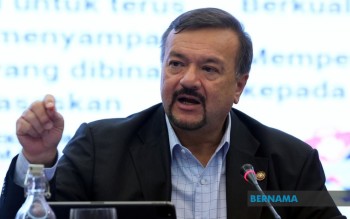
Malaysia's economic trajectory remains firmly upward despite the turbulent international environment, according to Finance Minister II Datuk Seri Amir Hamzah Azizan, who highlighted the country's consistent expansion across multiple consecutive reporting periods. Speaking at a GEAR-uP Progress Report press conference in Putrajaya on August 7, Amir Hamzah presented a series of economic figures demonstrating steady performance: gross domestic product expanded 5.2 per cent throughout 2024, maintained that growth rate into 2025, and then accelerated further with first-quarter 2025 figures showing 5.4 per cent expansion. The minister disclosed that preliminary second-quarter estimates for the current year stand at 5.8 per cent, bringing the year-to-date average to 5.6 per cent.
What distinguishes Malaysia's economic narrative is the context in which this growth has occurred. Global trade dynamics have been complicated by escalating tensions between major economic powers, while regional security concerns in West Asia have created additional uncertainty for businesses and investors worldwide. Yet Malaysia has managed to insulate itself from the worst effects of these external shocks, demonstrating that the policy framework underpinning the national economy provides sufficient stability and direction to attract investment and maintain consumer and business confidence. For Malaysian readers accustomed to hearing warnings about external economic headwinds, this sustained performance represents a significant achievement in economic management.
The finance minister attributed this resilience directly to the implementation of the MADANI Economy Framework, suggesting that the government's strategic approach to economic development is yielding tangible results across the economy. Rather than passive acceptance of external circumstances, Amir Hamzah characterised Malaysia's position as one of active management and forward momentum. The framework appears designed to reduce the economy's vulnerability to international shocks by strengthening domestic capabilities and fostering internal sources of growth. This represents a meaningful departure from models that depend heavily on external trade and foreign direct investment, though Malaysia clearly remains open to international capital flows.
Central to the government's economic strategy is the GEAR-uP programme, which the Finance Ministry has led since 2024. This initiative represents a deliberate commitment to channelling domestic investment into the economy through a structured, long-term approach. The programme encompasses RM120 billion in domestic direct investment scheduled across the 2024 to 2028 period, a substantial commitment that signals government determination to sustain economic momentum across multiple years regardless of short-term market fluctuations. The scale of this investment suggests that policymakers have identified specific sectors and industries where strategic capital infusion can generate multiplier effects throughout the broader economy.
A critical element of GEAR-up's implementation involves government-linked investment companies and government-linked companies, which function as vehicles for channelling capital while simultaneously supporting the development of domestic industries. According to Amir Hamzah, these entities serve multiple purposes beyond simply injecting funds into the economy. They help connect domestic enterprises with talent and expertise, facilitate knowledge transfer, and create conditions that attract additional private investment and foreign know-how to Malaysia. This multi-dimensional approach recognises that sustainable economic development requires more than capital availability; it demands the human resources, institutional capacity, and technical knowledge that transform financial inputs into productive economic capacity.
The minister articulated a sophisticated understanding of the relationship between capital availability and genuine economic development. While acknowledging that securing funds represents one dimension of growth, Amir Hamzah emphasised that approach and implementation matter equally. Without careful planning and solid strategic frameworks, he suggested, merely bringing money into the country produces limited benefits. The focus instead should rest on ensuring that invested capital generates tangible improvements in living standards, employment opportunities, and productive capacity across Malaysian society. This perspective resonates with Southeast Asian readers who have witnessed instances where large-scale investment produced limited trickle-down benefits for ordinary citizens.
The finance minister's confidence in Malaysia's trajectory toward developed-nation status reflects an assessment that current policies are working synergistically to address both immediate economic challenges and long-term structural development. The combination of stable macroeconomic fundamentals, strategic domestic investment, and a framework designed to harness both public and private capital suggests a government operating with clear intentionality about economic direction. For regional observers, Malaysia's performance offers a contrasting case study to economies struggling with either external vulnerability or domestic policy uncertainty.
The broader significance of these figures extends beyond Malaysia's borders. Southeast Asia faces similar pressures from global trade tensions and geopolitical uncertainty, yet Malaysia's demonstrated resilience offers a template worth examining. The emphasis on domestic investment and strategic government guidance through GLICs and GLCs reflects an approach that differs from purely market-driven models while avoiding the inefficiencies associated with heavy-handed state control. This middle path may prove instructive for other developing economies seeking to balance openness to international capital with protection of domestic interests.
Amir Hamzah expressed confidence that continued cooperation among stakeholders in realising the MADANI Economy agenda would enable Malaysia to achieve its long-term development aspirations. This language suggests that government officials view economic development not as something government accomplishes unilaterally, but rather as a collective endeavour requiring engagement from private sector participants, civil society, and ordinary Malaysians. The emphasis on cooperation reflects both political rhetoric and practical recognition that sustainable growth emerges from broad-based participation and buy-in across society.
Looking ahead, the trajectory outlined by the finance minister suggests Malaysia aims to maintain momentum toward developed-country status through the remainder of this decade. The acceleration in growth rates evident in the quarterly progression for 2025 suggests that GEAR-uP and related initiatives are gaining traction as implementation deepens and projects move from planning phases into active deployment. Whether Malaysia can sustain these growth rates while managing inflation, maintaining financial stability, and ensuring equitable distribution of benefits across society will determine whether current optimism reflects genuine progress or merely a temporary cyclical upturn masking deeper vulnerabilities.

