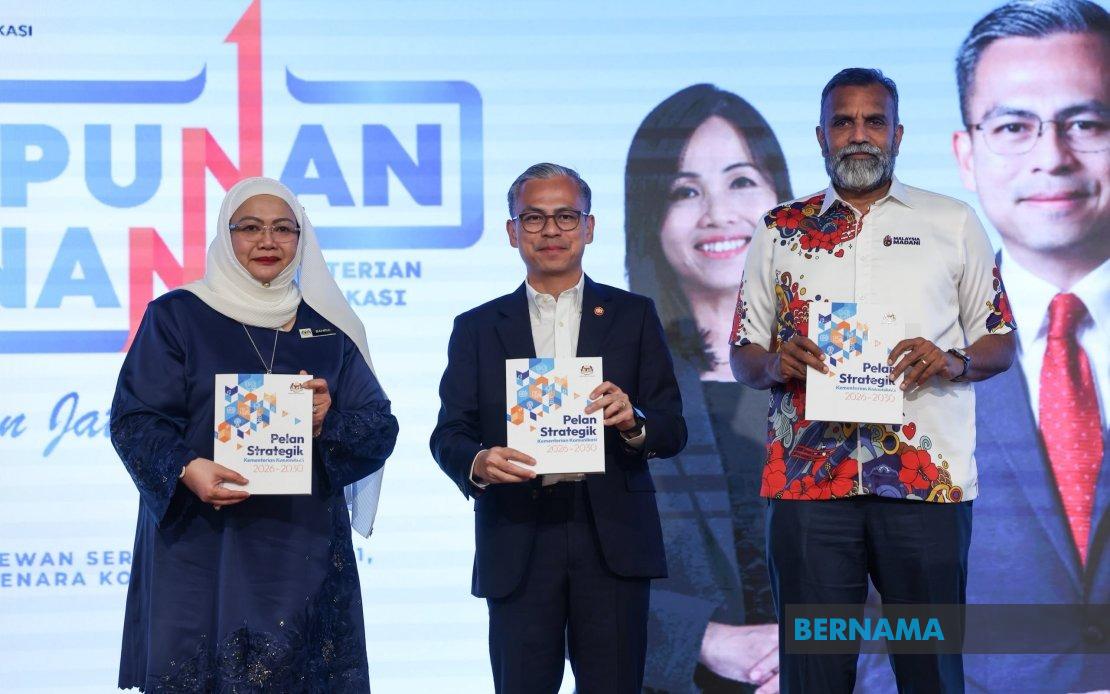
Malaysia's Communications Ministry has set ambitious targets for the next five years with the unveiling of its Strategic Plan 2026-2030, a comprehensive roadmap that positions digital connectivity, creative excellence, and information integrity as the cornerstones of national development. Announced by Communications Minister Datuk Seri Fahmi Fadzil in Putrajaya on July 20, this initiative represents a coordinated effort to operationalise the aspirations embedded in both the 13th Malaysia Plan and the Malaysia MADANI agenda, establishing concrete mechanisms through which ministry departments and statutory bodies will execute their mandates.
The strategic framework crystallises the ministry's ambitions around three foundational priorities that reflect Malaysia's digital-age challenges and opportunities. Enhanced internet infrastructure stands as the first pillar, recognising that connectivity disparities—particularly between urban centres and rural communities—continue to constrain economic participation and social inclusion. The second priority emphasises expanding the quantity and quality of creative content produced domestically, positioning Malaysian creators to compete in regional and global markets. The third addresses the persistent challenge of information authenticity in an era of misinformation, seeking to establish authoritative channels and narratives that serve public understanding.
These three priorities translate into the strategic plan's overarching vision of establishing 'A Connected, Informed and Creative Malaysia', a formulation that acknowledges the interdependence between technological infrastructure, cultural production, and social trust. Rather than operating in silos, these dimensions are conceived as mutually reinforcing—robust connectivity enables creators to reach wider audiences, while authoritative information ecosystems strengthen public confidence in digital platforms and services. This holistic approach represents a maturation in how Malaysia's communications policy integrates economic, social, and governance objectives.
The strategic plan operationalises this vision through four distinct strategic thrusts, each targeting specific institutional and market failures. The first thrust concentrates on upgrading the national communications ecosystem to deliver connectivity that is simultaneously inclusive, high-quality and secure—addressing the reality that mere infrastructure deployment, without attention to affordability, service standards and cybersecurity, leaves populations vulnerable and excluded. The second thrust pivots toward competitive advantage in creative industries, specifically targeting film and music sectors where Malaysia possesses existing talent pools and production capabilities that remain underexploited relative to regional competitors like Thailand and Indonesia.
The third strategic thrust tackles the fragmentation that characterises Malaysia's information landscape, where government messaging, media outlets, and digital platforms often operate disconnectedly, creating confusion among citizens navigating public services or civic participation. By promoting integrated information delivery, the ministry aims to create coherent narratives and accessible guidance across touchpoints. The fourth thrust recognises that even well-designed policies fail without responsive implementation, mandating service delivery reforms that prioritise customer experience and align operational practices with stated government priorities.
To operationalise these four thrusts, the strategic plan encompasses 94 specific programmes spanning the five-year horizon. This granular decomposition—from broad strategic directions to discrete, measurable initiatives—provides the Communications Ministry and its subordinate agencies with implementable benchmarks against which progress can be assessed. Minister Fahmi noted that many of these programmes are already in motion, suggesting that the strategic plan formalises and accelerates work already underway rather than representing entirely new commitments.
For Malaysian readers and businesses, the strategic plan's emphasis on internet access holds particular relevance. Persistent connectivity gaps have limited Malaysia's digital economy participation rates relative to peers, disadvantaging rural entrepreneurs, students and workers. By prioritising inclusive, high-quality connectivity, the ministry signals commitment to narrowing these divides, potentially unlocking economic activity in underserved regions and enhancing competitive positioning in sectors like e-commerce and digital services.
The plan's focus on creative industries addresses a recognised gap in Malaysia's economic diversification strategy. While Singapore has developed world-class media and entertainment ecosystems, and Thailand has leveraged cultural industries for tourism and export revenue, Malaysia's local film and music sectors have historically struggled with underinvestment and brain drain. By designating these sectors as strategic priorities and embedding specific initiatives within the broader communications framework, the ministry creates potential for cluster development and talent retention.
The emphasis on information authenticity and integrated delivery reflects Malaysia's experience with misinformation challenges, particularly during election periods and public health crises. By positioning authoritative information dissemination as a core ministry function rather than peripheral activity, the strategic plan acknowledges that governance legitimacy increasingly depends on citizens' confidence in public communication channels. This approach aligns with international best practices in government communications while respecting Malaysia's particular vulnerabilities to coordinated disinformation campaigns.
Regionally, Malaysia's communications strategy carries implications for Southeast Asian digital governance. As countries across the region grapple with balancing connectivity expansion with content quality and information security, Malaysia's experience implementing this five-year plan will offer instructive lessons. The integration of economic development (through creative industries), infrastructure (through connectivity), and governance (through information authenticity) objectives may serve as a model for other ASEAN members navigating similar policy challenges.
Implementation success will depend on inter-ministerial coordination, adequate resource allocation, and sustained political support across electoral cycles. Previous strategic initiatives have sometimes faltered when institutional silos prevented coordinated action or when budget priorities shifted. The Communications Ministry's willingness to articulate clear, measurable priorities suggests recognition of these implementation challenges.
The strategic plan also implies evolving expectations for regulatory bodies operating under the ministry's purview, including the Malaysian Communications and Multimedia Authority (MCMC) and the National Film Development Corporation. These agencies will need to align enforcement activities, licensing decisions, and strategic investments with the broader ministry agenda, requiring clarification of priorities where existing mandates may appear contradictory.
As Malaysia advances toward 2030, the Communications Ministry Strategic Plan 2026-2030 represents a deliberate effort to position communications infrastructure, content industries, and information systems as central pillars of national development. The plan's articulation of clear priorities and comprehensive programme architecture provides stakeholders—from telecommunications companies to independent creators to government agencies—with visibility into the ministry's direction and opportunities for aligned action. Success in executing this roadmap could meaningfully enhance Malaysia's digital competitiveness while strengthening democratic governance through more authentic, accessible information flows.

