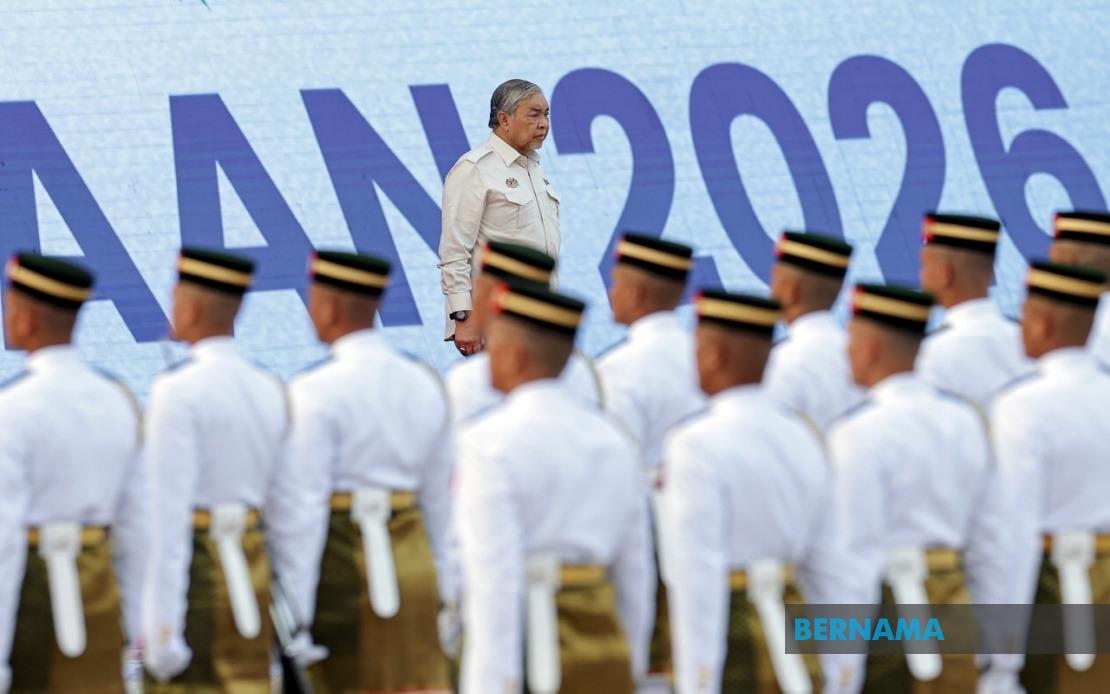
Malaysia's 2026 National Day observance at Dataran Putrajaya has emerged as a defining moment of national unity, with Deputy Prime Minister Datuk Seri Dr Ahmad Zahid Hamidi characterising the event as a watershed demonstration of collective patriotism. Speaking to journalists following the colourful proceedings on August 31, Ahmad Zahid underscored the significance of what unfolded across the capital's ceremonial grounds, noting marked improvements in both scale and public engagement compared with celebrations from previous years. His remarks carried particular weight given the symbolic importance of annual Independence Day observances in maintaining Malaysia's social cohesion and national identity.
The magnitude of public participation proved striking, with more than 100,000 people converging on Dataran Putrajaya from dawn to witness the National Day parade and accompanying festivities. This substantial turnout—coupled with the participation of 10,819 individuals organised into 76 distinct contingents and 22 marching bands—painted a picture of a nation mobilised around shared civic purposes. The sheer numbers involved represented a logistical undertaking of considerable complexity, requiring coordination across multiple government agencies, civic organisations, and community groups. For Malaysian observers, such demonstrations of coordinated national celebration serve as periodic reminders of the country's multiethnic character and the mechanisms through which diverse populations affirm common belonging.
The 2026 celebration carried thematic resonance deliberately woven into its ceremonial fabric. Titled "Malaysia MADANI: Kesejahteraan Dinikmati"—translating to a vision of shared prosperity under the Malaysia MADANI framework—the event articulated contemporary government messaging around inclusive development and national wellbeing. This thematic anchoring connected the festivities to broader policy directions currently being pursued, embedding the celebration within ongoing narratives about Malaysia's trajectory. For the government, such linkages between ceremonial moments and policy frameworks represent opportunities to reinforce messaging about national direction to both domestic and international audiences.
The presence of Malaysia's highest constitutional officials lent ceremonial weight to proceedings. His Majesty Sultan Ibrahim and Her Majesty Raja Zarith Sofiah, reigning as Malaysia's King and Queen, graced the celebration with their attendance, fulfilling the ceremonial and symbolic roles expected of the constitutional monarchy. Prime Minister Datuk Seri Anwar Ibrahim and assembled Cabinet ministers similarly participated in the formal proceedings, ensuring executive branch representation at the apex of national commemoration. Such hierarchical participation in formal state occasions reinforces institutional frameworks and demonstrates governmental commitment to national observances.
Ahmad Zahid's personal engagement with assembled crowds throughout the morning underscored a deliberate political strategy of proximity and accessibility. Rather than confining himself to formal platforms or dignitaries' viewing areas, the Deputy Prime Minister moved through throngs of citizens gathered since early hours, creating opportunities for direct interaction and informal political theatre. Such moments, captured by media and observed by assembled crowds, serve multiple functions: they humanise political leadership, create photo opportunities for news dissemination, and signal administrative engagement with popular sentiment. For Malaysian political operatives, these carefully choreographed instances of spontaneous connection represent essential components of democratic performativity.
The characterisation of patriotic sentiment as "growing" carries implications extending beyond mere celebration rhetoric. Ahmad Zahid's assessment suggests a reading of Malaysian public mood in which national consciousness is intensifying, citizenship affiliation deepening, and communal pride strengthening. Whether such subjective impressions reflect measurable shifts in underlying attitudes remains difficult to establish independently, yet such statements from senior officials articulate how government perceives and seeks to frame national sentiment. The invocation of "Alhamdulillah"—a religious expression of gratitude common in Muslim-majority Malaysian discourse—also embedded the observance within spiritual and cultural frameworks familiar to the nation's majority population.
The logistical scale of the 2026 celebration raises questions about resource allocation and planning priorities. Organising an event attracting over 100,000 participants requires extensive advance preparation, security arrangements, traffic management, and coordination among diverse institutional actors. Such events represent significant public investment, warranting consideration of opportunity costs and whether alternative applications of such resources might generate different social benefits. For Malaysian observers concerned with public expenditure scrutiny, understanding how National Day budgets are constructed and justified remains an ongoing governance question.
The comparative framing—suggesting 2026 surpassed previous years—introduces a competitive temporal dimension to national celebrations. If each successive Independence Day observance is measured against predecessors and judged on relative magnificence, this dynamic potentially creates pressures toward escalating scale and elaborate ceremonialism. For administrations seeking to demonstrate forward momentum and improving governance, presenting each National Day as superior to the last becomes rhetorically advantageous. However, such competitive framing also suggests that patriotic sentiment itself becomes quantifiable through attendance figures and parade magnificence, potentially reducing deeper forms of national consciousness to visible metrics.
The broader Southeast Asian context provides relevant perspective. Across the region, National Day celebrations operate as crucial moments for state legitimacy reinforcement, particularly in plural societies managing significant ethnic, religious, or linguistic diversity. Malaysia's challenge of binding together Malay-Muslim, Chinese, Indian, and indigenous communities around shared national symbols remains ongoing and contentious. That Ahmad Zahid characterised the 2026 observance as reflecting national cohesion suggests official satisfaction with how patriotic sentiment functioned as a unifying mechanism, at least in ceremonial contexts. Whether such unity extends into everyday political discourse and policy prioritisation remains a more complex question requiring sustained examination beyond annual rituals.
Looking forward, the 2026 National Day celebration's apparent success establishes a benchmark against which future observances will likely be measured. Future administrations will face implicit pressure to maintain or exceed this year's attendance figures, parade participation, and demonstrated patriotic fervour. This dynamic reflects how state ceremonies function within competitive political environments—serving not merely as remembrance of national origins but as contemporary demonstrations of governmental efficacy and popular support. For Malaysian citizens and observers, understanding these multiple dimensions of National Day observances—ritual, political, symbolic, and material—enriches comprehension of how modern nations construct and perform collective identity, particularly in contexts characterised by underlying diversity and periodic tensions around national belonging.

