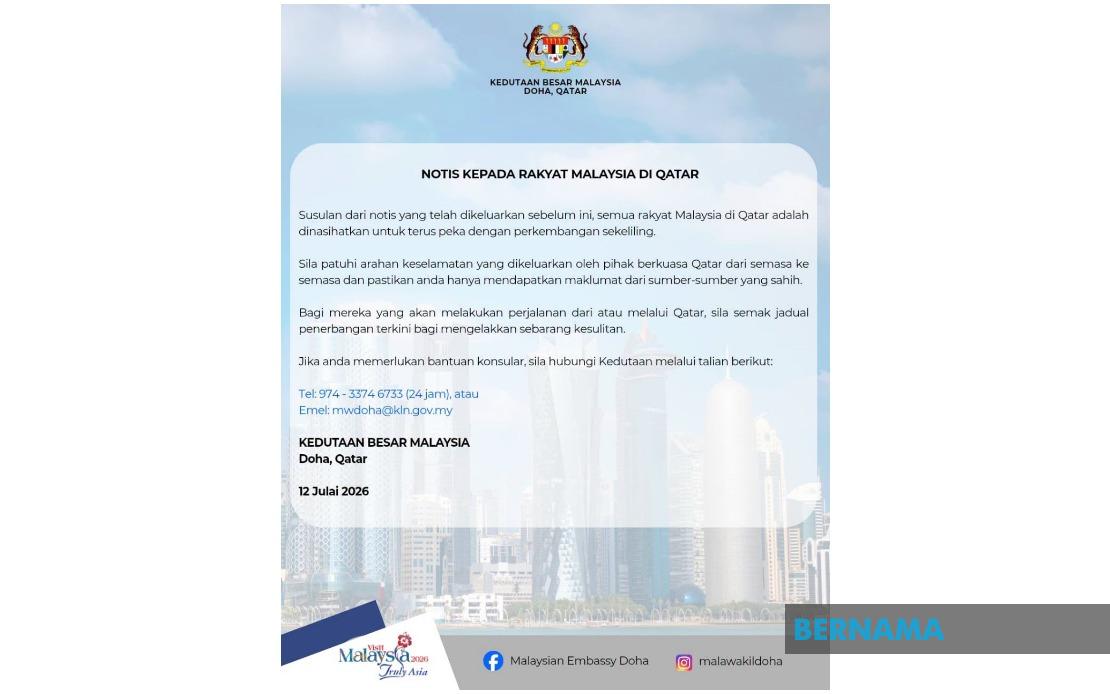
The Malaysian Embassy in Qatar has issued an urgent advisory for all Malaysian citizens residing in or transiting through the Gulf state, directing them to strictly observe security protocols established by Qatari officials. The warning comes amid a sharp deterioration in regional stability following renewed military exchanges between Washington and Tehran over critical shipping lanes that underpin global trade.
In a statement distributed through its official social media channels, the embassy has instructed Malaysians to maintain heightened awareness of their surroundings and remain vigilant about developments unfolding in the region. The directive emphasises the importance of obtaining information exclusively from official and credible sources, as misinformation during security crises can amplify confusion and inadvertently put civilians at greater risk. The embassy has also recommended that those planning to depart Qatar or transit through the country should monitor airline schedules closely, as regional instability often triggers flight cancellations and route modifications that can disrupt travel plans without warning.
For Malaysians requiring immediate assistance or facing emergencies, the embassy has activated its round-the-clock support line available at +974-3374 6733, with additional contact options through email channels. This accessibility marks a standard diplomatic response to regional security incidents, ensuring that Malaysian nationals have direct pathways to consular support regardless of the time of day.
The advisory follows a dramatic escalation in hostilities this past Sunday, when the United States military executed its third major strike operation against Iranian targets within a single week. The strikes were triggered by Iranian military action against commercial vessels navigating the Strait of Hormuz, one of the world's most strategically vital waterways through which roughly one-third of global maritime trade passes annually. The Iranian Islamic Revolutionary Guard Corps navy responded by announcing an indefinite closure of the strait, effectively blocking all international shipping until it determines that American involvement in regional affairs has ceased.
This closure announcement represents an unprecedented escalation with potentially catastrophic implications for global energy markets and supply chains. The Strait of Hormuz serves as the primary export route for crude oil and liquefied natural gas from Gulf producers, meaning that even temporary disruptions can send shockwaves through international energy pricing and destabilise economies far from the Middle East. For Malaysia, a significant importer of energy resources and a nation dependent on open maritime trade routes, such disruptions carry direct economic consequences that could ripple through domestic fuel prices and shipping costs.
The current crisis follows a surprising diplomatic breakthrough in June, when Tehran and Washington agreed to a Pakistan-mediated memorandum of understanding that was intended to conclude the military conflict that erupted in late February. That agreement explicitly outlined provisions for an immediate cessation of hostilities across all operational fronts, a withdrawal of American naval blockades surrounding Iran, and crucially, the restoration of unobstructed passage through the Strait of Hormuz. The accord appeared to signal a potential de-escalation pathway that could have stabilised the region and restored predictability to international shipping.
However, the durability of that agreement has proven fragile. Despite the two nations having committed to the terms just weeks earlier, disagreements over commercial traffic permissions through the Strait of Hormuz have reignited hostilities and shattered the brief period of relative calm. The resumption of military strikes by both sides demonstrates how fragile agreements can become when underlying tensions and mutual distrust remain unresolved, and when enforcement mechanisms lack sufficient teeth to compel compliance.
The implications for Southeast Asia and Malaysia specifically merit serious consideration. Beyond the immediate concerns for Malaysian citizens in Qatar, the broader regional instability threatens to disrupt the maritime shipping lanes that form the economic lifeline of Southeast Asian trade. Many Malaysian businesses rely on uninterrupted passage through Middle Eastern waters to reach European and African markets, while domestic energy security depends on consistent oil and gas imports from Gulf suppliers. Any prolonged closure of the Strait of Hormuz would impose significant costs on the Malaysian economy through elevated fuel prices, delayed shipments, and increased insurance premiums for vessels transiting contested waters.
The Malaysian government's response through the embassy reflects standard diplomatic protocol during periods of regional instability, prioritising the safety and welfare of its citizens abroad while avoiding public commentary that might inflame an already tense situation. However, the situation also underscores Malaysia's vulnerability to distant geopolitical crises over which it exercises minimal influence. As a trading nation dependent on open seas and stable international relations, Malaysia has a vested interest in the restoration of durable peace between the United States and Iran, and in the establishment of mechanisms that can enforce maritime security agreements more effectively than current arrangements have proven capable of doing.
The trajectory of US-Iran tensions will likely dominate regional security discussions in coming weeks, with ripple effects extending far beyond the immediate participants. Malaysian policymakers, business leaders, and citizens should remain attentive to developments while following the practical guidance provided by their diplomatic mission in Doha.

