Coronary artery disease remains one of the leading causes of death globally, and Malaysia is no exception to this burden. The disease develops when fatty deposits, cholesterol, calcium and cellular debris accumulate on artery walls, gradually restricting blood flow to the heart muscle. This progressive narrowing can eventually trigger a heart attack, stroke or heart failure if left untreated. Managing this condition requires a multifaceted approach combining lifestyle modifications, pharmaceutical interventions and, in many cases, invasive procedures to restore blood circulation.
The challenge of treating atherosclerosis has evolved significantly as medical science advances. For patients with soft plaque deposits, interventional cardiologists have long employed percutaneous coronary intervention, a procedure that uses a balloon to compress the blockage and then deploys a metal stent to maintain the newly opened passage. However, this conventional approach encounters substantial difficulties when dealing with severely calcified arteries, where the plaque has hardened into a rock-like consistency. In these cases, the balloon cannot adequately compress the calcium, and stents may fail to expand properly, compromising long-term outcomes and increasing the risk of restenosis, where the artery narrows again.
To address this limitation, interventional cardiologists have adopted more sophisticated techniques including rotational atherectomy and high-pressure balloon angioplasty. Among these newer approaches, intravascular lithotripsy has emerged as a promising option. This minimally invasive catheter-based procedure generates sonic pressure waves that fracture calcified plaque, theoretically allowing blood vessels to expand more freely. According to Datuk Dr Tamil Selvan Muthusamy, a consultant cardiologist who leads research into these techniques, the concept is elegant in principle but encounters practical constraints in clinical application.
The conventional intravascular lithotripsy systems rely on an external energy generator to produce ultrasound pulses transmitted through a catheter to the blocked artery. One significant limitation is the number of pulses available—earlier devices offered only eight pulses to break up calcification, whilst newer iterations provide twelve. This finite resource means clinicians must carefully calculate their approach, as each pulse represents a discrete attempt to crack the calcium. Beyond the technical restrictions of pulse limitations, the device itself presents physical challenges. Its relatively bulky catheter design complicates insertion through narrowed vessels, particularly when the residual lumen is minimal. Furthermore, conventional lithotripsy devices come in fixed sizes, creating a mismatch with the natural tapering of coronary arteries, which vary in diameter along their length.
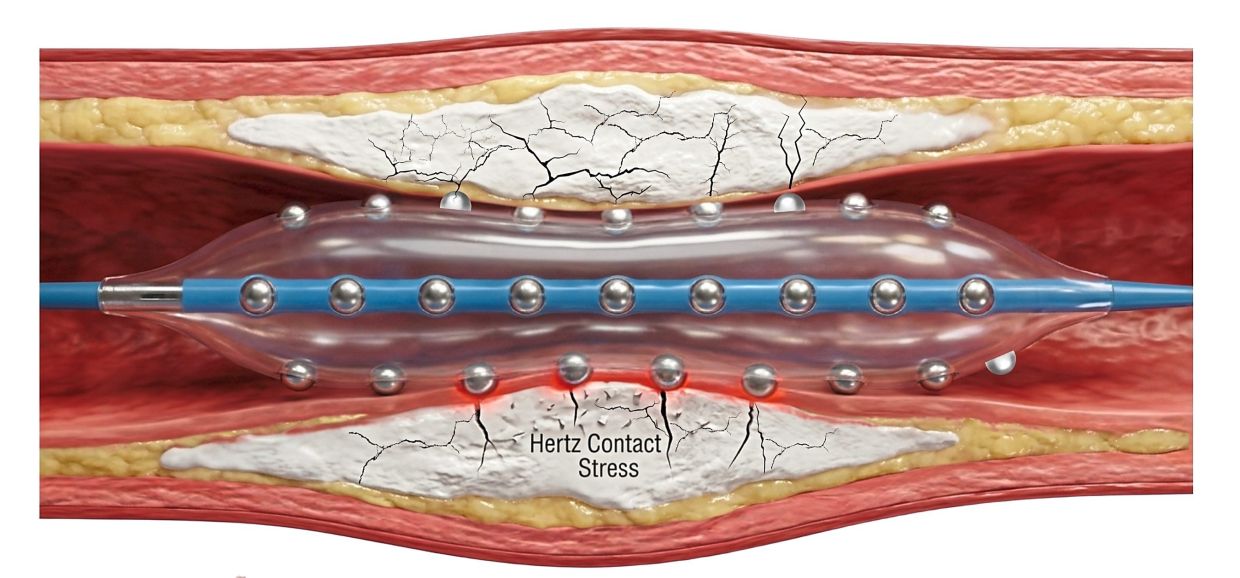
Recognizing these shortcomings, a team of Malaysian cardiologists spearheaded by Dr Tamil Selvan began investigating a novel iteration called the Hertz Contact-IVL System in 2025. This mechanical innovation represents a departure from energy-based approaches. Rather than relying on external sonic generators, the HC-IVL employs a balloon integrated with tiny metallic hemispheres that amplify pressure when they contact calcified surfaces. When the balloon is inflated against hardened plaque, the stainless steel hemispheres create focal pressure points that multiply and concentrate force, effectively shattering calcium deposits whilst minimizing collateral damage to surrounding vessel tissue. This mechanical principle allows deeper and wider fracturing of dense plaques without the constraints of a limited pulse count.
The practical advantages of this mechanical approach extend beyond mere calcium fracture. Dr Tamil Selvan explains that the HC-IVL catheter design offers substantially improved deliverability through tortuous and narrowed vessels. Because the device navigates through arterial passages with greater ease, a single balloon can address multiple blockages or lengthy lesions that might otherwise require repeated interventions with conventional lithotripsy. This translates into shorter procedure times, reduced radiation exposure from fluoroscopy, and potentially lower complication rates. The ability to treat extensive disease with one device represents a meaningful clinical improvement that resonates with practical considerations in busy interventional laboratories.
The decision by Dr Tamil Selvan's team to undertake a larger, locally-conducted study reflects a strategic assessment of the evidence landscape. Whilst the device developers had conducted preliminary trials across multiple centers in the United States, these investigations remained relatively small in scale and scattered across different institutions. Malaysian cardiologists recognized an opportunity to generate more robust safety and efficacy data through a comprehensive local trial. This approach serves dual purposes: it contributes to the global evidence base whilst providing Southeast Asian clinicians with data specifically relevant to patient populations in this region, potentially revealing differences in vascular anatomy, calcification patterns or comorbidities compared to Western cohorts.
The implications of this research extend well beyond the immediate patient population requiring intervention for calcified coronary disease. As the region's population ages and lifestyle-related risk factors for coronary atherosclerosis become increasingly prevalent, the burden of complex, heavily calcified lesions will likely grow. Malaysian cardiologists are positioning themselves at the forefront of addressing this public health challenge by investigating cutting-edge solutions tailored to regional needs. Success with the HC-IVL system could establish Malaysia as a hub for interventional cardiology innovation within Southeast Asia, enhancing the country's capacity to manage advanced coronary disease and potentially attracting regional referrals.
From a broader healthcare perspective, the development and refinement of techniques to treat severe coronary calcification addresses a critical unmet clinical need. Patients with calcified disease often face limited options and higher procedural failure rates, potentially leading to more invasive surgical interventions such as coronary artery bypass grafting. Improving percutaneous options could spare some patients the morbidity and recovery time associated with open-heart surgery. Moreover, for elderly patients or those with significant comorbidities, avoiding surgery altogether carries substantial quality-of-life and safety benefits. The HC-IVL system's mechanical design, combined with its improved deliverability and flexibility, may allow interventional cardiologists to expand their therapeutic reach to previously challenging cases.
The Malaysian research team's commitment to rigorous evaluation of this technology underscores the importance of local clinical investigation in advancing medical practice. Rather than simply adopting innovations developed elsewhere, Malaysian cardiologists are critically evaluating new tools within their own healthcare context. This approach builds local expertise, generates relevant evidence for regional decision-making, and contributes to the global medical literature. As cardiovascular disease continues to exact a heavy toll on health systems across Southeast Asia, initiatives like this study represent meaningful steps toward improving outcomes for patients with complex coronary disease.

