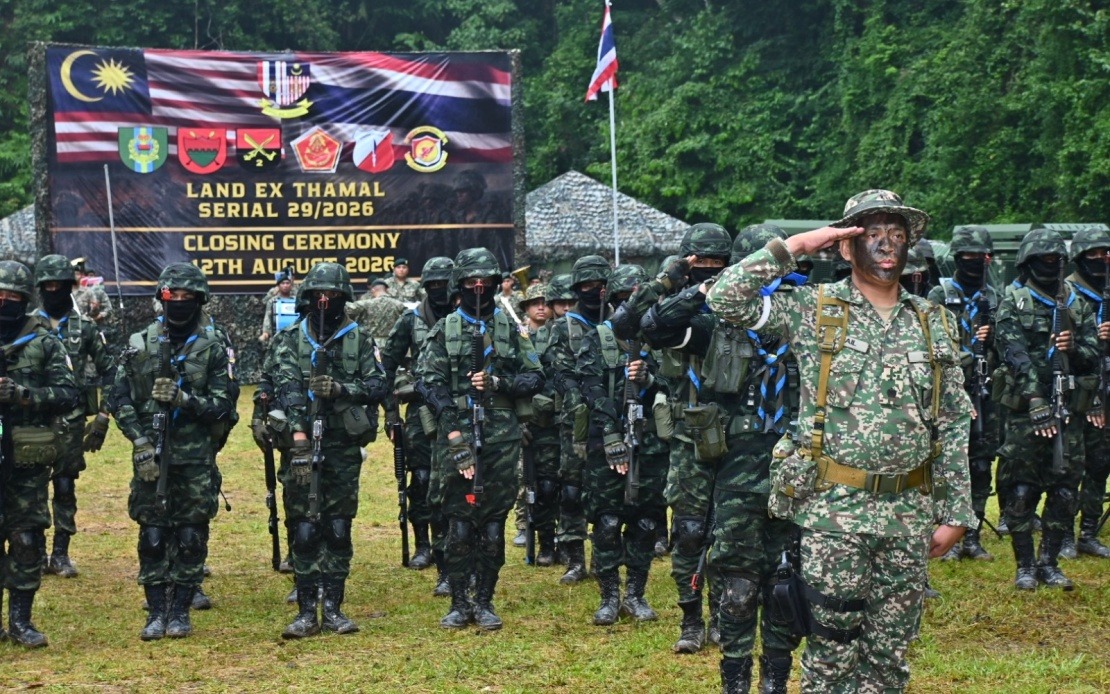
A combined contingent of 252 military personnel from Malaysia and Thailand is undergoing intensive tactical training through Exercise LAND THAMAL Series 29/2026, which commenced in the Perak town of Gerik on August 5. The participation of 197 Malaysian Army (TDM) soldiers alongside 55 Royal Thai Army (RTA) personnel reflects the deepening defence cooperation between Southeast Asia's two major land-focused military forces, addressing the growing importance of joint operational readiness in an increasingly complex regional environment.
The exercise represents far more than routine training. According to the Headquarters of the 2nd Malaysian Infantry Division, the operation is structured across three distinct phases designed to build systematic capability and foster genuine working relationships. The Cross Training Exercise (CTX) provides foundational knowledge exchange, while the Field Training Exercise (FTX) exposes troops to realistic combat scenarios including obstacle negotiation, base establishment, patrol tactics, and coordinated assault operations. The third component, Combined Military Civil Action (CMCA), extends the exercise's scope beyond purely military domains into civil-military cooperation, demonstrating how armed forces can respond to broader societal challenges.
The tactical curriculum employed during the FTX phase encompasses the full spectrum of infantry operations. Personnel from both nations are being trained side-by-side in combat procedures, river and terrain obstacle crossing, forward operating base construction and management, tactical patrolling in varied terrain, ambush execution and counter-ambush procedures, and coordinated attacks on simulated enemy positions. This comprehensive approach ensures that soldiers develop not just technical proficiency but also understanding of how their counterparts approach identical challenges, creating a foundation for genuine interoperability during actual operations.
Beyond the mechanical aspects of military training, the exercise emphasises knowledge exchange and capability development through organic sharing of tactical insights. Thai and Malaysian commanders and troops are systematically comparing operational methodologies, learning how each nation's training systems produce different but complementary approaches to common problems. This intellectual dimension of the exercise is crucial; effective joint operations depend not merely on common equipment or procedures, but on mutual comprehension of how allied forces think and act under pressure. The exercise creates space for this understanding to develop naturally through extended working relationships rather than theoretical discussion alone.
The official launch ceremony on August 5 at Gerik Airstrip was jointly conducted by Brigadier General Datuk Mohd Zaini Hashim, Commander of the 30th Malaysian Infantry Brigade, and Senior Colonel Taweeporn Kanatong, Commander of Thailand's 5th Infantry Brigade. This ceremonial equality—with both nations' senior representatives sharing officiating duties—underscores that the exercise represents a genuine partnership rather than a larger force training a smaller one or a senior power mentoring a junior partner. Taweeporn's remarks at the ceremony contextualised LAND THAMAL within broader security concerns affecting the region, emphasising that the exercise serves multiple purposes beyond traditional battlefield skills.
Thailand's 5th Infantry Brigade commander stressed that LAND THAMAL strengthens bilateral relations while simultaneously enhancing both nations' capacity to address diverse contemporary challenges. He explicitly referenced natural disasters, security threats, internal conflicts, and broader regional security issues—a notably expansive definition that reflects how modern military cooperation encompasses far more than traditional interstate defence. The exercise becomes, in this framing, preparation for the complex security landscape that Southeast Asia actually faces: humanitarian crises, transnational criminal activity, terrorism, and regional tensions that require coordinated military responses within a broader international framework.
The success of this 29th iteration of LAND THAMAL demonstrates the durability and institutionalisation of Malaysia-Thailand defence cooperation. These exercises have become routine enough that their occurrence barely registers in either nation's domestic politics, yet they remain significant in maintaining military relationships that transcend political fluctuations. The 2nd Malaysian Infantry Division's statement notes that LAND THAMAL reflects the strong professional relationship between TDM and RTA, suggesting that the bonds developed through repeated joint exercises have become embedded in institutional culture rather than dependent on individual personalities or political goodwill.
The exercise yields tangible operational benefits beyond the immediate training value. Joint exercises measurably improve interoperability—the ability of different military forces to work seamlessly together—which remains a significant challenge even among allied nations. They provide genuine opportunities for personnel from different countries to build trust through extended contact and shared challenges. They allow military organisations to evaluate and potentially adjust their operational concepts based on observing how allies approach similar problems. Most critically, they create personal relationships among military personnel across borders, relationships that prove invaluable when actual crises emerge and rapid coordination becomes essential.
The inclusion of the Jiwa Murni Programme, which integrates civil-military action into the exercise framework, demonstrates the sophistication of modern joint training. By conducting community activities at Sekolah Menengah Kebangsaan Sultan Idris Shah II in Gerik, both militaries demonstrate their commitment to civil society engagement and the principle that military institutions serve broader national development objectives. This civilianisation of the exercise—allowing civilian populations to interact with foreign military personnel and appreciate their positive contributions—builds public understanding of defence cooperation and counters potential misperceptions about military activity in border regions.
For Malaysia and Thailand specifically, military cooperation carries particular significance given their shared border and the complex mix of strategic interests, cultural ties, and occasional tensions that characterise their relationship. Border security remains a persistent concern for both nations, with challenges ranging from smuggling and human trafficking to occasional localized conflicts. Exercise LAND THAMAL contributes to managing these challenges through enhanced border-area coordination, improved crisis response capabilities, and the practical development of joint operational procedures. The Gerik location—situated in Perak near the Thai border—was deliberately chosen to enhance this geographic relevance and make the exercise's benefits directly applicable to actual border management challenges.
Regionally, these bilateral exercises acquire additional importance within the broader context of Southeast Asian security architecture. ASEAN's emphasis on non-interference and consensus-based decision-making limits collective military operations, making bilateral and smaller multilateral exercises the primary vehicle for developing shared military capabilities. Malaysia-Thailand defence cooperation, conducted through institutionalised exercises like LAND THAMAL, demonstrates that substantive military cooperation can flourish without infringing on national sovereignty or violating ASEAN principles. The exercise model has proven sufficiently successful that both nations are likely to continue expanding and deepening it, potentially exploring additional joint training initiatives in different environments and addressing different operational challenges.
As Exercise LAND THAMAL Series 29/2026 concludes its operations in Gerik, the 2nd Malaysian Infantry Division's statement indicates that this exercise will remain a permanent feature of the Malaysia-Thailand defence relationship. This commitment to continuity is itself significant; militaries value predictability and long-term planning, and the institutionalisation of LAND THAMAL as an annual or regular event ensures that the development of joint capabilities remains a continuous process rather than an ad-hoc occurrence. The exercise thus becomes far more than a single training event; it represents an enduring commitment to deepening the professional and operational bonds between two neighbouring nations' armed forces.

