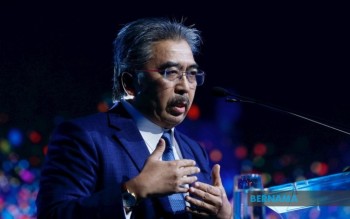
The Malaysian government remains committed to developing comprehensive electric vehicle infrastructure but faces mounting pressure to establish a sustainable funding model that avoids placing an undue burden on consumers. During parliamentary proceedings, Investment, Trade and Industry Minister Datuk Seri Johari Abdul Ghani outlined the administration's approach to financing a nationwide EV charging network, emphasizing that no final decision has been made on imposing a dedicated levy despite ongoing deliberations about the most effective mechanism.
The core challenge confronting policymakers involves reconciling multiple competing priorities: the need to expand charging infrastructure to support Malaysia's EV transition, the government's constrained fiscal position as it operates under a budget deficit, and widespread public sensitivity regarding any new taxation or fees. Johari acknowledged during his remarks at the RHB Bank conference that funding constraints have forced the government to reconsider how charging infrastructure development can be financed without indefinitely extending state subsidies across the electricity and transport sectors.
If the government decides to implement a levy structure, officials are considering whether to apply charges directly at the manufacturing stage, on individual vehicle purchases, or through some hybrid mechanism. The minister stressed that the location of any levy within the supply chain matters critically because manufacturers will naturally transmit costs downstream to consumers if they bear the initial burden. This economic reality constrains the apparent choices available to policymakers seeking to shield ordinary Malaysians from price increases while still securing revenue for infrastructure investment.
Malaysia's energy infrastructure landscape shapes the broader context for this discussion in ways that distinguish the country from global EV leaders. The electricity generation system remains significantly dependent on fossil fuels including natural gas and coal, meaning that the environmental and economic benefits of vehicle electrification cannot be calculated in isolation from the power sector's composition. As EV adoption accelerates, the demands placed on Malaysia's grid will intensify, potentially requiring substantial additional investment in generation capacity and distribution networks before the full advantages of vehicle electrification can be realized.
The minister emphasized that policymakers must maintain realistic expectations about Malaysia's ability to replicate the charging infrastructure achievements seen in countries like China, where government coordination and investment reach scales unattainable within Malaysia's current budgetary framework. This pragmatic acknowledgement shapes the discussion around what funding mechanisms are actually feasible rather than what might theoretically represent ideal policy. The gap between aspirational EV targets and available resources forces difficult choices about prioritization and sequencing.
One specific option under consideration involves establishing a dedicated fund fed by modest levies collected on each electric vehicle sold, creating a sustainable revenue stream explicitly designated for public charging station development. This approach would tie infrastructure funding directly to EV adoption rates, ensuring that charging network expansion proceeds in proportion to the growing number of vehicles requiring access to these facilities. Such a structure could theoretically prove more equitable than general taxation mechanisms that would spread costs across the entire population including those unlikely to benefit from EV infrastructure.
However, implementing any levy structure carries political and economic risks that extend beyond immediate consumer reaction. Higher purchase prices for electric vehicles could slow adoption rates precisely when government policy aims to accelerate the transition away from internal combustion engines. Malaysia currently lacks the charging density that might encourage hesitant consumers to overcome range anxiety, creating a chicken-and-egg problem where infrastructure development requires revenue that can only be generated through vehicle sales that might themselves be dampened by higher prices.
The minister's broader point about understanding interconnected policy challenges appears directed at constituents and observers who sometimes view automotive policy in isolation from electricity supply considerations, fiscal realities, and energy system constraints. Johari suggested that critics of potential levy mechanisms often focus on single policy dimensions without grasping how various government priorities interact and constrain one another. Building charging infrastructure requires not only capital investment but also understanding how power system reliability, electricity pricing, and grid capacity improvements all factor into successful EV ecosystem development.
For Southeast Asian observers, Malaysia's deliberation offers insights into how mid-income countries approach the EV transition without the fiscal resources available to wealthier economies. The region faces similar tensions between climate objectives, fiscal limitations, and political sensitivity around consumer costs. How Malaysia ultimately structures its EV funding mechanism could influence approaches adopted by neighboring countries facing comparable constraints, particularly those maintaining significant reliance on fossil fuel electricity generation while attempting to demonstrate environmental commitment through vehicle electrification policies.
The government has signaled it will continue engaging stakeholders before finalizing any levy structure, suggesting that the consultation process itself remains genuine rather than proceeding toward a predetermined outcome. This approach provides time for manufacturers, charging infrastructure companies, consumer advocates, and energy sector participants to present evidence about which mechanism would most effectively balance infrastructure development needs against affordability and competitiveness concerns. The eventual policy outcome will likely reflect compromises across these competing interests rather than any theoretically pure approach to sustainable infrastructure financing.

