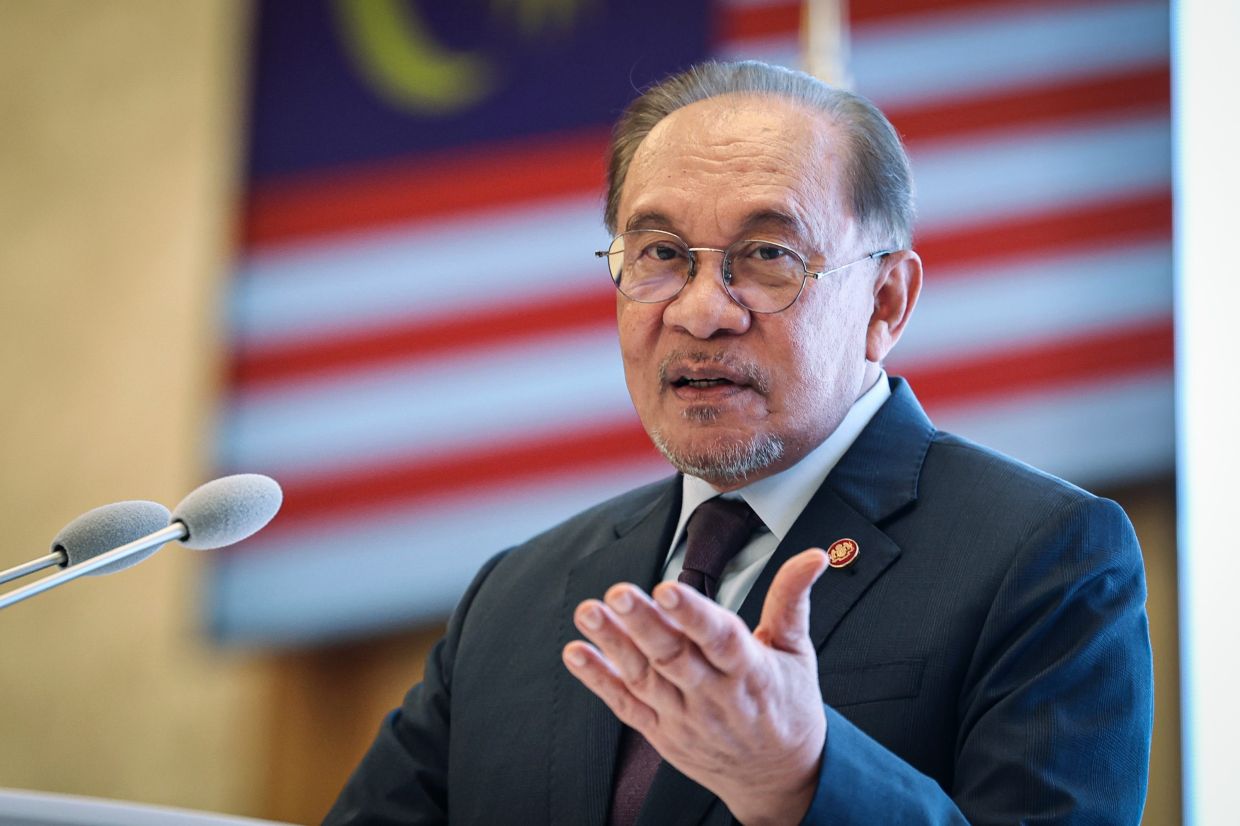
Malaysia's government is open to exploring a hybrid taxation approach that would selectively incorporate elements of the Goods and Services Tax into the existing Sales and Service Tax framework, Prime Minister Datuk Seri Anwar Ibrahim revealed during the Budget 2027 engagement session in Putrajaya. The proposal signals a willingness to refine the nation's tax architecture in pursuit of greater progressivity, though Anwar made clear that any reforms would occur within a carefully circumscribed scope that prioritises protection for lower-income households.
As both Prime Minister and Finance Minister, Anwar underscored a critical political boundary that will govern the examination of any tax modifications: Malaysia will definitively retain SST as its foundational taxation mechanism rather than pivoting toward GST. This reaffirmation addresses longstanding concerns within Malaysia's political landscape about the GST, which the previous government had implemented before the current administration repealed it and reinstated SST. The distinction between retaining a base system while selectively adopting certain administrative or structural features from an alternative model represents a nuanced middle ground in an otherwise polarised taxation debate.
Anwar's central objection to GST centres on its comprehensive character as a broad-based consumption tax that blankets the entire population regardless of income level or vulnerability. The fundamental philosophical divide he articulated reflects growing global recognition that universally applied consumption taxes can exacerbate inequality, particularly when coupled with rising cost-of-living pressures. In Malaysia's context, where inflation and household debt burden remain persistent concerns, a tax mechanism that captures contributions from all citizens—including those already struggling to meet basic expenses—constitutes a regressive policy tool masked within claims of administrative efficiency.
The government's reasoning illuminates a critical tension within modern taxation debates across Southeast Asia and beyond. While economists frequently champion GST's efficiency and broader tax base, which reduces reliance on narrower taxes that might distort economic behaviour, Anwar's position reflects a counter-argument that deserves serious consideration: efficiency divorced from equity becomes a mechanism for shifting financial burden downward through the income distribution. When workers earning minimum wages and pensioners on fixed incomes face identical consumption tax rates as wealthy households, the proportional impact on their purchasing power and living standards becomes dramatically unequal.
Anwar detailed his concerns by highlighting that individuals who have never previously encountered tax obligations would suddenly face mandatory contributions under a comprehensive GST regime. This expansion of the tax base, while administratively elegant, raises governance questions about the social contract and fairness. He framed the issue explicitly in contemporary economic terms, emphasising that Malaysia's current inflationary climate makes introducing such broad-based taxation particularly problematic from a welfare perspective. The rakyat, facing already-elevated food, housing, and transportation costs, would absorb additional tax burdens that would further compress their disposable incomes.
The Budget 2027 engagement session, held under the thematic framework of 'Malaysia MADANI: Menggapai di Langit, Mengakar di Bumi,' brought together a comprehensive coalition of economic stakeholders and policymakers to discuss fiscal priorities and directions. Finance Minister II Datuk Seri Amir Hamzah Azizan, Deputy Finance Minister Liew Chin Tong, Treasury secretary-general Tan Sri Johan Mahmood Merican, and Bank Negara Malaysia Governor Datuk Seri Abdul Rasheed Ghaffour participated in deliberations that will ultimately shape Malaysia's fiscal stance. The participation of industrial representatives, NGOs, and civil society figures alongside government officials suggests an intention to incorporate diverse perspectives into budget formulation processes.
For Malaysian readers and regional observers, this development carries implications extending beyond tax mechanics. The government's receptiveness to studying hybrid models demonstrates a commitment to evidence-based policymaking rather than ideological rigidity, while the firm rejection of universalised consumption taxation reflects genuine concern for distributional outcomes. In an era when many Southeast Asian governments face pressure from international financial institutions to broaden tax bases, Malaysia's leadership is articulating an alternative vision—one that acknowledges administrative elegance cannot override social cohesion and affordability imperatives.
The timing of these statements, preceding the October 9 parliamentary tabling of Budget 2027, suggests taxation architecture will feature prominently in the government's medium-term economic framework. Any hybrid model that emerges from this study period would likely incorporate GST's more sophisticated mechanisms for tracking supply chains and preventing revenue leakage, combined with SST's gentler incidence on consumption among lower-income populations. Such an approach could theoretically improve compliance and broaden the tax base while maintaining protections for vulnerable households through exemptions or differential rates.
Anwar's explicit refusal to compromise on this principle—maintaining that taxation should not impose blanket burdens on entire populations facing economic hardship—represents a notable positioning within contemporary global taxation discourse. Many developed economies rely heavily on consumption taxes as core revenue sources, accepting regressive outcomes as trade-offs for administrative efficiency and economic neutrality. Malaysia's leadership appears to be articulating that such trade-offs are unconscionable given current socioeconomic conditions, even if this complicates revenue collection and requires alternative mechanisms to sustain fiscal performance.

