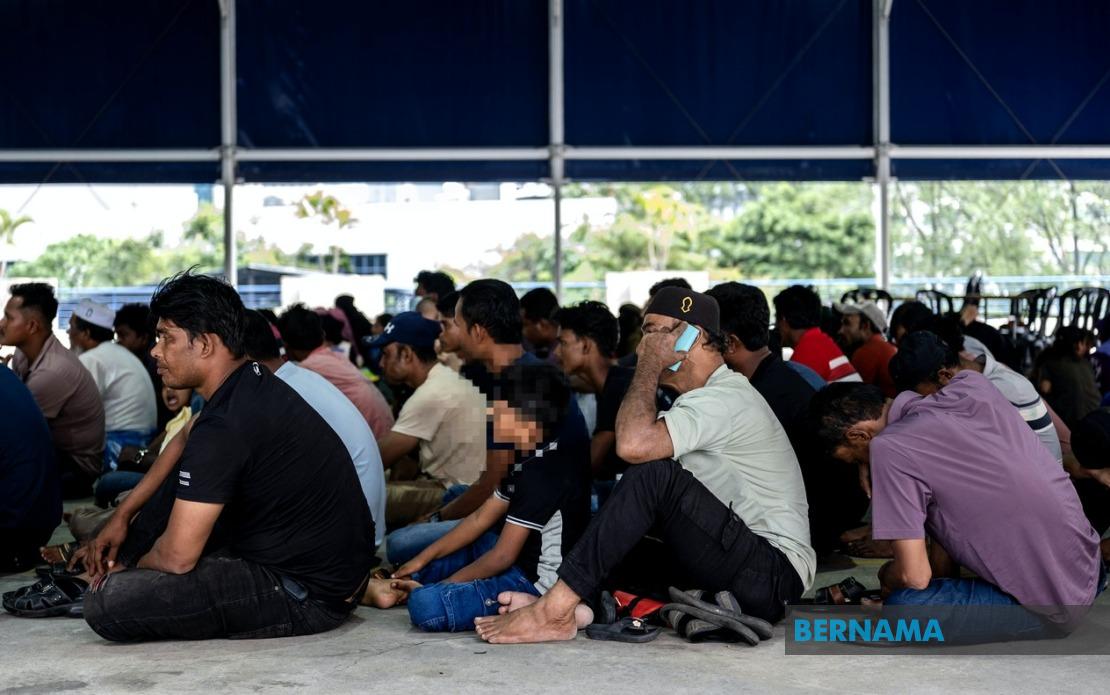
Malaysia is on track to unveil preliminary figures on Myanmar refugees by the final three months of 2024, according to Home Minister Datuk Seri Saifuddin Nasution Ismail. Speaking at an event in Putrajaya, the minister outlined the government's timeline for processing data collected under the Refugee Registration Document (DPP) scheme, a systematic initiative designed to bring greater order and transparency to how Kuala Lumpur manages one of Southeast Asia's most pressing humanitarian challenges.
The refugee registration effort represents a significant shift in Malaysia's administrative approach to the estimated hundreds of thousands of displaced persons from Myanmar currently within its borders. Rather than relying on ad-hoc measures or incomplete information, the Home Ministry through the Immigration Department has implemented a comprehensive data collection system intended to establish verified identity records and biometric information for individuals seeking refugee status. This methodical approach aligns with the National Security Council Directive No. 23 (Revision 2023), which sets the policy framework for managing refugees and asylum seekers under Malaysian jurisdiction.
Saifuddin Nasution emphasised that the government recognises the urgency of establishing accurate baselines before proceeding with repatriation efforts. The registration process serves multiple functions: it provides the government with reliable demographic and biometric data, helps identify individuals who genuinely qualify for refugee protection under international definitions, and creates a structured mechanism through which the Foreign Ministry (Wisma Putra) can coordinate with international bodies and the Myanmar government on eventual returns. Without such data, meaningful repatriation becomes logistically impossible and ethically fraught.
The minister acknowledged that mounting a successful outreach campaign remains central to the programme's effectiveness. Thousands of potential registrants remain scattered across urban centres and informal settlements, many reluctant to engage with government agencies due to fears about immigration enforcement or deportation. The Home Ministry's strategy therefore hinges on public communication efforts that convince individuals they will be treated fairly and that registration does not automatically lead to forced removal. This requires sustained messaging through community leaders, civil society organisations, and established refugee support networks.
While the focus of recent media coverage has centred on Myanmar nationals, Saifuddin Nasution clarified that the DPP programme encompasses all foreign nationals within Malaysia who meet refugee criteria, not exclusively those fleeing the Myanmar conflict. This broader mandate reflects Malaysia's position within the international refugee system. Although not a signatory to the UN Refugee Convention, Malaysia hosts significant populations from Afghanistan, Pakistan, and other countries experiencing instability. A unified registration system therefore serves the government's interests in comprehensive population management across multiple vulnerable groups.
The fourth quarter timeline carries practical implications for Malaysian policy-making. Once preliminary data emerges, the government will possess concrete figures on the scale of the challenge it faces, which will inform budget allocations, interagency coordination, and diplomatic engagement with Myanmar's authorities and international humanitarian organisations. These numbers will also become a reference point for public debate within Malaysia itself, where refugee issues intersect with concerns about labour market competition, social service costs, and national security.
For Myanmar's displaced population, the registration scheme represents a mixed development. Verification and documentation offer protection against arbitrary detention and facilitate access to essential services, yet they also signal Malaysia's intent to eventually repatriate registered refugees, particularly once Myanmar's security situation stabilises. Whether that stabilisation occurs in the coming years remains highly uncertain, given the unresolved nature of the military coup's aftermath and ongoing civil resistance.
The involvement of Wisma Putra in repatriation decisions underscores that refugee management in Malaysia operates at the intersection of humanitarian protection and foreign policy. Bangkok's approach to Myanmar refugees, for instance, has shifted according to diplomatic relations with the junta and pressure from international allies. Malaysia's framework similarly reflects balancing acts between regional diplomatic interests, ASEAN's non-interference norms, and its commitment to international humanitarian principles.
For regional observers, Malaysia's initiative signals an attempt to move beyond temporary ad-hoc accommodations toward institutionalised systems capable of handling protracted displacement. This mirrors efforts in other Southeast Asian countries grappling with refugee populations, though Malaysia's approach differs by explicitly prioritising eventual repatriation over long-term settlement. The release of preliminary data in Q4 will test whether the registration process can meaningfully distinguish between those who will be returned, those who require continued protection, and those who may eventually integrate into Malaysian society.
The coming months will reveal whether the outreach campaign successfully persuades sufficient numbers of Myanmar nationals to participate. Community trust remains fragile, and administrative capacity constraints could impede registration efforts. Yet the Home Ministry's public commitment to a specific timeline suggests institutional determination to move forward, regardless of obstacles. For Malaysia's policymakers and the displaced persons themselves, the fourth quarter dataset will mark a turning point in how this enduring humanitarian question is understood and managed within the country.

