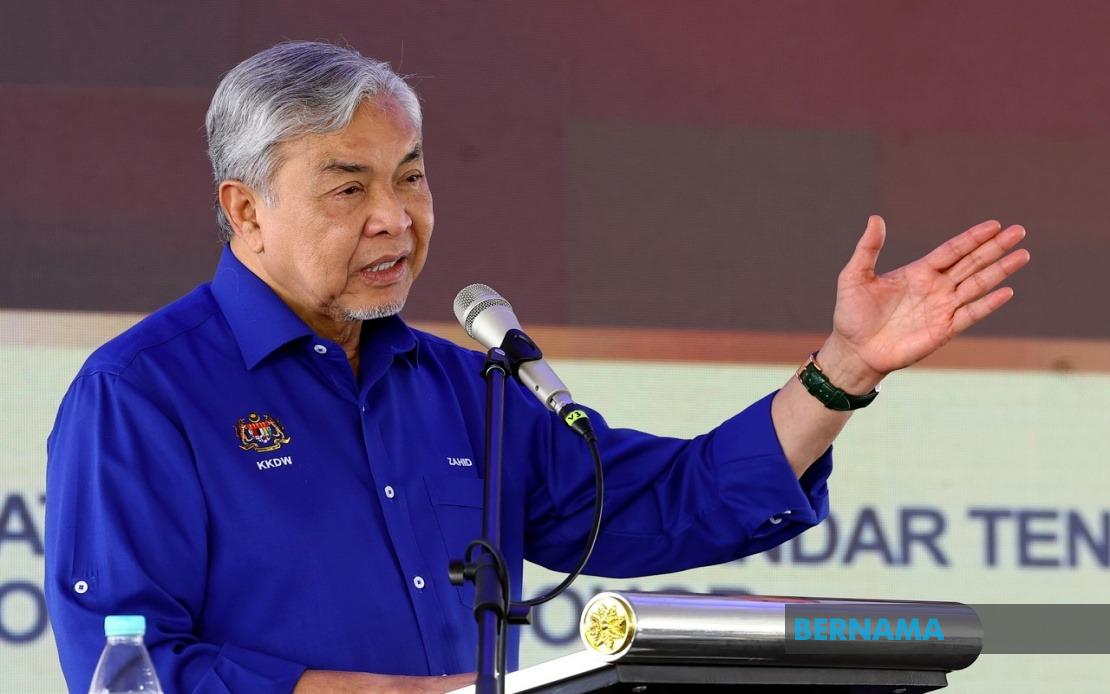
Deputy Prime Minister Datuk Seri Dr Ahmad Zahid Hamidi has unveiled an ambitious three-decade strategy to significantly diminish Malaysia's reliance on imported foodstuffs, aiming to achieve a 50 per cent reduction in import dependency by 2050. The Ministry of Rural and Regional Development (KKDW) has devised this long-term initiative in response to mounting food import expenditures, which currently consume approximately RM80 billion annually from the nation's resources. The announcement, made during his visit to Kota Tinggi while officiating the RISDA Agro Majestic programme, signals a fundamental shift in how Malaysia approaches its domestic food production capacity and economic resilience.
The strategy employs a graduated implementation schedule designed to translate the ambitious 2050 target into manageable intermediate milestones. Ahmad Zahid detailed that Malaysia aims to reduce food imports by at least 15 per cent within the next seven years by 2030, before accelerating progress toward a 30 per cent reduction by 2040. This phased approach allows policymakers to assess results, adjust strategies where necessary, and build institutional capacity throughout the three-decade journey. Such methodical planning reflects recognition that transforming an economy's food production infrastructure requires sustained commitment rather than sudden upheaval, particularly in a nation with established agricultural and trade patterns.
Central to this initiative is the mobilisation of underutilised and dormant agricultural land currently held by government agencies operating under KKDW's purview. Rather than allowing these parcels to remain idle, the ministry intends to repurpose them into productive Agro MADANI projects and livestock farming facilities. This approach sidesteps the complications of acquiring private land or displacing existing operators, instead leveraging existing public holdings to maximise domestic production capacity. By concentrating efforts on government-owned properties, the scheme can proceed more swiftly while demonstrating governmental commitment to food security improvements.
The operational framework depends upon enhanced coordination among several key institutions: RISDA, FELCRA, the Department of Veterinary Services, and state agricultural authorities. This collaborative structure recognises that modern food security demands multidisciplinary expertise and horizontal coordination across traditionally separate agencies. By breaking down departmental silos and fostering unified planning, KKDW intends to eliminate redundancies and harness each institution's specialised capabilities toward the common objective of augmenting domestic output.
Livestock development, particularly chicken and egg production, figures prominently in the government's calculation. Ahmad Zahid highlighted how broiler chicken and layer farming initiatives have already begun stabilising market prices following their introduction three years ago, demonstrating the tangible benefits of state involvement in these sectors. A reliable domestic supply of protein sources directly influences consumer purchasing power and food inflation, making livestock production central to achieving broader food security and economic stability goals.
The minister emphasised that government participation in food production does not constitute competition with established commercial operators. Rather, the initiative seeks to augment overall supply volumes, thereby preventing artificial scarcity and enabling consumers to access reasonably priced provisions. This clarification holds significance for private farmers and agribusiness enterprises, many of whom might perceive state involvement with apprehension. By framing public sector engagement as supply-side expansion rather than market displacement, Ahmad Zahid attempts to reassure existing producers that government programmes complement rather than undermine their operations.
For Malaysia, this initiative addresses a persistent structural vulnerability: excessive dependency upon international markets for essential food commodities. Global food price volatility, supply chain disruptions exemplified by recent pandemic-era disruptions, and geopolitical tensions affecting agricultural trade routes have all highlighted the risks of maintaining such import dependency. The RM80 billion annual expenditure also represents significant capital outflow that could theoretically be retained and circulated within Malaysia's economy. By investing in domestic capacity, the government seeks to insulate consumers from international price fluctuations while generating employment and economic activity throughout rural regions.
The Southeast Asian context amplifies the relevance of Malaysia's food security strategy. Throughout the region, countries grapple with similar challenges: rapidly growing urban populations, competing land use pressures, climate variability affecting crop yields, and supply chain vulnerabilities exposed by recent crises. Malaysia's phased approach potentially offers a replicable model for neighbouring nations, though success will depend upon effective implementation and sustained political commitment across multiple electoral cycles.
Implementing such an ambitious agenda requires navigating complex challenges beyond merely acquiring land and resources. Agricultural productivity depends upon technical expertise, modern farming practices, market information systems, and appropriate infrastructure—elements requiring continuous investment and attention. Weather-related risks, disease management in livestock operations, and market dynamics for agricultural commodities present ongoing operational challenges. Whether KKDW possesses sufficient institutional capacity and technical sophistication to manage these complexities across three decades remains an open question warranting careful monitoring.
The financial implications warrant scrutiny as well. While reducing food import expenditure by RM40 billion annually by 2050 would represent substantial savings, achieving this requires substantial upfront capital investment in land development, irrigation systems, equipment, training, and ongoing operational costs. The return on investment timeline and funding mechanisms remain largely unspecified in current announcements. Policymakers must ensure that domestic production economics ultimately favour the initiative, or else expensive state-subsidised farming could emerge as an alternative budgetary burden.
Regional agricultural trade presents another consideration. ASEAN frameworks and bilateral trade agreements facilitate the movement of agricultural products throughout Southeast Asia and beyond. A domestic focus on self-sufficiency must balance against the economic benefits derived from regional agricultural specialisation and trade. Malaysia's future food security strategy will likely require careful calibration between expanding domestic production and maintaining advantageous trade relationships that provide cost-effective access to imported commodities.
The success of this initiative ultimately hinges upon consistent execution across multiple government administrations and departments. Political commitment must translate into sustained budgetary allocation, technical support systems, and policy stability that allows farming operations to develop confidence in long-term viability. Malaysian citizens and international observers will assess progress against the articulated benchmarks—15 per cent by 2030 and 30 per cent by 2040—providing concrete metrics by which to evaluate whether the government's ambitions translate into tangible improvements in national food security and economic resilience.

