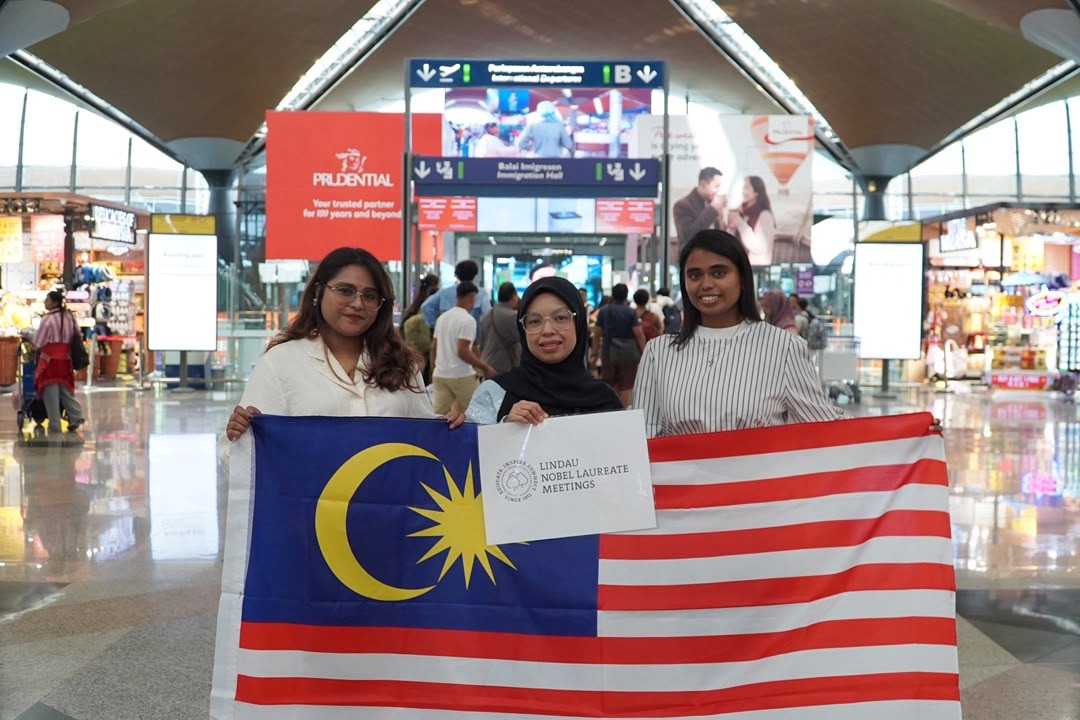
Malaysia is sending three accomplished early-career researchers to the 75th Lindau Nobel Laureate Meeting taking place in Lindau, Germany, from June 28 to July 3, the Ministry of Science, Technology and Innovation announced on June 29. The selection represents a continuation of Malaysia's engagement with one of the world's most prestigious forums for scientific exchange, where emerging researchers interact directly with Nobel Prize winners across multiple disciplines.
The three representatives showcase Malaysia's growing depth in biomedical and physical sciences. Dr Nur Liyana Mohammed Yusof, 34, a lecturer in pharmacology at Universiti Kebangsaan Malaysia's Faculty of Medicine, brings expertise in cardiovascular disease mechanisms, specifically investigating myocardial ischaemia-reperfusion injury and developing novel therapeutic approaches for acute myocardial infarction. At 29, Dr Pershaanaa K. Manogran, a postdoctoral fellow at Universiti Malaya's Department of Physics, specialises in advanced materials science with applications in next-generation energy storage, focusing on electrode materials and hybrid supercapacitor systems. The third delegate, Dr Ruth Naomi Manuel, 31, conducts research at UM's Institute of Ocean and Earth Sciences at the intersection of neuroscience and metabolic health, examining how environmental and metabolic factors shape brain function and behaviour through computational modelling.
This year's Lindau gathering assumes particular significance as the 75th anniversary edition, assembling more than 600 young scientists alongside approximately 75 Nobel Laureates from across the globe. The meeting's interdisciplinary theme—Resilience, Information, Integrity and Life—reflects a deliberate pivot toward understanding how contemporary scientific challenges increasingly transcend traditional academic boundaries. Malaysia's participation aligns with the nation's broader positioning within the global research ecosystem, with 92 Malaysian scientists having previously attended through Academy of Sciences Malaysia nominations, positioning the country within Lindau's network of more than 200 academic partners.
For Malaysia's science policy establishment, the meeting carries symbolic weight beyond mere international representation. Science, Technology and Innovation Minister Datuk Chang Lih Kang framed the delegates' attendance as embodying government commitment to nurturing talent aligned with the 13th Malaysia Plan's 2026-2030 strategic framework. The Plan explicitly prioritises developing future-ready talent across the educational spectrum, with particular emphasis on strengthening STEM literacy, digital competencies and exposure to emerging technologies including artificial intelligence. According to the minister, platforms such as Lindau provide Malaysian scientists with critical global exposure, professional networks and cross-border perspectives essential for driving innovation and sustaining competitive advantage in knowledge-intensive sectors.
The Academy of Sciences Malaysia, through its president Datuk Dr Tengku Mohd Azzman Shariffadeen, who also serves as Science, Technology and Innovation Adviser to the Prime Minister, characterised the programme as foundational to developing scientific leadership cadres within Malaysia. The academy's position suggests a strategic view of Lindau participation as building Malaysia's institutional research capacity through direct mentoring relationships with globally recognised scientists. The networking opportunities embedded in Lindau's format—including Nobel Hours, Science Walks, Laureate Lunches, and Next Gen Science sessions—create informal channels through which early-career researchers establish collaborations that often extend well beyond the meeting itself.
Malaysia's three delegates enter a highly competitive selection process that reflects the meeting's prestige within the international scientific community. The Lindau Nobel Laureate Meeting, organised annually by the Council for the Lindau Nobel Laureate Meetings, has evolved from its origins as a physics-focused gathering into a genuinely interdisciplinary forum. The selection of Malaysian representatives spanning cardiovascular pharmacology, materials physics and neuroscience demonstrates the breadth of Malaysian research ambition, though it also suggests that Malaysia's traditional strengths in biomedical research remain central to the nation's global scientific positioning.
For Southeast Asian readers, Malaysia's sustained participation in premier international scientific forums carries several implications. First, it signals that Malaysian universities—particularly the research-intensive institutions like UKM and UM—remain competitive at the global frontier across multiple disciplines. Second, the regular inclusion of Malaysian delegates within Lindau's network contributes to regional scientific visibility; adjacent countries monitor Malaysia's presence at such forums as indicators of the regional balance in research capacity. Third, the government's explicit linkage between Lindau participation and the 13th Malaysia Plan suggests that international scientific diplomacy is being consciously deployed as a tool for advancing domestic development objectives.
The three scientists' research trajectories also illuminate contemporary priorities within Malaysian science. Cardiovascular disease remains a significant public health burden across Southeast Asia, making Dr Nur Liyana's work on myocardial infarction therapeutics locally relevant. Dr Pershaanaa's research into energy storage materials addresses regional imperatives around sustainable development and clean energy transition—themes increasingly central to ASEAN-wide policy discussions. Dr Ruth's investigation of obesity and metabolic disorders through the lens of neuroscience reflects growing Malaysian recognition that health challenges in the region require mechanistic understanding at the molecular and systemic levels.
The Lindau format itself merits attention for Malaysian audiences less familiar with the meeting's structure. Unlike traditional academic conferences organised around paper presentations, Lindau deliberately minimises formal lectures in favour of dialogue. Nobel Laureates present their work, but the subsequent interaction emphasises open discussion, allowing young scientists to pose questions, propose alternative approaches and develop genuine intellectual exchange. This pedagogical philosophy reflects a conviction that scientific advancement increasingly requires collaborative networks spanning institutional and national boundaries. For Malaysian participants, such exposure to leadership models and research cultures across different institutional contexts can prove transformative, potentially shaping how they structure their own research programmes and mentoring relationships upon returning to Malaysia.
The Academy of Sciences Malaysia's role in nominating Malaysian delegates deserves recognition as well. The academy functions as Malaysia's primary interface with international scientific organisations and has maintained consistent engagement with Lindau over decades. This institutional continuity has enabled Malaysia to develop what amounts to an alumni network of previous Lindau participants, creating a feedback loop through which experience and insights from the meeting circulate within the Malaysian scientific community. Such networks, though often invisible in official announcements, frequently prove crucial for sustaining international collaboration and maintaining Malaysia's profile within global research conversations.
Looking forward, Malaysia's commitment to regular Lindau participation reflects confidence in the nation's capacity to produce research-active scientists capable of engaging with global intellectual leadership. The three delegates selected for 2024 represent the current wave of Malaysian scientific talent, yet their broader significance lies in demonstrating that Malaysia continues investing in the early-career researchers who will shape the nation's research landscape across the subsequent decade. Whether measured by publications, patents, policy influence or international collaborations, the trajectories of these and previous Malaysian Lindau participants offer a useful barometer for assessing how effectively Malaysia's science policy investments translate into sustained international competitiveness.

