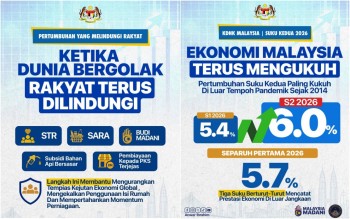
Malaysia has achieved a robust six per cent growth in gross domestic product during the second quarter of 2026, a result that has surpassed economist predictions and represents the country's strongest second-quarter expansion in over a decade when pandemic-era figures are excluded. Prime Minister Datuk Seri Anwar Ibrahim announced the figure, highlighting the accomplishment as a significant economic milestone for the nation at a time when global economic momentum continues to decelerate.
The timing of this growth announcement carries particular weight given the headwinds currently buffeting the international economy. Global supply chain disruptions stemming from geopolitical tensions in West Asia, combined with widespread inflationary pressures affecting most developing nations, have created a challenging external environment for regional economies. Yet Malaysia has managed to insulate itself from the worst effects of these global trends, a distinction that reflects deliberate policy choices by the MADANI administration.
According to Anwar's statement, the government's ability to deliver robust growth while protecting ordinary Malaysians from severe economic pain hinges on targeted intervention programmes. The BUDI MADANI initiative, alongside cash assistance schemes including Sumbangan Tunai Rahmah (STR) and Sumbangan Asas Rahmah (SARA), have cushioned households against inflationary shocks. These measures represent a fundamental shift in approach—prioritizing household purchasing power and social protection alongside conventional growth strategies.
Beyond the visible assistance programmes, Anwar indicated that the government has pursued less publicized economic management strategies to stabilize prices and maintain adequate supply chains. This backstage work encompasses supply-side interventions, dialogue with business sectors to moderate pricing, and supply chain management initiatives. The combination of demand-side support through cash transfers and supply-side management through supply chain optimization demonstrates a comprehensive approach to economic stewardship during turbulent times.
The second-quarter performance stands out particularly when measured against historical benchmarks. Outside of the exceptional circumstances of the pandemic period, when economies experienced unusual volatility, this quarter's growth rate represents the strongest second-quarter expansion since 2014—a twelve-year span that encompasses various economic cycles and external shocks. This comparison suggests that Malaysia's economy possesses underlying fundamentals that differentiate it from many peers navigating today's uncertain global environment.
However, Anwar was careful to temper celebrations with a realistic assessment of remaining challenges. His comments acknowledge that achieving a single strong quarterly result, while encouraging, does not automatically translate into sustained prosperity. The Prime Minister emphasized that maintaining growth momentum requires continuous effort and reform, suggesting the government views this quarter's success as a waypoint rather than a destination.
The government's articulated priority moving forward extends beyond mere GDP expansion toward inclusive prosperity. Anwar signaled commitment to ensuring that economic growth translates into tangible improvements in the material circumstances of ordinary citizens. This framing reflects recognition that raw economic statistics, however impressive, mean little to voters unless accompanied by higher real incomes, better employment opportunities, and strengthened support systems for marginalized populations. The emphasis on "meaningful income" and "quality job opportunities" suggests the administration views job creation and wage growth as central metrics alongside traditional GDP measures.
For vulnerable segments of the population, the government has indicated that targeted assistance will remain a policy cornerstone. This approach acknowledges that market mechanisms alone may not deliver equitable outcomes, particularly during periods of economic transition or external disruption. By combining growth-oriented policies with explicit support for disadvantaged groups, the MADANI administration presents a development model that departs from purely market-driven approaches that characterized earlier periods.
Regionally, Malaysia's economic resilience carries implications beyond its borders. As the largest economy in ASEAN alongside Indonesia, Malaysia's ability to achieve robust growth despite global headwinds may provide a template for other Southeast Asian nations grappling with similar external pressures. The government's combination of social support mechanisms with supply-side management suggests an approach that other developing economies in the region may study and potentially adapt to their own contexts.
Looking ahead, the government has framed its agenda as fundamentally reformist, aimed at elevating living standards while solidifying the structural foundations of the economy. This rhetoric signals that policymakers view the current growth phase not as justification for complacency but as an opportunity to implement deeper reforms that could enhance long-term competitiveness. Whether the government can translate these ambitions into concrete policy outcomes will likely determine whether the second-quarter performance represents an inflection point toward sustained prosperity or merely a strong quarter within a more volatile trajectory.
The announcement also reflects broader regional dynamics, with Malaysia's economic management drawing attention from observers tracking how Southeast Asian nations navigate the intersection of domestic political cycles, external economic uncertainty, and social expectations. The Prime Minister's emphasis on ensuring that prosperity is "achieved together by the rakyat" suggests an administration conscious of distributional questions that have increasingly animated political discourse across the region.

