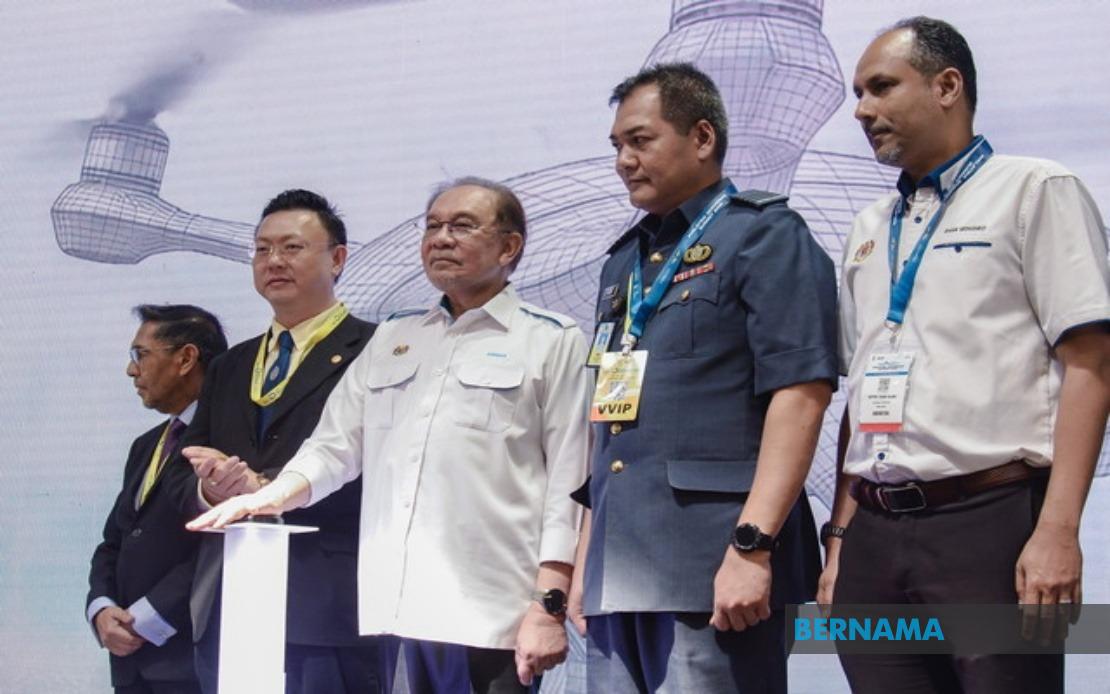
Prime Minister Datuk Seri Anwar Ibrahim has made an urgent call for Malaysia to prioritise the rapid development and deployment of unmanned aerial vehicle (UAV) and drone technologies as a cornerstone strategy for strengthening the nation's economic competitiveness on the global stage. Speaking at the closing ceremony of the MyDrone Expo 2026 in Sepang on June 27, Anwar emphasised that countries aspiring to achieve sustained economic success must demonstrate agility in embracing emerging technological domains, with the drone sector representing a particularly compelling opportunity.
The Prime Minister's remarks underscored a critical insight into the contemporary global economy: drone technology does not exist in isolation but rather serves as a convergence point for several transformative fields including artificial intelligence, digital infrastructure and advanced automation. This interconnectedness means that building capability in the UAV sector simultaneously strengthens Malaysia's broader technological foundations. Anwar stressed that for the nation to realise this potential, it must establish a comprehensive ecosystem that provides both the regulatory clarity and practical support mechanisms required by innovators and industry players.
The scale of opportunity facing Malaysia cannot be overstated. Global projections indicate that the worldwide unmanned aerial vehicle market will expand to exceed USD55 billion by 2030, while the low-altitude economy—encompassing commercial and industrial drone operations conducted below conventional aircraft altitudes—is rapidly becoming a significant investment magnet. This trajectory presents a time-sensitive window for Malaysian stakeholders to establish competitive advantages before market consolidation occurs around dominant international players.
Anwar articulated the government's commitment to supporting the sector across multiple dimensions of the regulatory and support infrastructure. Cabinet ministers, policymakers, research establishments and relevant agencies have been directed to provide comprehensive backing to the industry, signalling a whole-of-government approach to what the administration views as a strategic priority. This instruction represents more than rhetorical support; it indicates that concrete resources and policy adjustments will follow to remove barriers and facilitate growth.
The scope of potential applications extends well beyond military and defence applications, though those remain relevant to Malaysia's national security considerations. The Prime Minister specifically highlighted civil-sector possibilities, particularly in plantation management and agricultural productivity enhancement, where drone technology can deliver measurable efficiency gains. This diversification across multiple economic sectors amplifies the multiplier effects and ensures that benefits are not concentrated within a narrow industrial base.
To operationalise this vision, the government has identified three foundational pillars requiring immediate attention. First, the regulatory framework governing drone operations must be modernised and simplified to remove unnecessary obstacles while maintaining appropriate safety and security standards. Second, research funding mechanisms must be expanded to support innovation across the entire value chain, from fundamental research through to commercialisation. Third, the nation requires strengthened infrastructure for rigorous testing and certification of both vehicles and operators, establishing Malaysia as a trusted jurisdiction for UAV development and deployment.
The human capital dimension represents perhaps the most critical long-term requirement for sustaining competitive advantage in this field. Anwar called for intensified collaboration among private enterprises, government research institutions and universities to construct a robust pipeline of skilled professionals. He drew an instructive parallel to existing academic excellence in related domains such as artificial intelligence and quantum computing, suggesting that dedicated drone technology faculties and programmes should be established with similar institutional commitment and resource allocation.
The MyDrone Expo 2026 itself provided a tangible demonstration of Malaysia's emerging standing as a regional hub for drone innovation and discussion. The three-day event, co-organised by the World UAV Federation Malaysia Chapter and the Malaysia UAV Development Association, exceeded organisational expectations by hosting more than 100 exhibition booths. The geographical diversity of attendees—industry delegates from 46 countries—underscored the international dimension of this sector and Malaysia's potential to position itself as a convening hub for Asian and global drone industry collaboration.
For Malaysian business observers and policymakers, Anwar's intervention signals a definitive shift in national technology priorities. Rather than treating drone development as a peripheral or niche concern, the government has elevated it to the level of strategic economic policy, comparable to established tech initiatives. This elevation has immediate implications: entrepreneurs considering investment in drone-related ventures can now expect a more receptive policy environment, while established companies in adjacent sectors should evaluate opportunities to diversify into UAV applications.
Regionally, Malaysia's explicit commitment to drone technology development also carries broader implications for Southeast Asian technological sovereignty and competitiveness. As regional economies increasingly vie for position in emerging technology sectors, national governments that move decisively to support promising domains often capture disproportionate returns. Malaysia's early signal of commitment may attract talent, investment and partnerships that might otherwise gravitate toward Thailand, Vietnam or Singapore.
The intersection of drones with artificial intelligence deserves particular emphasis, as this combination creates multiplicative capabilities. AI-enabled autonomous drones can operate with reduced human supervision, access dangerous environments, process vast quantities of sensor data in real-time, and learn from operational experience to improve performance continuously. Nations that master this integration will possess significant advantages across agriculture, environmental monitoring, emergency response and industrial inspection sectors.
Implementing Anwar's vision will require sustained follow-through across multiple government agencies and continued private-sector participation. The articulation of policy support must translate into concrete actions: streamlined certification procedures, tax incentives for research and development, and perhaps most importantly, commitment to procuring domestically-developed drone solutions for government applications. Such procurement decisions would create the anchor demand necessary to justify commercial investment in Malaysian-based manufacturing and R&D operations.

