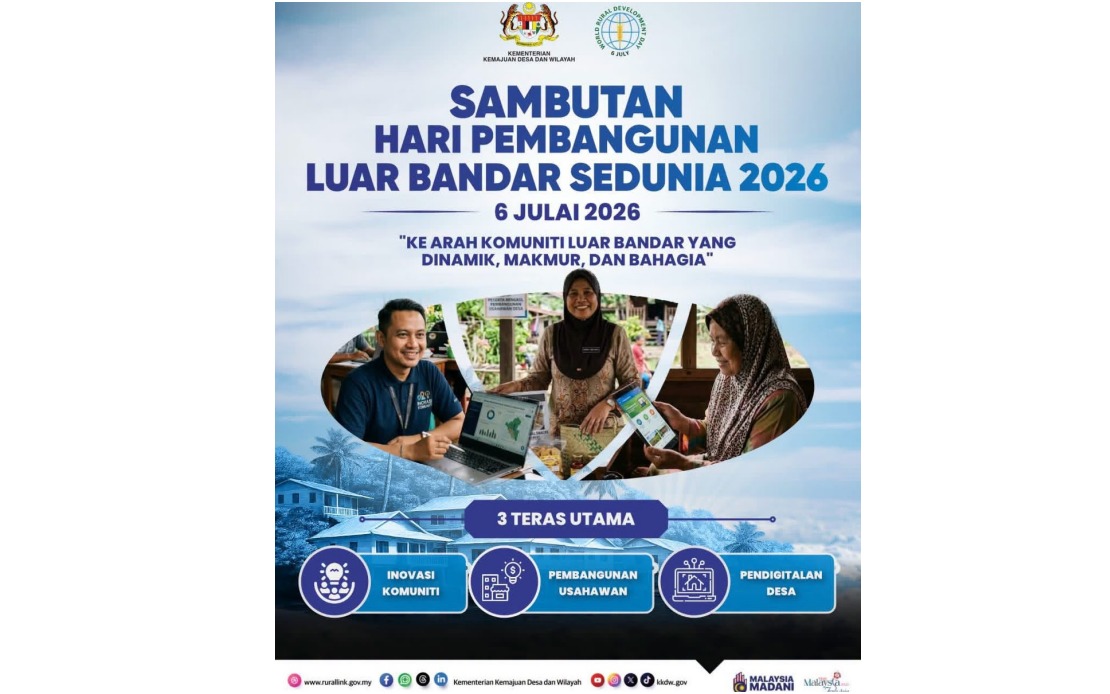
Malaysia is poised to make history tomorrow by becoming one of the first nations to formally observe World Rural Development Day, with a landmark ceremony scheduled at Tun Abdul Razak Stadium in Jengka near Maran. The inaugural celebration represents a significant moment for a country where rural communities remain integral to the national development narrative and economic prosperity. Deputy Prime Minister and Minister of Rural and Regional Development Datuk Seri Dr Ahmad Zahid Hamidi will preside over the event, underscoring the government's commitment to recognising the pivotal role of rural populations in advancing Malaysia's broader development agenda.
The United Nations General Assembly officially designated World Rural Development Day on September 6, 2024, establishing July 6 as the annual observance date in commemoration of the Centre on Integrated Development for Asia and the Pacific (CIRDAP). The global community first observed the occasion in 2025, and Malaysia is now joining this international movement as a participating member. By adopting this observance in 2026, Malaysia demonstrates its alignment with global sustainability commitments while localising the agenda to address the specific challenges and opportunities facing rural populations across the peninsula and East Malaysia.
Themed around the vision of "Toward Vibrant, Prosperous and Happy Rural Communities," tomorrow's celebration will anchor itself on three transformative pillars that the Ministry of Rural and Regional Development (KKDW) believes are essential for contemporary rural progress. These pillars—community innovation, rural digitisation and rural entrepreneur development—represent a deliberate shift away from traditional top-down development models toward more participatory and technology-enabled approaches. The ministry's emphasis on these areas reflects a recognition that rural Malaysia must evolve beyond primary agricultural production toward more diverse and resilient economic foundations.
Community innovation serves as the first strategic thrust, acknowledging that grassroots-level problem-solving and local entrepreneurial spirit drive sustainable progress. By elevating innovation as a development pillar, the government signals its intent to harness the creative potential already present within rural communities rather than imposing external solutions. This approach particularly resonates in contemporary Malaysia, where younger rural populations increasingly seek opportunities to establish tech-based ventures and service industries without necessarily migrating to urban centres.
Rural digitisation emerges as the second critical component, addressing a persistent digital divide that has historically disadvantaged rural Malaysia in accessing financial services, educational resources, and market opportunities. Enhanced digital connectivity and infrastructure expansion are prerequisites for enabling rural entrepreneurs to participate in e-commerce platforms, access online banking and financial services, and maintain competitive advantage in increasingly digital supply chains. For Malaysian policymakers, this thrust carries particular urgency given the government's broader digitalisation targets and the recognition that rural communities cannot be left behind in the transition to a digital economy.
The third pillar focusing on rural entrepreneur development directly addresses economic diversification and poverty alleviation objectives. By intentionally cultivating entrepreneurship in rural areas, the government aims to create employment opportunities, reduce urban migration pressures, and retain human capital in regional communities. This is especially relevant in Malaysia's context, where rural areas have historically experienced brain drain as younger residents seek career opportunities in major urban centres like Kuala Lumpur, Penang and Johor Bahru.
Tomorrow's programme will showcase several flagship initiatives demonstrating government commitment to rural advancement. The Rural Aspiration Award MADANI will recognise outstanding contributions from rural communities, whilst the Felda Plan Excellence Award will highlight success stories within the Federal Land Development Authority scheme. The launch of the My Rural Insight Journal signals intent to create evidence-based platforms documenting rural experiences and development outcomes. Additionally, the announcement of Felcra Bhd interim distributable profit distribution for 2026 demonstrates tangible economic returns flowing to stakeholders in rural development schemes.
The celebration provides an opportunity for multiple government agencies and development organisations to present their programmes and initiatives at dedicated exhibition booths. This platform allows rural communities and stakeholders to directly engage with policymakers and programme administrators, facilitating dialogue on ground-level challenges and emerging opportunities. Such interactive engagement is crucial for translating national development strategies into locally relevant, community-responsive initiatives that address specific contexts across Malaysia's diverse rural regions.
For Malaysian readers, tomorrow's observance carries broader significance beyond ceremonial recognition. It represents official acknowledgment that rural development remains a government priority, even as urbanisation and industrialisation continue reshaping Malaysia's demographic and economic landscape. The emphasis on innovation and entrepreneurship rather than subsistence agriculture reflects evolving policy thinking about rural futures. Furthermore, Malaysia's participation in the UN-designated observance signals the nation's commitment to Sustainable Development Goals and positions the country within a global peer group focused on equitable rural development. Regional observers across Southeast Asia may also view Malaysia's formal celebration as indicative of renewed policy emphasis on rural advancement after periods when urban-centric development dominated national discourse.
The timing of this inaugural celebration also merits consideration. Held in Jengka, Pahang—a region with significant agricultural heritage and ongoing development projects—the venue choice demonstrates intentional geographic significance rather than selecting a central urban location. This placement reinforces the message that rural communities themselves are central to the development narrative rather than passive beneficiaries of government programmes. As Malaysia navigates complex transitions toward higher-value agricultural production, rural service industries, and digital economies, formally celebrating rural development through a UN-designated day provides symbolic and substantive momentum for sustained policy attention and resource allocation to these communities.

