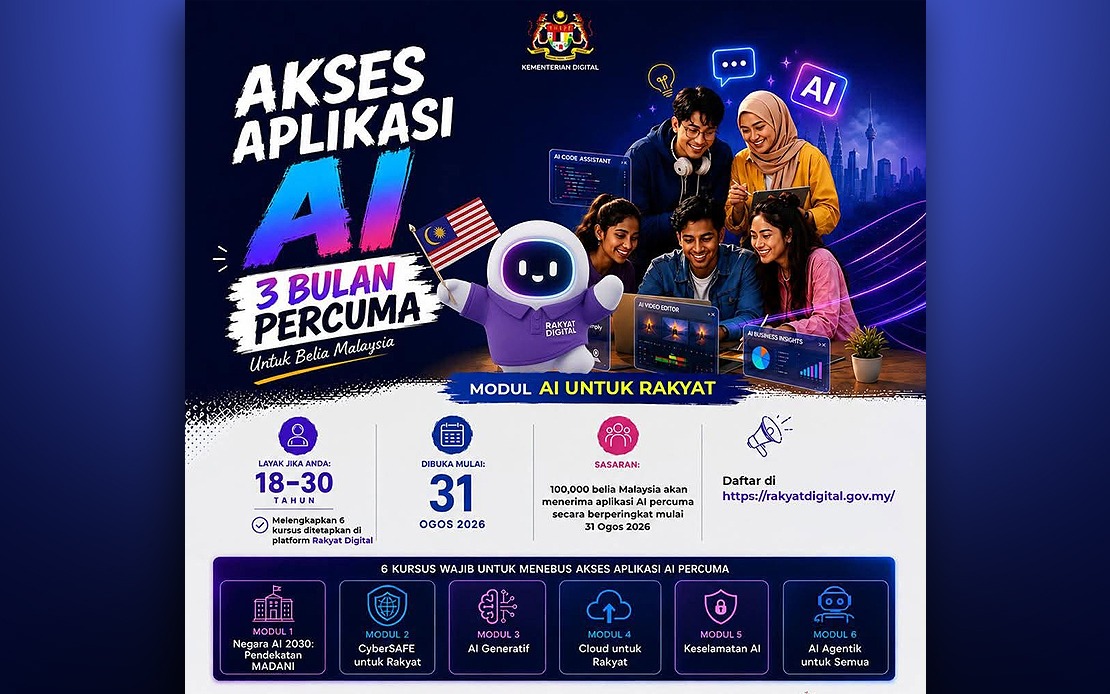
The Malaysian government has unveiled an ambitious artificial intelligence education programme designed to democratise access to cutting-edge digital tools among the country's youth population. Announced by Prime Minister Datuk Seri Anwar Ibrahim during the 2026 National Day Premier Address at the Putrajaya International Convention Centre, the AI for the People initiative represents a significant expansion of the nation's digital skills development agenda and reflects growing recognition that technological literacy has become essential for economic participation and social mobility in the digital era.
The programme targets 100,000 Malaysians aged between 18 and 30 over the next three years through 2027, with enrolment beginning immediately via the Rakyat Digital portal at rakyatdigital.gov.my. Structured as a phased rollout rather than a single mass intake, this approach allows the Digital Ministry to manage capacity and ensure quality delivery across the curriculum. Young Malaysians interested in acquiring AI competencies can register online, with the portal serving as the central hub for course materials, progress tracking, and access to subsidised software subscriptions. This digital-first registration method itself functions as a practical introduction to the kinds of platforms and systems participants will encounter throughout their professional careers.
Successfully completing the programme requires participants to pass six carefully designed modules that progress from foundational concepts to specialised applications. The curriculum sequence—beginning with AI Nation 2030: The MADANI Approach, followed by CYBERSAFE for the People, Generative AI, AI Security, Agentic AI for All, and concluding with Cloud for the People—reflects a pedagogical structure that balances Malaysia's national development priorities with global technological best practices. The opening module explicitly links AI adoption to the government's MADANI (Madani Advancement through Technology, Innovation, and Sustainability) framework, contextualising technical learning within the broader vision of inclusive national development. Subsequent modules address the legitimate concerns surrounding AI deployment, particularly cybersecurity and the emerging challenges posed by agentic systems that operate with increasing autonomy.
Upon successful completion of all six modules, participants receive access to a three-month free subscription to selected artificial intelligence tools and applications. This tangible benefit transforms the programme from a purely educational exercise into a practical engagement with enterprise-grade technology. The initial roster of available tools demonstrates partnerships with both local and international providers, including YTL AI Labs' IlmuChat platform, Alibaba's Wonderclip and MuleRun offerings, and Google's Gemini Enterprise suite. These selections span conversational AI, visual content creation, and enterprise productivity applications, ensuring participants encounter diverse use cases and develop versatile skill sets rather than expertise limited to a single platform.
The Digital Ministry has signalled its intention to expand the available tool roster progressively, with additional software from other technology companies to be integrated in subsequent phases. This rolling enhancement strategy serves multiple purposes: it maintains participant engagement by introducing new capabilities throughout the programme lifecycle, accommodates the rapid evolution of the AI landscape by allowing curriculum and tool selections to keep pace with technological advancement, and potentially creates opportunities for additional technology vendors to participate in Malaysia's digital development ecosystem. For Malaysian tech entrepreneurs and smaller software companies, this tiered rollout presents pathways to reach substantial user populations and demonstrate product viability at scale.
Digital Ministry secretary-general Datuk Fabian Bigar emphasised that the initiative aims to ensure young Malaysians achieve not merely theoretical understanding of AI technology but genuine practical proficiency with operational tools. This distinction between comprehension and capability reflects lessons learned from previous digital skills programmes, where certification alone proved insufficient without accompanying access to functional technology. By coupling structured learning with extended tool access, the programme creates conditions for participants to experiment, build projects, and develop the confidence necessary to leverage AI in professional and creative contexts. The three-month subscription period provides sufficient duration for meaningful exploration while remaining manageable within the programme's resource constraints.
The broader context for this initiative reflects Malaysia's strategic positioning within regional competition for digital talent and technological leadership. As Southeast Asian economies increasingly compete for both domestic and foreign investment in technology sectors, workforce AI literacy has emerged as a critical differentiator. Countries that successfully develop large cohorts of AI-capable workers create more attractive ecosystems for technology companies considering regional headquarters locations, research centres, and development operations. By targeting 100,000 young adults—a substantial but achievable cohort—Malaysia demonstrates serious commitment to closing skills gaps without the unrealistic ambition of programmes lacking adequate resources and support infrastructure.
The programme explicitly frames AI access as a matter of democratic inclusion rather than privilege restricted to those attending elite institutions or working for wealthy corporations. This positioning acknowledges that technological advancement has historically concentrated benefits among already-advantaged populations, and that intentional policy intervention remains necessary to prevent AI-driven economic divergence. Digital Ministry statements reference Malaysia's aspiration to develop an inclusive AI Nation by 2030, a formulation that privileges equitable participation over raw innovation metrics. For Malaysian policymakers, this represents a deliberate choice to prioritise societal cohesion and broad-based prosperity over purely competitive technological dominance.
The Rakyat Digital portal, which hosts this initiative, functions as the operational infrastructure for Malaysia's national digital learning strategy more broadly. Operated by MyDIGITAL Corporation under the Digital Ministry's supervision, the portal has previously delivered various digital literacy and skills programmes. The AI for the People initiative thus benefits from established user bases, proven technological architecture, and accumulated institutional knowledge about effective online learning delivery to diverse Malaysian populations. Participants logging onto the portal for AI training will encounter an ecosystem designed specifically for Malaysian learners, potentially including interface options in multiple languages and content references familiar to local audiences.
The announcement of this programme as one of six concurrent youth-focused digital initiatives underscores the government's comprehensive approach to youth employment and economic participation. Rather than addressing digital skills through isolated interventions, the multi-pronged strategy acknowledges that young adults require pathways spanning awareness-building, skills development, tool access, and credential-building. AI for the People specifically addresses the tool access dimension, ensuring that participation in digital economy activities does not depend on individual willingness or ability to purchase expensive software subscriptions. This subsidisation model particularly benefits participants from lower-income households, potentially extending technological opportunity beyond urban centres with robust technology infrastructure and employment.
For Malaysian employers and industry sectors anticipating talent shortages in AI-capable workers, this programme represents supply-side policy designed to address future hiring challenges. The technology and financial services sectors particularly have reported increasing difficulty recruiting professionals with functional AI expertise. By generating cohorts of 100,000 trained young Malaysians over several years, the initiative contributes to labour market rebalancing, though meaningful economic impact will only become apparent once participants complete training and enter the job market. The programme's emphasis on practical tool experience rather than theoretical knowledge should theoretically produce job-ready candidates, though success ultimately depends on labour market demand aligning with the skills developed.
Implementing a programme of this scale and complexity involves significant logistical and technical challenges. Managing concurrent enrolment from tens of thousands of participants, maintaining course quality while scaling delivery, ensuring equitable access across Malaysia's diverse geography, and sustaining technology partnerships over multi-year timeframes all require sustained commitment and adequate resource allocation. Early phase outcomes will provide crucial evidence regarding programme effectiveness and inform refinements necessary for subsequent expansion. Regional observers and other Southeast Asian governments likely monitoring Malaysian digital skills initiatives will evaluate whether this model successfully develops capable practitioners or produces credentials lacking substantial practical value.

