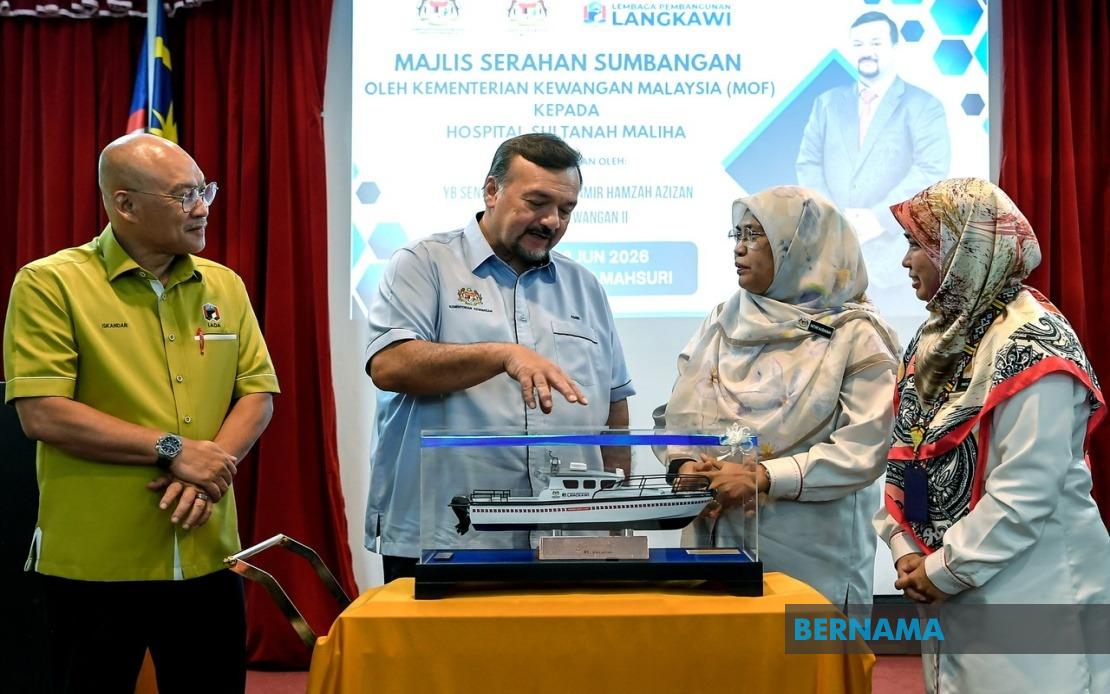
Malaysia's Ministry of Finance has committed RM5.5 million to establish a dedicated maritime ambulance service for Langkawi, a significant investment designed to modernise emergency healthcare delivery across the island archipelago. The service, expected to launch in early 2025, represents a substantial shift away from the current practice of relying on commercial passenger ferries for critical patient transfers to mainland facilities. Finance Minister II Datuk Seri Amir Hamzah Azizan revealed the initiative during a hospital equipment handover ceremony, framing it as essential infrastructure for both the resident population and the island's substantial tourism sector.
The rationale behind this investment becomes apparent when examining Langkawi's unique geographical challenges. Located roughly 30 kilometres from mainland Peninsular Malaysia, the island's isolation creates genuine obstacles when patients require emergency referral to larger tertiary hospitals. During periods when ferry operators reduce service frequencies—a common occurrence during monsoon seasons or due to operational considerations—families and medical teams face constrained options for urgent patient evacuation. This vulnerability has long represented a gap in Malaysia's healthcare accessibility, particularly for time-sensitive emergencies where delays of several hours can prove clinically significant.
The dedicated vessel will be managed by Hospital Sultanah Maliha, the island's principal medical facility, marking an important consolidation of emergency services under unified operational control. Rather than depending on passenger ferry schedules and commercial operations, hospital administrators will now maintain direct command of patient transport logistics. This structural change allows medical teams to prioritise clinical urgency over commercial timetables, a distinction that proves critical when managing stroke, cardiac, or trauma cases requiring immediate specialised intervention unavailable on the island itself.
Design specifications indicate the ambulance can accommodate two patients simultaneously on stretchers, alongside a complement of twelve medical and support personnel. This capacity reflects careful consideration of practical operational requirements, enabling the vessel to transport critically ill patients while maintaining full medical supervision throughout the journey. The inclusion of adequate staffing ensures that emergency interventions can continue uninterrupted during transit, a capability unavailable when utilising commercial ferries where medical space and personnel support remain severely constrained.
Beyond emergency transfer logistics, the vessel prioritises patient dignity and confidentiality in ways that commercial passenger ferries fundamentally cannot. Patients requiring urgent medical evacuation currently endure the psychological burden of public scrutiny aboard crowded ferry services, a situation that compounds physical distress with social embarrassment. A dedicated ambulance vessel eliminates this humiliation factor, enabling emergency transport to occur with appropriate privacy and clinical discretion. This humanitarian consideration reflects evolving expectations regarding patient-centred healthcare delivery across Malaysia.
Simultaneously, the Finance Ministry has contributed RM700,000 in advanced medical equipment to Hospital Sultanah Maliha, indicating a broader strategic commitment to strengthening Langkawi's healthcare infrastructure. This hardware investment encompasses diagnostic devices, information technology systems, furniture, vehicles, and security infrastructure. The cumulative effect positions the island facility to handle substantially greater clinical complexity, reducing the necessity for patient referrals in scenarios where local treatment proves feasible.
Particularly noteworthy is the hospital's integration with Malaysia's evolving digital health ecosystem. Computers on wheels equipped with electronic medical records capabilities will enable healthcare providers to document patient information directly during clinical encounters, with immediate synchronisation across networked hospitals. This connectivity transforms Langkawi Hospital from an isolated facility into an integrated node within the national healthcare system, where specialist consultations and coordinated care become logistically feasible despite geographical separation. Such digitalisation proves especially valuable for managing chronic diseases and follow-up care, where continuity across institutional boundaries directly impacts patient outcomes.
The investment timeline—with operational commencement anticipated in early 2025—suggests rigorous procurement and vessel commissioning processes currently underway. The Malaysian healthcare system has demonstrated commitment to such maritime medical initiatives previously, with established sea ambulance services operating in other archipelago regions. However, Langkawi's status as Malaysia's most visited island destination amplifies both the strategic importance and operational complexity of this particular deployment.
Tourism implications merit serious consideration. Langkawi welcomes millions of international visitors annually, many engaged in water-based recreational activities that carry inherent medical risks. The availability of rapid, equipped emergency transport enhances visitor safety assurance and strengthens the island's reputation as a well-provisioned destination. Travel insurance companies and international tourists will likely view the service as a meaningful safety enhancement, potentially influencing destination selection decisions among risk-conscious travellers.
The initiative also addresses infrastructure equity within Malaysia's healthcare geography. Peninsular island communities have historically experienced healthcare access disparities relative to mainland urban centres. By investing specifically in Langkawi's emergency capability, the Federal Government acknowledges geographical vulnerability as a legitimate policy concern requiring deliberate intervention. This principle extends relevance to other Malaysian maritime regions, potentially establishing precedent for similar investments in Sabah, Sarawak, and peninsula island clusters.
Financial Minister Amir Hamzah's explicit emphasis on strengthening healthcare capacity suggests this allocation reflects broader governmental priorities around healthcare modernisation. The RM5.5 million commitment, while significant, remains modest within the context of Malaysia's overall health budget—indicating government expectation that this foundational infrastructure investment will generate operational value substantially exceeding initial procurement costs through improved patient outcomes and enhanced emergency response capability.
Looking forward, successful implementation of Langkawi's sea ambulance service may inform similar infrastructure decisions across Southeast Asia's island economies. The region contains numerous archipelago nations facing comparable healthcare accessibility challenges, where dedicated maritime emergency transport could represent cost-effective investments yielding substantial public health improvements. Malaysia's initiative thus carries significance beyond local benefit, potentially establishing practical models for regional healthcare innovation.

