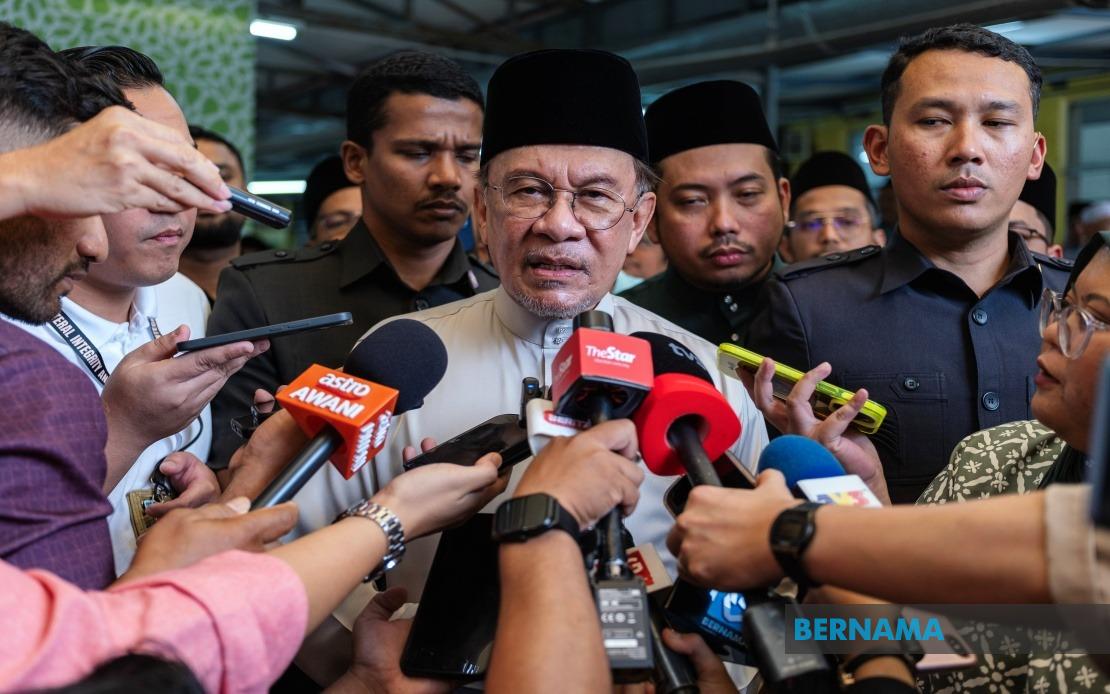
Prime Minister Datuk Seri Anwar Ibrahim has made clear that Malaysia will not waver in its stance toward fugitive businessman Low Taek Jho, commonly known as Jho Low, regardless of speculation surrounding a potential pardon from United States President Donald Trump ahead of America's Independence Day celebrations. Speaking to reporters after Friday prayers at Masjid As-Sodiqin in Taman Kobena here on July 3, Anwar emphasized that Malaysia's commitment to the rule of law supersedes external pressures or diplomatic considerations, positioning the country as steadfast in its pursuit of accountability.
The timing of Anwar's statement comes as international media outlets reported that Jho Low ranks among approximately 250 individuals under consideration for presidential clemency as part of the US's marking of its 250th Independence Day. Such reports naturally raise questions about potential diplomatic negotiations between Malaysia and the Trump administration, particularly given Jho Low's prominent role in the 1Malaysia Development Berhad (1MDB) scandal that triggered one of the world's most significant financial crime investigations. However, Anwar's comments appear designed to forestall speculation that Malaysia might soften its position in exchange for broader bilateral cooperation or other concessions.
The Prime Minister's framing of any American pardon decision as an internal matter reflects a careful diplomatic balance. By acknowledging that the US possesses sovereign authority over its own pardoning processes, Malaysia avoids accusatory rhetoric that could strain bilateral relations. Simultaneously, Anwar's reassurance that Malaysia remains uninfluenced, undisturbed, and unaffected by whatever Washington decides serves as a domestic message to Malaysian stakeholders, including victims of financial crimes and citizens who view the 1MDB case as emblematic of systemic corruption. This dual-audience approach preserves Malaysia's moral authority while respecting international protocol.
For Malaysian readers, Jho Low's continued evasion of prosecution represents unfinished business in the country's anti-corruption agenda. The fugitive businessman played a central role in orchestrating one of the largest kleptocratic schemes in history, siphoning billions from state coffers through elaborate international money-laundering networks. His disappearance and presumed refuge in foreign jurisdictions, combined with his apparent ability to maintain financial resources and legal representation, have long symbolized the challenges facing developing nations in pursuing transnational financial crimes through conventional mechanisms.
Malaysia's determination to maintain its position regardless of external developments carries particular significance given the broader context of Southeast Asian governance. The region has increasingly sought to establish itself as serious about financial regulation and anti-corruption efforts, partly to attract legitimate international investment and maintain credibility with global financial institutions. Jho Low's case remains one of the most visible tests of this commitment, and any perceived softening would undermine Malaysia's credibility not only domestically but across regional and international corridors.
The potential pardon consideration also raises complex questions about the nature of international cooperation in criminal justice. While bilateral extradition treaties and mutual legal assistance agreements form the foundation of cross-border prosecution, the ultimate discretion to grant clemency rests with individual sovereign states. For Malaysia, the possibility that the US might pardon someone whom Malaysian courts have convicted or sought to prosecute creates a troubling precedent. It demonstrates the vulnerability of smaller nations' legal systems when confronting individuals with international networks and access to resources that enable evasion.
Anwar's statement effectively signals to the international community that Malaysia views the rule of law as non-negotiable, even when faced with diplomatic inconvenience. This positioning aligns with the government's broader anti-corruption messaging and his own political brand, which has emphasized accountability and institutional reform since assuming office. The consistency of this message across administrations and changing geopolitical circumstances underscores that Malaysia's pursuit of Jho Low transcends temporary political considerations.
Separately, Anwar noted that he has received notice of a proposed United States contribution of RM1 million toward restoration of Tugu Negara, the National Monument, coinciding with Malaysia's National Day celebrations next year. He indicated the matter would feature in discussions at the following week's Cabinet meeting. This development, while distinct from the Jho Low question, provides context for Malaysia's bilateral relationship with Washington. The US willingness to contribute to Malaysian national heritage projects suggests ongoing diplomatic engagement and potential collaboration across various portfolios, even as disagreements may persist on specific individuals or issues.
The juxtaposition of these two developments—firm resistance on Jho Low paired with openness to US-funded infrastructure initiatives—reveals the complexity of Malaysia's diplomatic positioning. The country demonstrates capacity to compartmentalize issues, maintaining principled stances on matters of justice while simultaneously engaging constructively with Washington across other domains. This approach recognizes that bilateral relationships necessarily encompass multiple dimensions and that disagreement on singular issues need not derail broader cooperation.
Looking forward, Malaysia's unwavering commitment to its position on Jho Low serves notice that it will not sacrifice its institutional integrity for diplomatic expediency. Whether any US pardon materializes, Malaysia's legal authorities will continue pursuing available mechanisms for accountability. The case will likely remain emblematic of Malaysia's determination to establish itself as a nation serious about financial crime prosecution, particularly as it seeks to rebuild international confidence following years of governance challenges and to position itself as a responsible steward of Southeast Asian financial interests.

