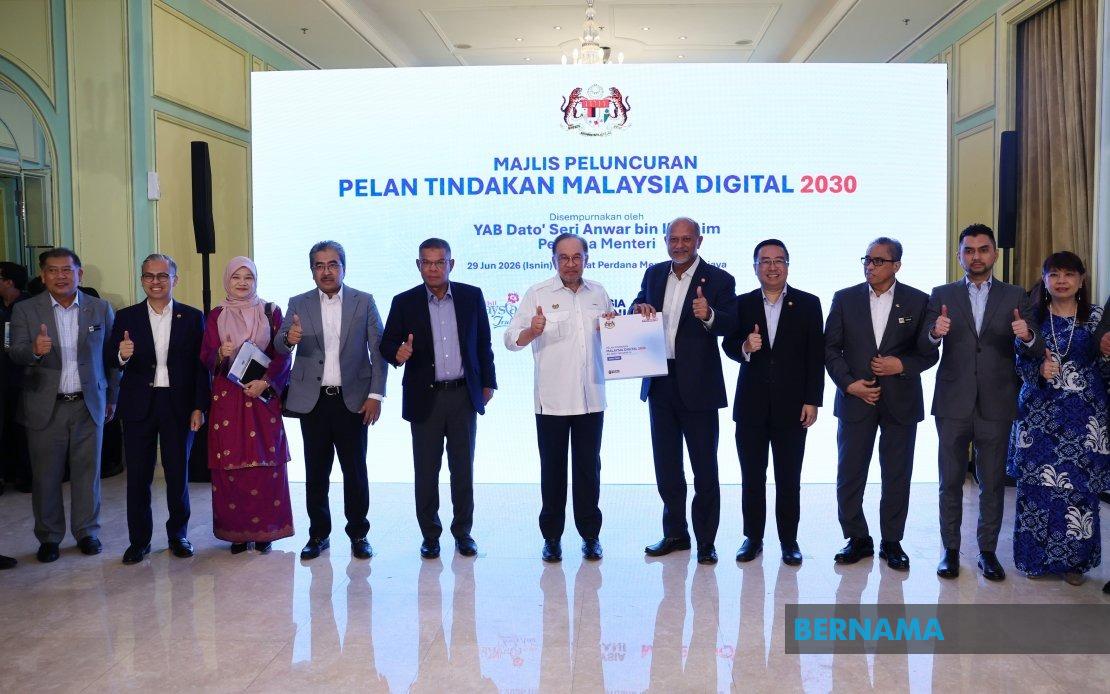
Prime Minister Datuk Seri Anwar Ibrahim has launched Malaysia Digital 2030 (MD2030), a comprehensive strategic roadmap spanning 2026 to 2030 that represents a fundamental reorientation of the country's approach to digital transformation. The initiative, unveiled in Putrajaya and supported by key cabinet ministers including Digital Minister Gobind Singh Deo and Communications Minister Datuk Fahmi Fadzil, signals Kuala Lumpur's intent to transition from being predominantly a consumer of global technology to becoming a sophisticated creator of homegrown digital solutions and artificial intelligence capabilities.
The action plan establishes an ambitious set of quantifiable targets designed to anchor Malaysia's digital ambitions firmly in economic reality. By 2030, the government intends to raise the digital economy's contribution to gross domestic product to 30 per cent, representing a significant jump from current levels and reflecting the sector's projected importance to national prosperity. Complementing this economic target, authorities aim to generate 500,000 high-value digital jobs, addressing both employment creation and skills elevation in the workforce. Additionally, the framework targets RM4.5 billion in public sector savings through digitalisation initiatives, demonstrating that transformation efforts extend beyond private enterprise into government operations themselves. Perhaps most ambitiously, the plan commits to delivering 95 per cent of government services fully online on an end-to-end basis, a figure that would rank Malaysia among the world's most digitally advanced public administrations.
The MD2030 structure reflects sophisticated governance thinking, organised around seven interconnected strategic pillars rather than isolated initiatives. These pillars—government, economy, infrastructure, talent, society, trust and security, and innovation—each address a distinct dimension of digital transformation while remaining integrated within an overarching whole-of-government framework. This architecture ensures that progress in one domain reinforces advances in others, and that coordination deficits are minimised through clear accountability structures. Each pillar operates under the stewardship of a specific cabinet minister, binding senior political leaders directly to implementation responsibilities and ensuring that digital transformation remains central to executive decision-making rather than relegated to technical ministries.
The Government pillar, led by Chief Secretary to the Government Tan Sri Shamsul Azri Abu Bakar, focuses on modernising public service delivery through establishment of GovTech Malaysia, a dedicated agency tasked with centralising technological innovation across the civil service. This institutional approach acknowledges that fragmentary technology adoption across disparate government agencies often produces inefficiencies and incompatibilities. By consolidating digital infrastructure and standards under a single entity, Malaysia seeks to create seamless inter-agency collaboration and unified citizen engagement platforms.
The Economy pillar, helmed by Investment, Trade and Industry Minister Datuk Seri Johari Abdul Ghani, targets Malaysia's repositioning as a regional hub for digital innovation and trade. This pillar emphasises the "Made by Malaysia" concept, seeking to develop indigenous technology products capable of competing regionally and globally rather than merely assembling or distributing foreign innovations. The strategy encompasses accelerating technology adoption within High Growth High Value sectors—those offering premium returns and advanced technical content—while simultaneously unlocking Malaysia's potential to monetise data assets, digital intellectual property, and information-based competitive advantages.
Infrastructure development forms a critical enabler of broader transformation ambitions. Under Communications Minister Datuk Fahmi Fadzil's leadership, this pillar prioritises achieving nationwide high-quality internet connectivity that extends into underserved rural regions, while simultaneously developing sophisticated digital infrastructure including data centres, cloud computing facilities, and smart city systems. This dual focus recognises that inclusive connectivity requires both universal coverage and advanced capabilities for knowledge economy participation.
The Talent pillar, directed by Human Resources Minister Datuk Seri R. Ramanan, acknowledges that technological infrastructure means little without skilled personnel capable of deploying and innovating within digital ecosystems. The approach encompasses comprehensive workforce policy frameworks, agile workforce transition initiatives enabling mid-career professionals to retrain, and sustained efforts to position Malaysia as both a regional and global digital talent destination capable of attracting international expertise while developing domestic capabilities.
Under the Society pillar led by Women, Family and Community Development Minister Datuk Seri Nancy Shukri, digital inclusion becomes institutionalised through the Malaysian Digital Inclusion Index, ensuring that transformation benefits extend broadly across demographic groups rather than concentrating among urban elites or urban professionals. Rural community empowerment and socially impactful digital solutions receive explicit attention, reflecting recognition that sustainable transformation requires equitable participation.
The Trust and Security pillar, overseen by Digital Minister Gobind Singh Deo, confronts a fundamental tension within digital transformation: balancing innovation's imperative for openness against security imperatives requiring controlled access and data protection. The operational framework includes the National Data Commission and a dedicated National Digital Trust and Data Security Strategy spanning 2026 to 2030, providing institutional mechanisms for resolving this perpetual tension.
The Innovation pillar, directed by Science, Technology and Innovation Minister Datuk Chang Lih Kang, focuses on strengthening Malaysia's capacity to translate research into commercialised products and services. The proposed Research, Development, Commercialisation, Innovation and Economy ecosystem establishes structured pathways through which university research, private sector development, and market deployment become integrated rather than sequential or disconnected processes.
Implementation architecture assigns the Digital Ministry as lead agency while delegating execution to specialised entities including the National AI Office, GovTech Malaysia, the Malaysia Digital Economy Corporation, CyberSecurity Malaysia, MyDIGITAL Corporation, and the Malaysia Centre for the Fourth Industrial Revolution. This distributed responsibility model leverages existing institutional expertise while maintaining coherent strategic direction through the coordinating ministry.
For Malaysian businesses and citizens, MD2030 signals that government intends digital transformation to permeate economic activity and daily life systematically rather than sporadically. Companies operating in High Growth High Value sectors should anticipate accelerated digitalisation demands alongside newly available infrastructure and talent resources. Simultaneously, the emphasis on data as a strategic national asset suggests forthcoming regulatory frameworks governing data monetisation, privacy, and cross-border flows—areas where regional standards currently remain inconsistent.
The vision articulated through MD2030 imagines Malaysia in 2030 as a nation where artificial intelligence integrates across economic and social domains, data functions as a recognisable strategic asset equivalent to natural resources, intelligent and autonomous systems operate as operational norms rather than novelties, and citizens engage with technology as collaborative partners rather than passive consumers. Whether this transformation realises fully depends substantially on implementation fidelity across seven distinct pillars, sustained political commitment through electoral cycles, and genuine coordination among competing government agencies and private sector participants whose interests may not always align perfectly.

