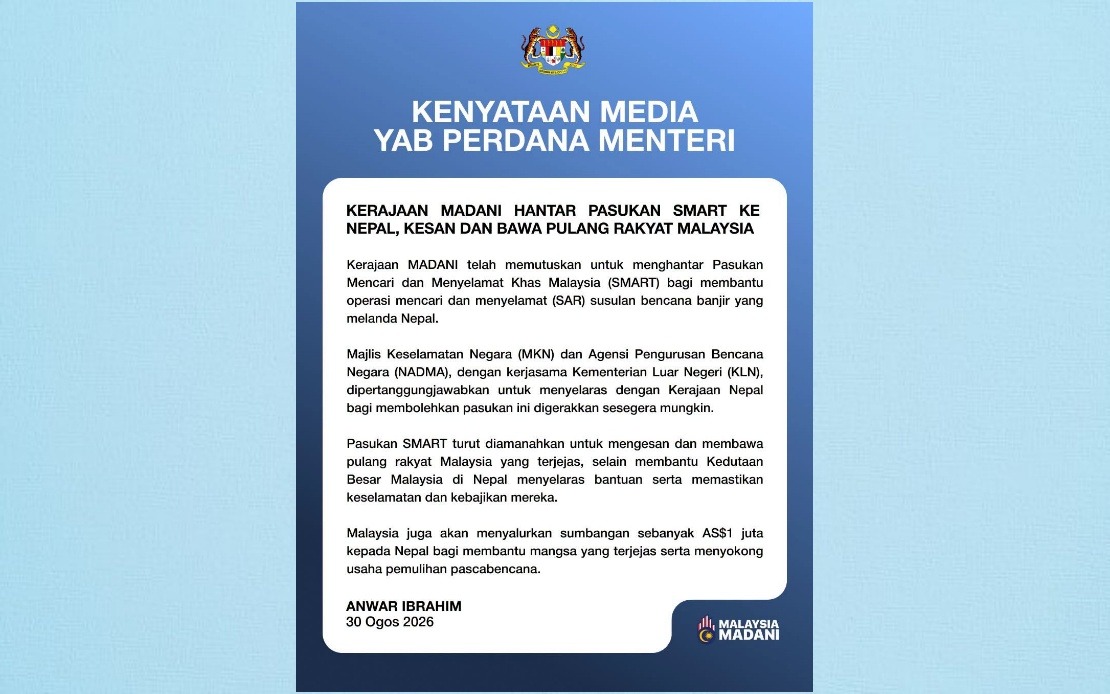
Malaysia's MADANI Government has mobilised its specialised disaster response capabilities to assist Nepal following severe flooding that devastated the Himalayan nation earlier this week. The decision to deploy the Special Malaysian Disaster Assistance and Rescue Team (SMART) marks a significant humanitarian intervention, demonstrating Malaysia's commitment to regional solidarity during crisis situations. Prime Minister Datuk Seri Anwar Ibrahim announced the deployment through an official statement, emphasising the government's coordinated approach to managing the emergency response across multiple agencies and ministries.
The coordination of Malaysia's relief efforts involves several key governmental bodies working in tandem to ensure an effective and organised response. The National Security Council (MKN) and the National Disaster Management Agency (NADMA) have been assigned primary responsibility for liaising with the Nepalese authorities, while the Foreign Ministry provides diplomatic support to facilitate rapid team deployment. This multi-agency framework reflects the complexity of international disaster response operations, where securing government approvals, arranging logistics, and maintaining communication channels across borders demands sophisticated coordination. The involvement of these specialised agencies ensures that Malaysia's assistance aligns with Nepal's specific needs and operational capacities on the ground.
Beyond immediate search and rescue operations, the SMART team has been tasked with a humanitarian dimension that addresses the welfare of Malaysian nationals caught in the disaster zone. The team will undertake specific efforts to locate Malaysians affected by the flooding and work toward their safe return home. This dual mandate—assisting local rescue efforts while protecting Malaysian citizens—reflects the priority the government places on its citizens' safety whilst fulfilling obligations to international humanitarian norms. Coordination with the Malaysian Embassy in Nepal will be crucial in this regard, as the diplomatic mission possesses on-ground intelligence about Malaysian communities and their current status.
The scope of Malaysia's engagement extends beyond immediate rescue operations to encompassing broader post-disaster reconstruction and recovery support. The government's decision to contribute US$1 million in financial assistance signals recognition that Nepal's recovery will require sustained support extending well beyond the initial emergency response phase. This funding commitment addresses pressing humanitarian needs including medical care, temporary shelter, food security, and clean water provision. For Malaysian observers, this assistance demonstrates how Malaysia leverages its economic capacity to contribute meaningfully to regional crisis response, establishing Malaysia as a dependable partner in Southeast Asian and broader Asian humanitarian frameworks.
The disaster that triggered this international response occurred on August 26 when Rasuwa district in Nepal experienced devastating flash floods and landslides of catastrophic proportions. The mountainous terrain of the affected region amplified the disaster's severity, as monsoon rainfall transformed into dangerous torrents cascading through valleys and villages. Such geological and meteorological conditions create compounded hazards where flooding combines with land instability, multiplying casualties and property destruction. The Rasuwa district incident exemplifies the vulnerability of Himalayan communities to extreme weather events intensified by climate change and topographical factors that concentrate water flows with exceptional force.
The welfare situation of Malaysian nationals remains precarious as of late August. The Foreign Ministry confirmed that 55 Malaysians remain uncontactable following the floods, representing a significant concern for families and the government alike. This number likely includes Malaysian tourists, temporary workers, and possibly longer-term residents scattered across the affected region. The communication blackout following the disaster—a common consequence when infrastructure deteriorates—compounds the difficulty in ascertaining their precise status and immediate needs. These individuals represent Malaysia's human stake in Nepal's crisis, creating domestic pressure on the government to demonstrate effective protective action.
The deployment of SMART reflects Malaysia's institutional investments in disaster response capacity building over preceding years. The team represents a specialised capability developed through training, equipment acquisition, and operational experience in previous deployments across the region. SMART personnel undergo rigorous preparation to operate in challenging environments, manage complex rescue scenarios, and coordinate with international and local counterparts. By deploying this trained capacity, Malaysia effectively transfers knowledge and resources to assist Nepal's own emergency services, which may be stretched managing the scale of devastation across affected districts.
Regional implications of Malaysia's response extend beyond bilateral Malaysia-Nepal relations to encompassing Southeast Asian collective approaches to disaster management. As an ASEAN member state, Malaysia's willingness to deploy resources for extra-regional crises reinforces the principle that humanitarian imperatives transcend political boundaries. Nepal, whilst not an ASEAN member, sits within Asia's interconnected geography where Malaysian citizens work, travel, and study, creating natural intersections of interest. Malaysia's response contributes to establishing regional norms where economically capable nations mobilise resources for vulnerable neighbours, creating mutual expectations of assistance during respective crises.
The timing and scale of Malaysia's intervention also reflect lessons learned from previous disaster experiences within the region, including the 2004 Indian Ocean tsunami that prompted major international coordination reforms. Contemporary disaster response emphasises rapid deployment of specialised teams, financial contributions accompanying personnel deployment, and integration with host-nation authorities. Malaysia's coordinated approach through multiple agencies demonstrates absorption of these lessons, where response mechanisms operate with predetermined protocols rather than ad-hoc improvisation. This institutional maturity enhances effectiveness and reduces delays that could affect rescue operation outcomes.
Looking forward, Malaysia's involvement in Nepal's recovery will likely continue extending beyond the initial emergency phase. Post-disaster reconstruction efforts often require sustained engagement as communities rebuild infrastructure and livelihood capacities. Malaysian expertise in development projects, particularly in infrastructure and community development domains, could contribute to Nepal's longer-term recovery trajectory. This expansion from emergency response to development partnership represents the evolution of disaster assistance from immediate lifesaving interventions toward comprehensive recovery support that addresses underlying vulnerabilities exposed by the disaster.
The fiscal commitment of US$1 million, whilst representing Malaysia's proportionate contribution relative to its economic capacity, signals genuine engagement rather than symbolic gesture. This amount becomes meaningful when directed toward specific initiatives—establishing water purification systems, funding temporary shelter construction, or supporting medical facility rehabilitation—where concentrated funding can generate substantial humanitarian impact. The allocation decisions will likely involve consultation with Nepalese authorities to ensure resources address priority needs identified by those managing the disaster response on the ground.
Malaysian public and political discourse surrounding this response generally emphasises humanitarian obligation and regional responsibility. The deployment receives support across Malaysia's political spectrum as representing uncontroversial government action aligned with national values and international standing. For Malaysian citizens, the rescue efforts targeting uncontactable nationals provide reassurance that government institutions prioritise citizen welfare across international boundaries. This dimension of the response addresses both practical security needs and broader political expectations that governments protect their citizens' interests abroad.

