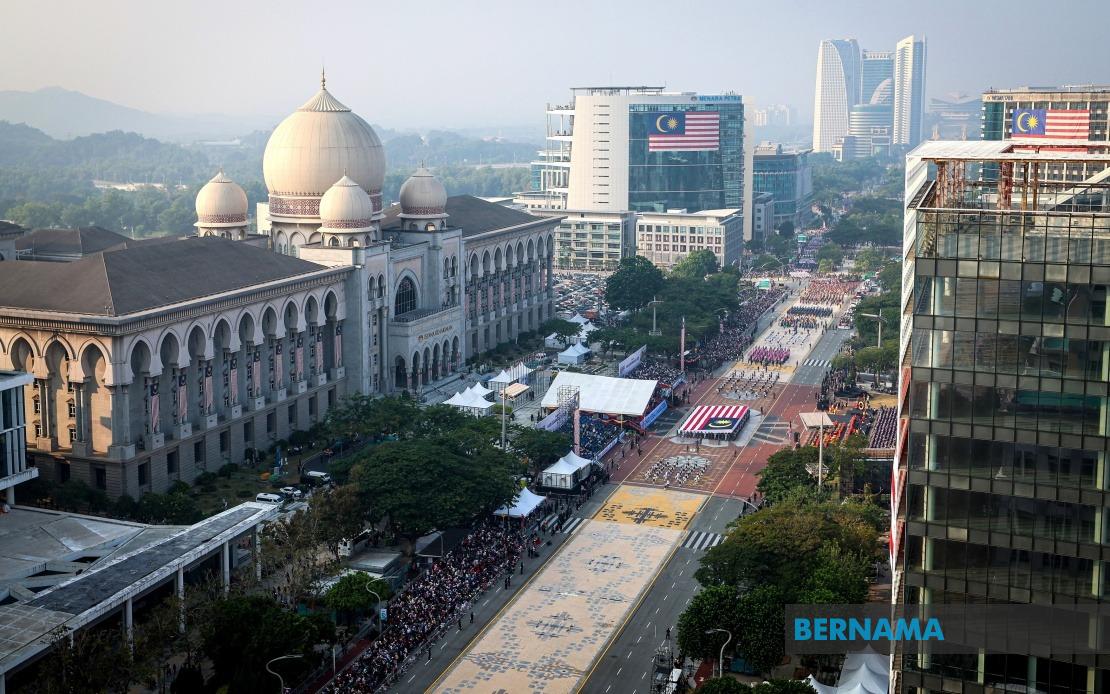
The Royal Malaysia Police will mobilise 2,354 personnel to safeguard Malaysia's 69th National Day celebration at Dataran Putrajaya on August 31, marking a significant security operation for one of the nation's most important ceremonial occasions. The deployment reflects the police force's commitment to maintaining public order while enabling smooth execution of the festivities that are expected to draw upwards of 80,000 spectators to the federal administrative capital.
Putrajaya district police chief ACP Aidi Sham Mohamed outlined the operational scope during remarks following the full-scale rehearsal of the event, which was witnessed by Communications Minister Datuk Seri Fahmi Fadzil. The assignment encompasses both static and dynamic traffic management across multiple strategic zones within the vicinity of Dataran Putrajaya, where festivities will unfold. This dual approach ensures that officers can respond flexibly to changing crowd patterns whilst maintaining predetermined security perimeters.
The 2026 iteration carries thematic significance, operating under the banner "Malaysia MADANI: Kesejahteraan Dinikmati" (Malaysia MADANI: Prosperity Enjoyed), which underscores the government's commitment to delivering shared wellbeing across society. For Malaysian audiences, this messaging reflects broader policy objectives articulated since the administration's inception, connecting national symbolism to lived economic and social experiences. The choice of messaging reveals how contemporary National Day celebrations have evolved beyond ceremonial markers to become platforms for communicating governance philosophies.
ACP Aidi Sham issued clear public guidance aimed at maximising safety whilst minimising operational friction. He urged attendees to arrive early at the venue, thereby distributing arrivals across extended timeframes and preventing dangerous crowd compression. Compliance with established protocols emerged as a central theme, encompassing conventional traffic regulations such as avoiding prohibited parking zones and ensuring vehicles remain clear of thoroughfares. These seemingly routine directives carry particular weight in an environment where tens of thousands converge simultaneously within confined urban spaces.
The police chief placed special emphasis on personal and family security, instructing visitors to exercise vigilance regarding their own wellbeing and that of accompanying children and valuables. Such counsel acknowledges the vulnerability inherent in large public gatherings, where opportunistic crime and accidental injury represent persistent concerns. The specificity of mentioning children reflects recognition that National Day celebrations attract multi-generational family groups, requiring tailored safety messaging across age demographics.
A notable security parameter involved explicit warnings against bringing dangerous weapons to the venue. This directive, whilst appearing straightforward, carries implications in the Malaysian context where public order management remains sensitive. The phrasing "for the purpose of enlivening our National Day" suggests authorities framed the prohibition within inclusive rather than punitive language, appealing to collective patriotic sentiment rather than enforcement threat alone. Such rhetorical choices reflect contemporary policing approaches that emphasise community cooperation over confrontation.
Communications Minister Fahmi Fadzil confirmed that the 2026 National Day celebration would proceed along established parameters, indicating continuity in ceremonial format despite the substantial security footprint. His assurance carries significance for public confidence, signalling that extensive police deployment represents protective infrastructure rather than indicator of heightened threat environment. For Malaysian residents and visiting observers, such messaging helps distinguish between routine security precautions and genuine public safety crises.
The anticipated attendance of over 80,000 visitors positions this celebration among the more heavily patronised National Day events in recent years, suggesting growing public engagement with commemorative occasions. This attendance projection necessitates the substantial police presence, as crowd density of such magnitude presents inherent logistical and safety challenges. The deployment density reflects sophisticated security planning calibrated to specific attendance forecasts, representing a data-informed approach to resource allocation.
For regional observers, Malaysia's approach to National Day security illustrates how Southeast Asian democracies balance public ceremonial access with protective measures. Unlike some neighbouring jurisdictions where security might impose substantial restrictions on civilian movement, Malaysia's model emphasises enabling widespread participation whilst maintaining orderly conduct. This philosophy reflects broader Malaysian governance approaches that seek to accommodate diverse populations within pluralistic frameworks.
The rehearsal conducted prior to the actual celebration underscores professional preparation standards within the Malaysian police service. Such dress rehearsals enable officers to identify operational vulnerabilities, test communication systems, and refine coordination protocols before actual implementation. For personnel deployed across dispersed locations, rehearsals provide critical opportunities to synchronise activities and ensure consistent understanding of tactical responses to various scenarios.
From a security studies perspective, the 2,354-officer deployment represents substantial resource commitment within domestic policing contexts. This allocation reflects institutional prioritisation of national symbolic occasions, implying that protecting state ceremonies ranks highly within police operational hierarchies. The specific number suggests detailed calculations regarding optimal personnel density, positioned between ensuring adequate coverage and avoiding over-deployment that might itself create public friction or appear unnecessarily militaristic.
Looking forward, this deployment establishes a baseline for National Day security operations, likely influencing planning for subsequent annual celebrations. As Malaysia navigates evolving security environments and changing public gathering dynamics, the protocols established for 2026 will inform institutional learning regarding effective crowd management practices. The experience accumulated during this large-scale event will contribute to refinement of procedures applicable to other major public occasions throughout the calendar year.

