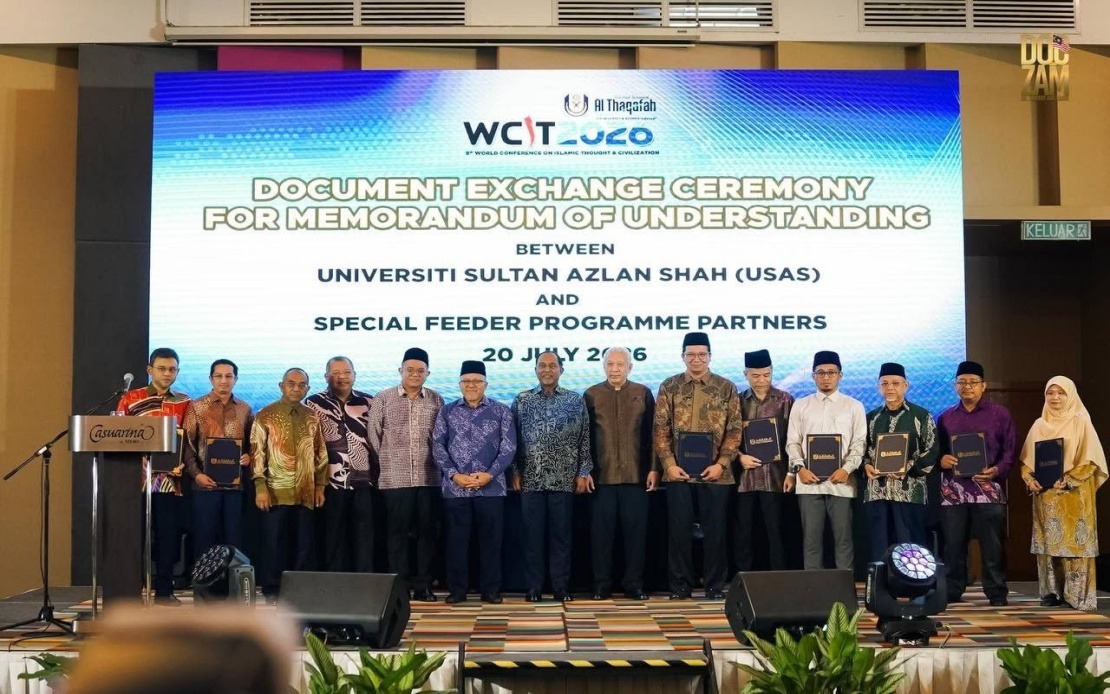
Malaysia is positioning itself as a crucial bridge for international intellectual exchange and a destination for higher education excellence, drawing on its role as host of the 8th World Conference on Islamic Thought and Civilisation (WCIT2026). Higher Education Minister Datuk Seri Dr Zambry Abdul Kadir articulated this strategic vision, highlighting how the three-day conference represents a significant opportunity to unite scholars, researchers, and thought leaders from multiple nations in addressing shared challenges facing both Islamic societies and the wider global community.
The gathering, inaugurated in Kuala Lumpur, reflects Malaysia's broader aspiration to serve as an inclusive and forward-looking platform where diverse perspectives converge. Rather than operating as a forum dominated by a single worldview or interest, the conference embodies principles of open intellectual engagement that transcend national borders and cultural divides. This approach aligns with Malaysia's historical positioning as a multicultural nation where different traditions of knowledge and thought have coexisted, making it a natural venue for such international dialogue.
At an evening reception held in conjunction with the conference, Zambry addressed more than 180 delegates representing multiple countries and academic disciplines. His remarks underscored a critical distinction between nostalgic reverence for past Islamic golden ages and the practical work needed to build a prosperous future for the ummah. The minister emphasized that sustainable advancement depends on three interconnected pillars: rigorous research methodologies, genuine innovation that responds to contemporary problems, and institutional excellence within universities themselves. This framing positions education not as a static repository of inherited wisdom, but as a dynamic engine for problem-solving and societal transformation.
A particularly striking element of Zambry's address focused on the vulnerability of civilizations when their centres of learning are destroyed or degraded. Drawing historical parallels ranging from the medieval fall of Baghdad through the siege of Granada and the destruction in Sarajevo to the ongoing Palestinian conflict, he illustrated how military destruction of universities and libraries represents a civilizational catastrophe extending far beyond physical infrastructure. The loss of such institutions means the obliteration of accumulated knowledge, research networks, and the intellectual capacity to imagine and construct alternative futures. This observation carries particular resonance for Southeast Asian policymakers navigating regional tensions and the imperative to protect institutions that preserve and advance human knowledge.
Zambry's emphasis on insulating education from the pressures of political ideology, military conflict, and technological determinism speaks to a growing concern within academic circles worldwide. As universities increasingly face pressure to align themselves with narrow nationalist agendas or to prioritize commercialization, his call for knowledge as humanity's shared inheritance offers a counterweight. For Malaysia specifically, this positioning reinforces the country's capacity to host scholars and researchers who might face constraints or hostility in their own nations, potentially attracting academic talent and fostering collaborative networks that benefit Malaysian institutions.
The WCIT2026 conference functions simultaneously as a platform for generating practical solutions to pressing contemporary issues. Rather than serving purely ceremonial functions, the gathering aims to produce substantive resolutions and actionable ideas that can improve conditions within Islamic-majority societies and contribute to global well-being. This results-oriented approach distinguishes the conference from academic forums that prioritize theoretical discourse without consideration of real-world applications. For Malaysia's higher education sector, participation signals alignment with international standards of research output and practical impact measurement.
Hosting such a prominent international conference on Islamic thought and civilization carries geopolitical implications for Malaysia's regional standing. As Southeast Asia's largest Muslim-majority nation with a substantial Hindu, Buddhist, and Christian population, Malaysia occupies a unique position as a living example of pluralistic governance within an Islamic framework. The decision to hold WCIT2026 in Malaysia rather than in Middle Eastern or other Asian locations represents a subtle but significant assertion that contemporary Islamic thought need not emanate exclusively from traditional centres of Islamic civilization, and that Asian perspectives—particularly those rooted in multicultural experience—deserve prominence in shaping the intellectual direction of the Islamic world.
The involvement of Universiti Sultan Azlan Shah as a key organizer highlights Malaysia's investment in developing specialized institutions capable of hosting world-class academic events. Building such capacity requires sustained commitment to faculty recruitment, research infrastructure, and international partnerships. By successfully executing complex international conferences, Malaysian universities enhance their reputation and attractiveness to global scholars and students, creating positive feedback loops for institutional development. This mirrors how other Southeast Asian nations have leveraged signature academic events to accelerate their emergence as regional knowledge hubs.
For Malaysian policymakers and educators, the minister's framing of higher education as fundamentally separate from political instrumentalization addresses recurring tensions in the sector. Universities across the region have faced pressure to support government narratives or restrict academic freedoms in the name of national interests. By positioning knowledge as a universal human heritage transcending any single nation or civilization, Zambry articulates a counter-narrative that positions academic autonomy not as a threat to national interests, but as essential to national competitiveness and soft power. This conceptual move may prove influential in debates over academic governance across Southeast Asia.
The three-day duration and ambitious scope of WCIT2026 suggest Malaysia is committing substantial resources to ensuring substantive outcomes rather than perfunctory proceedings. The conference represents an opportunity not only to showcase Malaysian hospitality and organizational capability, but to genuinely influence the trajectory of contemporary Islamic thought on critical issues ranging from governance and social justice to environmental sustainability and technological ethics. For Southeast Asian observers and participants, the conference offers a venue for advancing regional perspectives that have historically received less attention in global Islamic intellectual discourse, potentially enriching the global conversation while amplifying Malaysia's voice within international academic networks.

