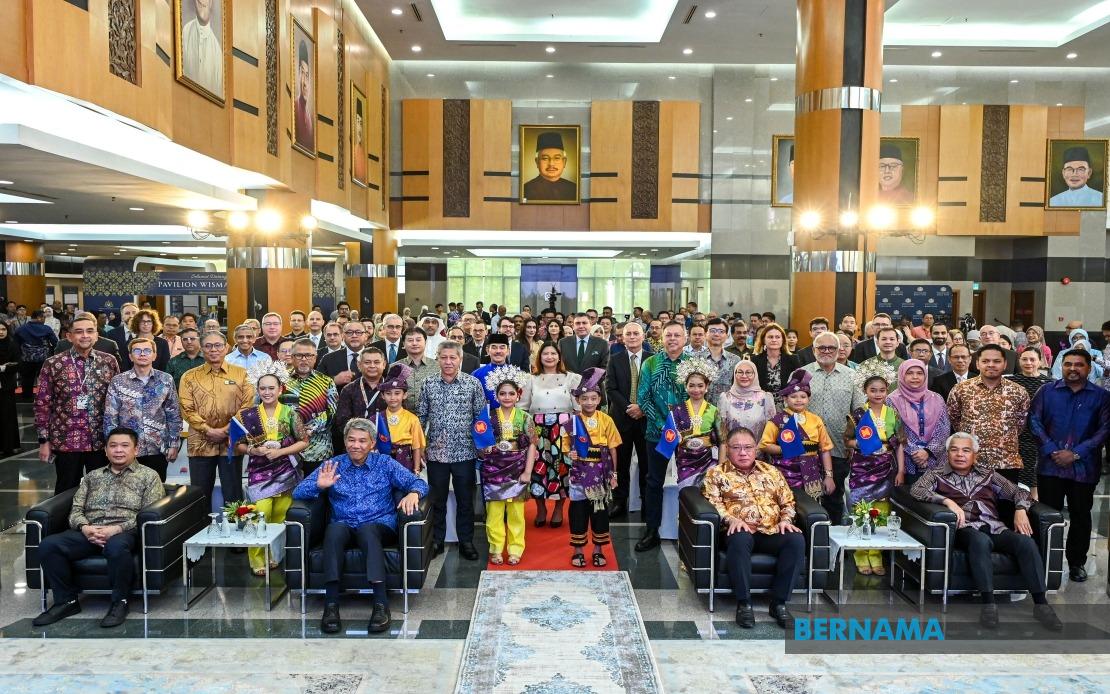
Malaysia joined the international community in commemorating ASEAN's 59th founding anniversary at an official celebration held in Putrajaya on Monday, bringing together approximately 300 guests to mark nearly six decades of regional partnership and cooperation. The event, hosted by Malaysia's Foreign Ministry, underscored the nation's central role in shaping Southeast Asia's trajectory since ASEAN's establishment and reflected on the progress achieved through sustained collaboration among member states.
Foreign Minister Datuk Seri Mohamad Hasan presided over the ceremony, which carried the thematic message "59 Years of Navigating Together". This framing encapsulates ASEAN's fundamental approach to regional challenges—a commitment to collective problem-solving rooted in shared interests and mutual respect for sovereignty. The message resonates particularly strongly in an era of geopolitical complexity, where Southeast Asian nations have relied increasingly on ASEAN mechanisms to maintain autonomy whilst addressing transnational concerns.
The celebration highlighted ASEAN's foundational architecture, which rests upon three interdependent pillars: political-security cooperation, economic integration, and socio-cultural exchange. For Malaysia, these dimensions represent more than abstract organisational principles. The political-security pillar has enabled dialogue on maritime disputes, terrorism prevention, and conflict management without surrendering national interests. The economic component has facilitated Malaysia's integration into regional supply chains and preferential trading arrangements, whilst the socio-cultural dimension has preserved ASEAN's unique identity as a community bound by shared values rather than coercive structures.
Also attending were Tourism, Arts and Culture Minister Datuk Seri Tiong King Sing, Deputy Foreign Minister Datuk Lukanisman Awang Sauni, alongside diplomats, government officials, and representatives of international organisations. The breadth of participation reflected ASEAN's importance across multiple government portfolios and its relevance to Malaysia's domestic and foreign policy agendas.
The ceremony featured a specially produced video montage entitled "ASEAN Journey: Navigating Our Future, Together - 59 Years of Malaysia in ASEAN", which traced Malaysia's contributions and experiences within the regional framework. This visual presentation served to educate younger generations and foreign observers about the historical context of Malaysia's engagement with Southeast Asian neighbours. A formal cake-cutting ceremony led by Foreign Minister Mohamad concluded the official programme, a symbolic gesture reaffirming collective celebration of shared achievements.
ASEAN's expansion since its founding reveals the organisation's magnetic appeal as a forum for regional states. Established on August 8, 1967, through the Bangkok Declaration signed by Indonesia, Malaysia, the Philippines, Singapore and Thailand, the grouping has grown substantially over five decades. Brunei's accession in 1984 marked the first enlargement, whilst Vietnam's 1995 admission represented a watershed moment as post-Cold War reconciliation enabled former adversaries to join the collective framework. The near-simultaneous admission of Laos and Myanmar in 1997 brought mainland Southeast Asia more fully into ASEAN's ambit, whilst Cambodia's 1999 entry completed the inclusion of Indochina's key players.
Most recently, Timor-Leste achieved full membership during the 47th ASEAN Summit in October of the previous year, bringing ASEAN's membership to eleven. This expansion from five to eleven states underscores the organisation's evolution from a Cold War instrument serving specific geopolitical purposes into a comprehensive regional institution encompassing virtually all of Southeast Asia. For Malaysia, this growth has both enriched the organisation's diversity and complicated consensus-building—the cornerstone of ASEAN decision-making.
The statement issued by Malaysia's Foreign Ministry emphasised that this year's anniversary represented a significant milestone in ASEAN's evolution. The organisation's track record demonstrates considerable institutional resilience, having navigated major crises including the 1997 Asian financial turmoil, the 2002-2003 SARS epidemic, the 2004 Indian Ocean tsunami, the global financial collapse of 2008, and most recently the Covid-19 pandemic. Through each challenge, ASEAN mechanisms—though often criticised as insufficiently robust—have provided frameworks for dialogue and coordinated response that prevented destabilising unilateral action.
For Malaysia specifically, ASEAN membership has proven instrumental in advancing national interests across multiple domains. Economically, ASEAN provided the foundation for the ASEAN Free Trade Area and subsequent agreements that have integrated Malaysian industries into broader Southeast Asian value chains. Politically, ASEAN has offered a platform for Malaysia to influence regional outcomes and maintain constructive relations with countries that possess divergent interests. Diplomatically, the organisation has allowed Malaysia to punch above its weight, leveraging collective ASEAN voice in bilateral and multilateral negotiations with major powers.
The contemporary relevance of ASEAN's founding principles becomes apparent when examined against current regional dynamics. As great power competition intensifies and extra-regional powers seek influence in Southeast Asia, ASEAN's commitment to political and security cooperation based on non-interference, respect for sovereignty, and peaceful settlement of disputes provides critical ballast. Malaysia's participation in ASEAN institutions enables it to maintain strategic flexibility whilst avoiding entanglement in great power rivalries that could compromise its interests or security.
Looking forward, ASEAN faces both opportunities and challenges that will test the solidarity celebrated at Monday's commemoration. Regional economic integration requires deeper coordination on labour standards, environmental protection, and digital governance. The South China Sea remains a source of potential friction, demanding sustained commitment to managing tensions through ASEAN-centred dialogue. Climate change, pandemic preparedness, and transnational crime necessitate collective action that transcends traditional diplomatic channels.
Malaysia's role in navigating these complexities will prove consequential for both ASEAN's future trajectory and Malaysia's own development aspirations. As a founding member and regional heavyweight, Malaysia carries particular responsibility for maintaining ASEAN's institutional cohesion and forward momentum. The 59th anniversary celebration thus represented not merely retrospective acknowledgment of past achievements, but a reaffirmation of commitment to principles that have enabled Southeast Asian nations to shape their own destinies in an increasingly complex international environment.

