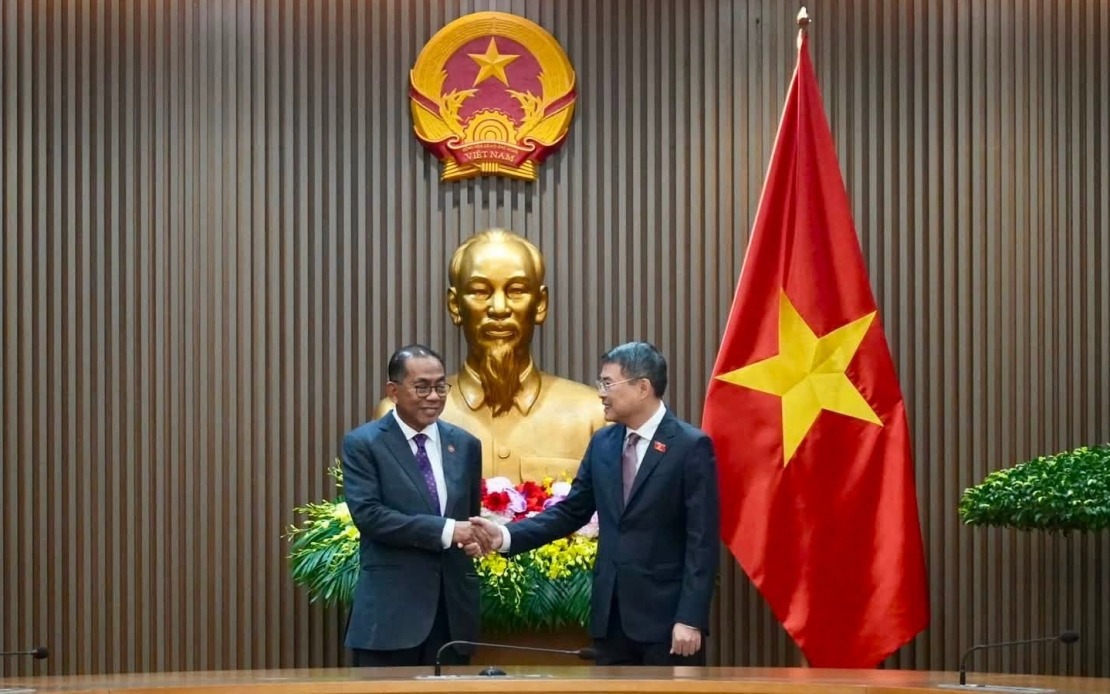
Malaysia and Vietnam have reaffirmed their commitment to deepening defence ties during a high-level meeting between Defence Minister Datuk Seri Mohamed Khaled Nordin and Vietnamese Prime Minister Lê Minh Hưng. The bilateral engagement underscored both nations' determination to elevate their defence relationship beyond existing frameworks, positioning it as a strategic partnership that reflects shared interests in maintaining regional stability.
During the official visit to Vietnam, Mohamed Khaled highlighted the breadth of collaborative initiatives under discussion. The two countries have identified several key domains for expanded engagement, notably maritime security operations, military capability enhancement, technology development, and joint ventures within the defence industrial sector. These pillars represent a comprehensive approach to bilateral defence cooperation that extends beyond traditional military exchanges to encompass modern security challenges facing the region.
The foundation for this strengthened partnership rests on longstanding trust and mutual respect. Malaysia views Vietnam as a dependable ally with whom it shares complementary strategic perspectives, particularly in upholding the principles that guide ASEAN's collective approach to regional affairs. Both nations consistently emphasize dialogue and diplomatic channels as the primary mechanisms for resolving disputes and preserving peace across Southeast Asia, a philosophy increasingly vital as geopolitical tensions rise globally.
A critical dimension of the renewed partnership centres on addressing contemporary security threats that transcend traditional military concerns. The officials acknowledged the complex threat environment shaped by great power competition, an issue of particular relevance to Southeast Asian nations navigating relationships with major global powers. The discussion also encompassed grey zone activities—a growing concern across the region where competitors employ coercive tactics that fall below the threshold of conventional conflict—alongside cyber threats that have become increasingly sophisticated and destabilizing.
The integration of artificial intelligence into defence strategies emerged as another priority area. As AI reshapes military capabilities and decision-making processes worldwide, Malaysia and Vietnam recognize the necessity of coordinating their approaches to ensure technological advancement serves regional interests rather than exacerbating vulnerabilities. The phenomenon of cognitive warfare, where adversaries target populations' perceptions and beliefs through disinformation and propaganda, represents yet another challenge demanding collaborative responses from likeminded partners.
Supply chain disruptions, accelerated by geopolitical fragmentation and pandemic-related challenges, also featured prominently in discussions. Defence industries depend heavily on resilient supply networks, and Malaysia and Vietnam can leverage their geographic positioning and manufacturing capabilities to strengthen regional self-sufficiency in critical defence systems and components. This economic dimension of defence cooperation creates mutual benefits extending beyond security considerations.
The 2023 Memorandum of Understanding on Defence Cooperation serves as the institutional framework guiding bilateral initiatives. Rather than representing a one-time agreement, this MoU functions as a living roadmap that evolves with changing circumstances and emerging opportunities. By explicitly designating it as the governing document for their partnership's next phase, both nations signal their intention to implement commitments systematically while remaining flexible enough to address unforeseen developments.
Maritime security deserves particular emphasis given the strategic importance of Southeast Asian waters. The region contains some of the world's busiest shipping lanes and remains subject to competing territorial claims, making robust maritime cooperation essential. Malaysia and Vietnam, both possessing significant maritime interests, stand to benefit substantially from coordinated patrols, intelligence sharing, and joint capacity-building exercises that enhance their ability to respond to unauthorized activities and protect vital sea routes.
Capability development initiatives promise to modernize both nations' military forces through knowledge transfer and collaborative acquisition programs. Rather than pursuing entirely independent modernization paths, joint development projects can optimize resource allocation while reducing costs and timelines. Technology cooperation similarly enables both countries to access innovations and expertise that might prove difficult or expensive to develop independently, creating efficiency gains that strengthen overall regional defence posture.
The defence industry cooperation dimension reflects growing recognition that security challenges increasingly demand integrated civil-military technological solutions. By fostering partnerships between Malaysian and Vietnamese defence manufacturers, both nations can develop indigenous capabilities in critical areas while generating economic benefits through job creation and technological advancement. Such cooperation also reduces dependence on external suppliers, a consideration gaining weight amid trade tensions and geopolitical fragmentation.
Mohamed Khaled's emphasis on ASEAN collective resilience reflects a broader strategic calculation. Rather than viewing bilateral ties as zero-sum competitions, Malaysia and Vietnam frame their partnership as contributing to regional stability that benefits all ASEAN members. This approach contrasts sharply with zero-sum security paradigms that have historically characterized other regions, positioning Southeast Asia as a model for pragmatic, interest-based cooperation despite persistent territorial disagreements.
The timing of this renewed commitment carries significance amid shifting regional dynamics. The Indo-Pacific region faces intensifying great power competition as established and rising powers vie for influence and strategic positioning. For a middle power like Malaysia and an important regional player like Vietnam, strengthening defence partnerships provides a mechanism to enhance agency and influence over their own security destinies rather than becoming passive objects of external powers' strategic competition.
Looking forward, the concrete expansion of maritime cooperation, technology sharing, and industrial partnerships will determine whether the renewed commitment translates into substantive outcomes or remains largely declaratory. The successful implementation of the 2023 MoU's provisions and the identification of new collaborative opportunities will demonstrate whether Malaysia and Vietnam can convert shared strategic interests into tangible enhancements of both nations' defence capabilities and broader regional stability.

