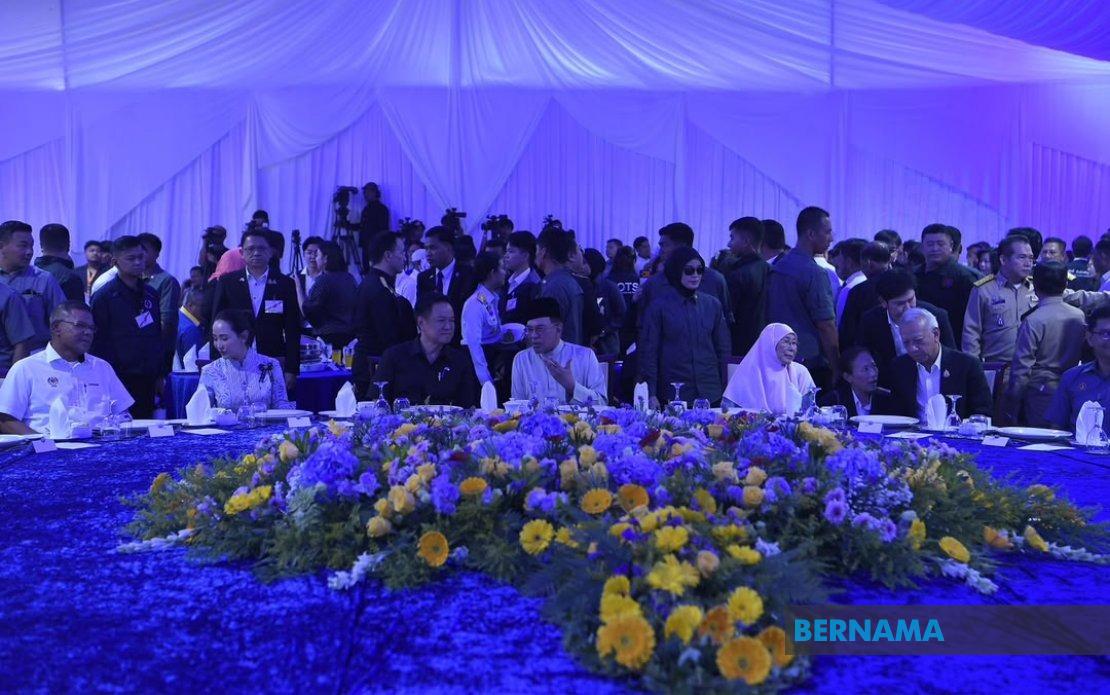
Prime Minister Datuk Seri Anwar Ibrahim and Thai Prime Minister Anutin Charnvirakul jointly inaugurated a modern road corridor on July 10 that connects Malaysia's Bukit Kayu Hitam Immigration, Customs, Quarantine and Security Complex with Thailand's Sadao Customs, Immigration and Quarantine facility. The milestone represents a significant upgrade to border infrastructure along one of Southeast Asia's busiest land crossings, replacing decades-old connectivity with state-of-the-art thoroughfares designed to handle contemporary cross-border traffic volumes.
The project underscores both governments' determination to deepen bilateral relations and integrate their border management systems. According to the Home Ministry, the initiative reflects a shared vision for strengthening diplomatic partnerships while simultaneously advancing the broader ASEAN agenda for regional economic integration. By modernising the physical and administrative linkages between the two nations, Malaysia and Thailand are positioning themselves as architects of improved regional connectivity that extends beyond their mutual border into the wider Southeast Asian trade and investment ecosystem.
Operationally, the new road commenced full service at 6 am Malaysia time on July 11, with the older Bukit Kayu Hitam-Danok crossing permanently closed from midnight the same day. This transition marks the culmination of careful coordination between Malaysian and Thai authorities to ensure seamless handover without disrupting the substantial daily flow of travellers, commercial vehicles and goods that traverse this critical artery. The phased approach allowed both nations to validate new systems, train personnel and communicate logistical changes to the travelling public and business community.
Beyond the symbolic significance of enhanced cooperation, the upgraded facility promises tangible economic and operational benefits for both countries. The modern infrastructure incorporates integrated control systems that streamline immigration procedures, customs clearance and quarantine protocols, reducing processing times and administrative bottlenecks that previously characterised border crossings in the region. These efficiency gains are particularly consequential for the logistics and supply chain sectors, which rely on predictable border transit windows to maintain just-in-time delivery schedules across the Malaysia-Thailand corridor.
The project aligns strategically with Malaysia's broader infrastructure modernisation agenda under the Malaysia MADANI framework, which prioritises leveraging contemporary technology and international collaboration to enhance national competitiveness. Border infrastructure represents a critical component of this vision, as entry and exit points serve as gateways for trade, investment and tourism—sectors essential to sustained economic growth. By partnering with Thailand on this upgrade, Malaysia demonstrates commitment to harnessing bilateral cooperation as a vehicle for advancing national development priorities while contributing to regional prosperity.
For the ASEAN North-South Economic Corridor specifically, this new crossing constitutes a meaningful advancement. The corridor functions as a vital arterial system connecting Indonesia, Malaysia, Thailand, Laos and beyond, facilitating the movement of capital, goods and labour across multiple borders. Improved Malaysia-Thailand connectivity directly enhances the corridor's overall efficiency, potentially attracting foreign investment to border regions and stimulating economic activity in previously peripheral areas. Business communities on both sides anticipate expanded opportunities for cross-border commerce, manufacturing networks and service provision.
The integration of modern border management systems carries secondary security implications worthy of note. Contemporary customs and immigration infrastructure enables real-time intelligence sharing, enhanced document verification and coordinated enforcement responses against illicit trafficking and security threats. By adopting integrated systems, both nations demonstrate commitment to combating transnational crime—drug smuggling, human trafficking, counterfeiting—while maintaining open channels for legitimate commerce and movement. This balance between security and facilitation remains central to contemporary border management philosophy throughout Southeast Asia.
The Home Ministry's emphasis on enhanced transparency and efficiency signals recognition that border operations increasingly serve as indicators of a nation's institutional capacity and commitment to rules-based governance. International businesses evaluating supply chain routes and investment locations closely monitor border crossing performance; delays, corruption or unpredictability significantly influence location decisions. By showcasing modernised, technology-enabled border infrastructure, Malaysia and Thailand send market signals about institutional reliability and professional management, potentially redirecting regional trade flows toward their shared corridor.
For Malaysian travellers, particularly those in the northern states who regularly cross into Thailand, the new infrastructure promises improved experience quality. Enhanced facilities typically incorporate better signage, expanded waiting areas, sanitary provisions and clearer procedural guidance—amenities that accumulate into meaningful quality-of-life improvements over repeated journeys. Tourism operators anticipate reduced border delays will make cross-border excursions more feasible for regional tourists, potentially increasing visitor flows in both directions.
The successful completion of this project reflects broader institutional learning in Southeast Asia regarding cross-border infrastructure development. Earlier generations of border crossings often developed haphazardly, with infrastructure lagging demand and systems remaining fragmented between nations. Contemporary approaches, exemplified by the Bukit Kayu Hitam-Sadao initiative, emphasise planned development, bilateral coordination and integrated system design from inception. This evolution reflects maturation of ASEAN regionalism, where states increasingly recognise that bilateral infrastructure investments yield multiplier benefits throughout the broader regional architecture.
Looking forward, the Home Ministry indicated this project represents an opening phase for expanded Malaysia-Thailand border cooperation. Officials flagged intentions to continue modernising other entry points through similar infrastructure investment and technology adoption strategies. The broader strategic context involves positioning Malaysia and Thailand as regional logistics hubs—roles increasingly critical as Southeast Asian economies deepen integration and global supply chains reconfigure around shifting geopolitical circumstances. Enhanced border infrastructure provides essential foundations for such aspirations.
The project also carries symbolic weight in contemporary regional diplomacy. Cross-border infrastructure development serves as tangible manifestation of bilateral commitment, offering populations visible evidence of government cooperation and concrete improvements to daily life. In an era where political relationships between neighbouring states can oscillate based on leadership changes or policy disputes, successful completion of infrastructure projects generates momentum and shared investment in positive relationships. Both nations have clearly prioritised signalling stability and sustained partnership through this collaborative initiative.

