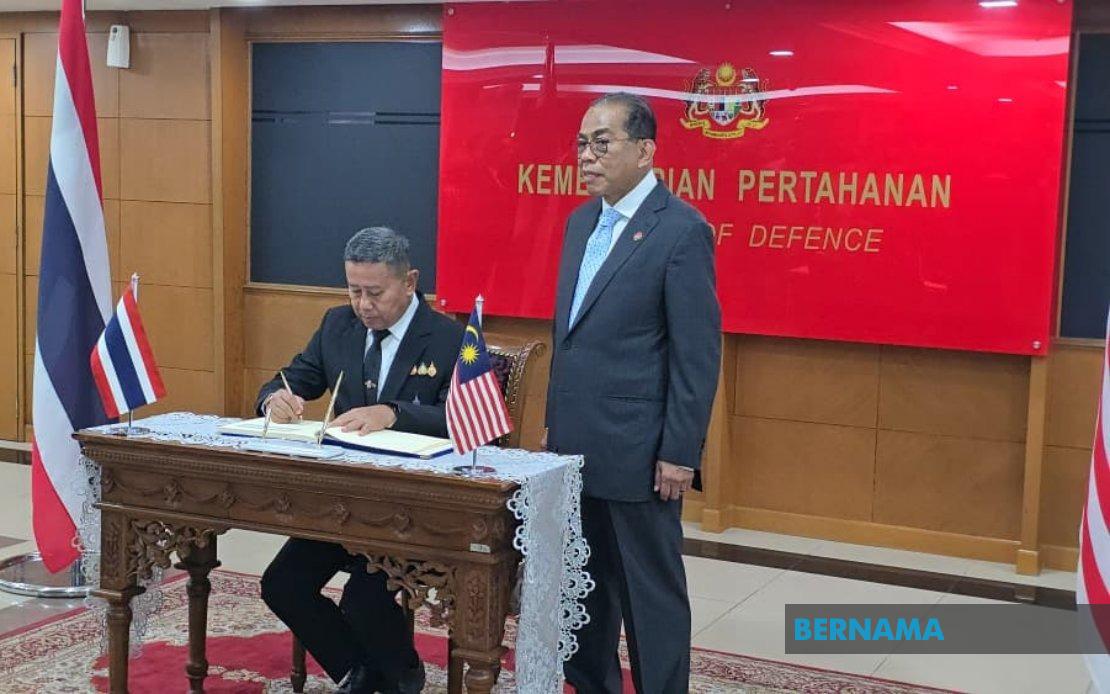
Malaysia and Thailand have moved to bolster their defence partnership, with the two nations' military leaders meeting in Kuala Lumpur to chart a course for deeper cooperation on regional security matters. The encounter between Defence Minister Datuk Seri Mohamed Khaled Nordin and Thailand's Defence Minister Lieutenant General Adul Boonthumjaroen underscores the importance both Southeast Asian nations place on coordinated action to maintain stability across the region.
Adul's visit to Wisma Pertahanan marked his introductory engagement with Malaysia's defence establishment following his appointment to the Thai defence portfolio. The formal bilateral meeting served as a platform for the two officials to discuss shared defence objectives and explore mechanisms through which Malaysia and Thailand can enhance their strategic alignment. Such high-level exchanges are crucial for building the trust and operational understanding necessary for effective regional cooperation in an era of evolving security challenges.
Mohamed Khaled extended his congratulations to Adul on assuming his ministerial role, signalling Malaysia's confidence in Thailand's commitment to regional development under Prime Minister Anutin Charnvirakul's leadership. The acknowledgement reflects the interconnected nature of Southeast Asian governance, where transitions in defence leadership carry implications for the broader security architecture of the region. By welcoming Thailand's new defence minister with formal recognition and expressions of confidence, Malaysia positions itself as a constructive partner invested in Thailand's institutional continuity.
Central to the discussions was a reaffirmation of both nations' dedication to promoting peace and stability throughout Southeast Asia. This commitment transcends bilateral interests; it speaks to a shared understanding that regional prosperity depends on a security environment free from major conflict. Malaysia and Thailand recognise that their defence partnership contributes to this broader objective by establishing channels of communication and mechanisms for addressing challenges that could otherwise destabilise neighbouring territories.
Thailand's explicit backing of Malaysia's mediation efforts in the Thailand-Cambodia border dispute represents a significant diplomatic gesture. Malaysia has invested considerable diplomatic capital in facilitating dialogue between Bangkok and Phnom Penh, seeking to defuse tensions that periodically flare along their shared frontier. Thailand's recognition of these efforts validates Malaysia's role as a neutral facilitator capable of bringing conflicting parties to the negotiating table—a function that enhances Malaysia's standing within ASEAN as a responsible regional actor.
The acknowledgement of Malaysia's proactive role in regional stabilisation carries practical significance for Southeast Asian security architecture. Border disputes, while sometimes dismissed as bilateral matters, have the potential to destabilise entire subregions through military escalation, refugee crises, and disruptions to regional trade. By working to resolve such conflicts, Malaysia contributes to the collective security of Southeast Asia, benefiting not only Thailand and Cambodia but also the broader association of nations dependent on regional stability for economic and social development.
Beyond the formal ministerial exchange, Adul's itinerary included a visit to the National Aerospace and Defence Industries (NADI) Group of Companies, a significant component of Malaysia's defence industrial base. This facility visit provided both delegations with an opportunity to examine concrete areas where Malaysia and Thailand could collaborate on defence procurement, technological development, or industrial partnerships. Such engagement at the technical and industrial level can translate high-level political commitment into tangible defence cooperation that benefits both economies.
The exploration of cooperation opportunities through NADI reflects a strategic approach to defence partnership that encompasses both security dialogue and industrial collaboration. Malaysia's defence sector offers capabilities and expertise that could support Thailand's modernisation efforts, while Thai requirements could stimulate Malaysian defence industries. This mutually beneficial arrangement strengthens defence-industrial ties across Southeast Asia and reduces reliance on external suppliers, a consideration of increasing importance as geopolitical competition intensifies in the region.
The bilateral engagement occurs against a backdrop of evolving regional dynamics, where traditional security concerns persist alongside emerging challenges ranging from transnational terrorism to maritime security and cybersecurity threats. Malaysia and Thailand, sharing borders with Cambodia, Myanmar, and maritime boundaries with other nations, face overlapping security imperatives that make bilateral and multilateral cooperation essential. The defence ministers' meeting signals that both governments view cooperation as a priority rather than an optional element of foreign policy.
For Malaysia specifically, strengthened ties with Thailand enhance the nation's capacity to address security challenges along its northern frontier while contributing to broader ASEAN cohesion. Thailand's cooperation in regional stabilisation efforts, particularly regarding the Cambodia border situation, creates positive spillover effects for Malaysia's own border security and regional diplomatic standing. As Malaysia positions itself increasingly as a voice for moderation and dialogue within ASEAN, partnerships grounded in mutual respect and shared security interests become essential assets.
The visit also underscores the continuity of Malaysia-Thailand defence relations across changes in Thai political leadership. Despite periodic transitions in Bangkok's government, defence cooperation between the two nations has remained relatively stable, suggesting that military-to-military engagement provides a foundation less vulnerable to political fluctuations than some other dimensions of bilateral relations. This institutional stability enables long-term planning and commitment to security objectives that transcend individual administrations.

