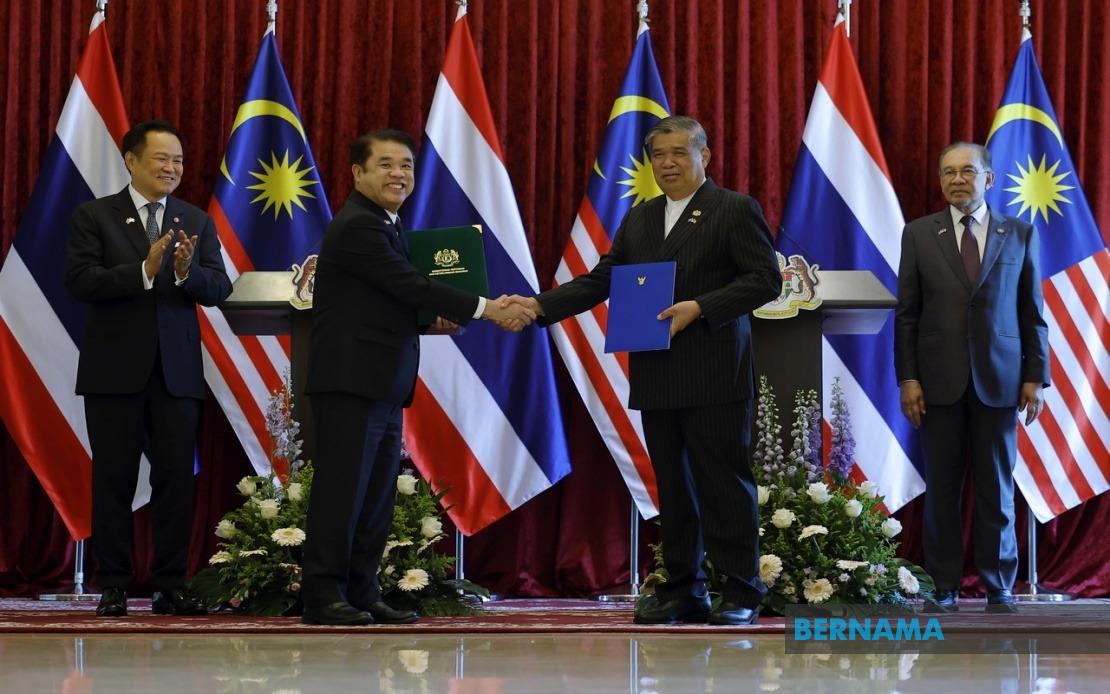
Malaysia and Thailand have cleared away contentious fisheries market access disputes and committed to implementing their Agricultural Cooperation Memorandum within one week, marking a significant breakthrough in bilateral relations at the ministerial and leadership level. The agreement was formalised during Thai Prime Minister Anutin Charnvirakul's inaugural official visit to Malaysia, with Prime Minister Datuk Seri Anwar Ibrahim and Anutin witnessing the signing ceremony between Agriculture and Food Security Minister Datuk Seri Mohamad Sabu and Thai Agriculture Minister Suriya Juangroongruangkit in Putrajaya.
The accelerated timeline for activation represents a decisive shift from the original Thai proposal, which had sought a one-and-a-half-month implementation period. Anwar's announcement that both nations had agreed to compress this to a single week underscores the political will from both capitals to move beyond protectionist measures and strengthen regional agricultural integration. This expedited approach signals recognition that protracted trade disputes can undermine broader economic cooperation objectives between two of Southeast Asia's most significant agricultural producers.
The fisheries impasse had lingered for several months, creating friction in what is otherwise a robust trade relationship. On June 1, Malaysia had implemented stricter import controls on Thai fisheries products, requiring Certificates of Analysis for barramundi imports and imposing temporary restrictions on five specific shrimp species. These measures, while ostensibly designed to ensure product safety and traceability, had created uncertainty for Thai exporters and disrupted supply chains across the region. The resolution of these technical barriers reflects a pragmatic negotiation process where both agricultural ministries identified pathways to maintain regulatory standards whilst facilitating legitimate trade flows.
The newly activated Agricultural Cooperation Memorandum establishes a comprehensive framework extending far beyond the immediate fisheries dispute. The accord encompasses crop production, livestock management, fisheries cooperation, trade facilitation, and agri-food marketing strategies. Critically, the framework also addresses research and development partnerships, capacity building initiatives, and alignment of biosecurity standards alongside sanitary and phytosanitary measures—technical areas where harmonisation can unlock significant efficiency gains and cost reductions for producers on both sides of the border.
For Malaysia, the institutionalisation of agricultural cooperation through this structured mechanism offers tangible benefits to domestic producers and consumers alike. The agreement establishes clearer communication pathways and more transparent coordination mechanisms between Malaysian and Thai agricultural authorities, enabling faster resolution of future trade impediments without escalating tensions or imposing unilateral restrictions. This institutional architecture is particularly valuable given the geographic and economic interdependencies characterising the broader Southeast Asian agricultural landscape.
The bilateral agricultural trade relationship has demonstrated robust growth trajectories despite periodic friction points. Between January and December 2025, agricultural and agri-food commerce reached RM20.33 billion, reflecting both nations' mutual dependence on cross-border agricultural flows. Malaysia's primary exports to Thailand encompass coffee, cocoa, tea, spices, and processed food commodities—predominantly higher-value-added products reflecting Malaysia's positioning within regional value chains. Conversely, Thai shipments centre on meat and meat-based products, categories where Thailand maintains significant competitive advantages rooted in its livestock production capabilities and geographic positioning as a regional agricultural hub.
Anutin's explicit acknowledgement that food security constituted a central focus of his discussions with Malaysian leadership reflects broader geopolitical realities across Southeast Asia. Regional supply chain vulnerabilities, climate volatility, and demographic pressures have elevated food security from a sectoral policy concern to a strategic national interest consideration. Thailand and Malaysia, as net agricultural exporters with significant domestic consumption requirements, face parallel imperatives to ensure stable, diversified, and resilient food supply networks. Bilateral cooperation on agricultural matters therefore extends beyond commercial considerations to encompass existential questions of national food security.
The bilateral engagement framework extends considerably beyond agricultural technicalities. Anwar noted that earlier discussions between the two leaders had addressed trade expansion, investment flows, regional cooperation mechanisms, and international issues of mutual concern. This multifaceted approach reflects recognition that compartmentalised negotiations often fail to unlock collaborative potential. By embedding agricultural cooperation within a broader bilateral partnership framework, both nations create momentum and political stakes that incentivise problem-solving across multiple policy domains simultaneously.
From a Southeast Asian perspective, the Malaysia-Thailand agricultural cooperation model offers instructive precedent value. Many regional governments struggle with the tension between protecting domestic producers and facilitating regional trade integration. The resolution achieved here—where both nations maintained their regulatory objectives while eliminating protectionist arbitrariness—demonstrates that these objectives need not be mutually exclusive. The structured dispute resolution mechanism embedded within the Agricultural Cooperation Memorandum could potentially serve as a reference model for other bilateral agricultural relationships across ASEAN, where similar tensions periodically surface.
The acceleration of the MoU implementation timeline also signals confidence from both agricultural ministries in their capacity to operationalise the agreement effectively. Rather than requesting extended preparation periods, both Datuk Seri Mohamad Sabu and Suriya Juangroongruangkit apparently concluded that their respective government agencies possessed sufficient institutional readiness and technical capacity to activate the framework immediately. This reflects positive assessments of administrative preparedness and suggests that implementation challenges, if they emerge, will likely concern substantive policy questions rather than procedural deficiencies.
Looking forward, the consolidated agricultural cooperation framework creates foundation for addressing emerging bilateral agricultural challenges collaboratively rather than through unilateral trade restrictions. Climate change impacts on agricultural productivity, evolving food safety standards, labour availability across agricultural sectors, and infrastructure requirements for value-chain development represent shared challenges where bilateral coordination mechanisms could generate superior outcomes compared to isolated national policy responses. The institutionalisation achieved through this MoU therefore establishes parameters for productive problem-solving extending well beyond current disputes into foreseeable future challenges.
For Malaysian consumers and agricultural producers, the resolution holds multiple implications. Cheaper Thai agricultural imports, particularly meat products, should become more reliably available following the clearance of import restrictions, potentially exerting downward pressure on domestic food prices whilst maintaining requisite safety standards. Simultaneously, Malaysian agricultural exporters can access Thai markets with greater predictability, supporting their expansion planning and investment decisions. The structured communication mechanism should prevent future disputes from escalating into trade wars that disproportionately harm small and medium-sized producers lacking capacity to navigate protectionist environments.
The timing of this resolution, occurring during Thailand's transition period as the country navigates its own domestic political complexities under Prime Minister Anutin Charnvirakul's leadership, carries additional significance. Securing tangible bilateral achievements during his initial official visit to Malaysia enhances his standing domestically whilst demonstrating capacity to deliver concrete outcomes benefiting Thai agricultural constituencies. For Malaysia's leadership, the successful expedited resolution reinforces Putrajaya's capacity as a responsible regional partner committed to resolving disputes through dialogue and structured negotiation rather than escalatory tactics.

