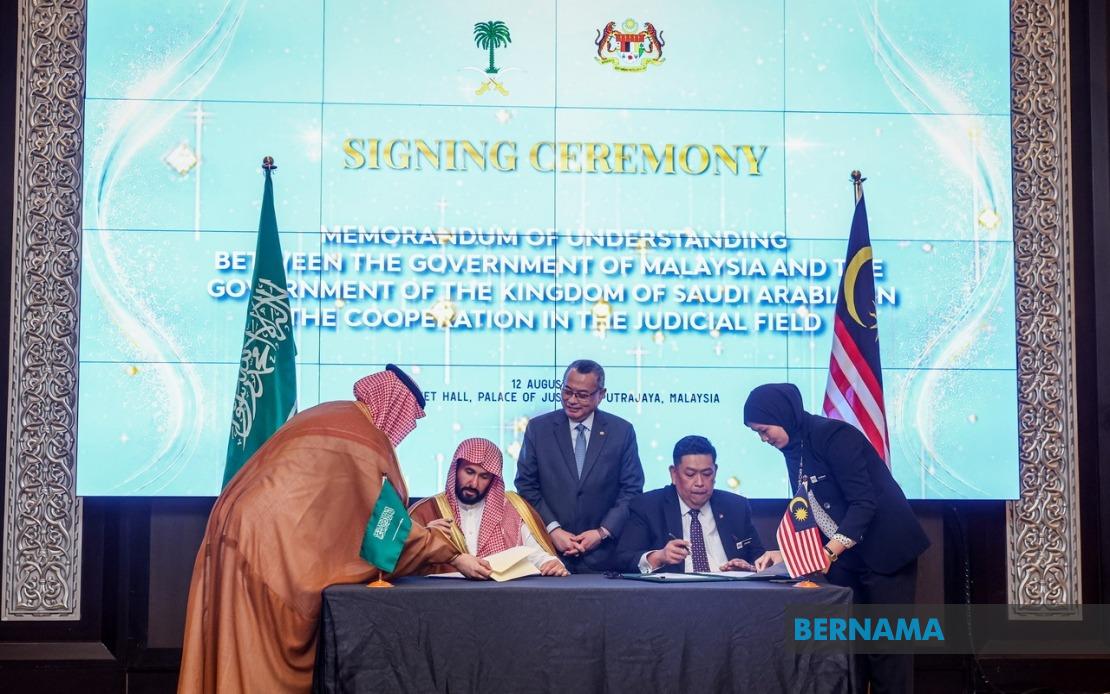
Malaysia and Saudi Arabia have formalized their commitment to strengthening judicial cooperation through the signing of a memorandum of understanding at the Palace of Justice in Putrajaya. The agreement, inked between Chief Registrar of the Federal Court of Malaysia Azhaniz Teh Azman Teh and Saudi Arabian Minister of Justice Sheikh Dr Waleed Mohammed Alsmani, marks a significant development in bilateral relations between the two predominantly Muslim nations. The signing ceremony, witnessed by Chief Justice Tun Wan Ahmad Farid Wan Salleh, took place during Sheikh Dr Waleed's official visit to Malaysia, underscoring the strategic importance both countries place on deepening their institutional ties.
The MoU establishes a structured framework addressing multiple dimensions of judicial interaction and modernisation. Beyond traditional areas of cooperation, the agreement encompasses civil case management protocols, judicial technology advancement and the digitalisation of court systems—a priority for both nations as they navigate the demands of contemporary litigation. The inclusion of technological cooperation reflects the broader global trend among judiciaries to streamline operations through digital infrastructure, reducing processing times and improving access to justice for citizens.
A critical component of the agreement involves the systematic exchange of practical experience and publicly available judicial information. This knowledge-sharing mechanism allows judges, court administrators and legal professionals from both countries to study each other's approaches to case administration, legal procedures and institutional best practices. Such exchanges are particularly valuable for smaller judicial systems seeking to benchmark their operations against established frameworks, and for larger systems to understand innovative solutions developed elsewhere.
The MoU also provides for institutional visits and regular exchanges between Malaysian and Saudi judicial officials. These direct engagements facilitate informal networking and relationship-building among members of the judiciary, fostering the personal connections that often prove essential for effective inter-governmental cooperation. Through recurring dialogue sessions, both nations can identify emerging challenges in their respective legal systems and collaboratively explore solutions grounded in practical experience rather than theoretical frameworks.
A notable focus of the initial engagement involves Malaysia's expertise in addressing sexual offences against children. During the visit, Malaysian judicial representatives shared their specialised approach to handling such sensitive cases, which often require careful attention to both evidentiary standards and the psychological welfare of child witnesses. This knowledge-sharing reflects Malaysia's confidence in its own judicial protocols and suggests Saudi Arabia views the Malaysian system as a model worth studying, particularly in developing procedures that balance justice with victim protection.
Equally significant is the attention given to Malaysia's e-Court system, a comprehensive digital platform that has transformed how the Malaysian Judiciary operates. This technology encompasses electronic filing, digital case management, virtual hearings and online access to court information. For Saudi Arabia, which is itself modernising its judicial infrastructure as part of broader Vision 2030 reforms, understanding Malaysia's experience with digital transformation offers practical insights into implementation challenges, user adoption strategies and system architecture decisions.
The bilateral partnership reflects the deepening institutional engagement between Malaysia and Saudi Arabia beyond traditional diplomatic channels. While both nations maintain long-standing cordial relations rooted in shared Islamic heritage and commercial ties, this judicial MoU represents a deliberate effort to operationalise cooperation in a sector fundamental to governance and rule of law. The judiciary's role in society extends beyond dispute resolution to encompassing public confidence in institutional fairness and transparency, making judicial cooperation agreements particularly significant in advancing mutual development goals.
For Malaysia, the agreement positions the country as a centre of judicial expertise in Southeast Asia and the broader Islamic world. By formalising knowledge-sharing arrangements with a major regional power like Saudi Arabia, Malaysia enhances its soft power and demonstrates the quality of its judicial institutions to other potential partners. This can catalyse additional judicial cooperation agreements with other nations and elevate Malaysia's profile as a contributor to global legal standards and best practices.
The timing of this MoU reflects both nations' broader commitment to institutional modernisation and governance reform. Malaysia has invested significantly in digitalising its courts and developing specialised judicial protocols for complex issues including cybercrime, family law and commercial disputes. Saudi Arabia, under its Vision 2030 development agenda, has prioritised modernising its legal system as part of broader social and economic transformation. The judicial cooperation agreement provides a practical mechanism through which both nations can accelerate these reforms by learning from each other's experiences.
The Office of the Chief Registrar's statement emphasising the MoU's role in providing a "structured platform for closer institutional engagement" suggests the agreement goes beyond symbolic gesture to create actionable mechanisms for ongoing cooperation. This structural approach increases the likelihood of sustained engagement beyond the initial signing ceremony, as specific areas of cooperation have been identified and frameworks for implementation established. Such clarity reduces the risk of the agreement becoming dormant, a common fate for international MOUs that lack specific implementation protocols.
For Southeast Asian judicial systems more broadly, this Malaysia-Saudi Arabia partnership offers a template for meaningful inter-regional cooperation. Rather than limiting engagement to formal diplomatic exchanges, both countries have identified concrete areas—technology, case management, specialised legal knowledge—where institutional learning can occur. This pragmatic approach to judicial cooperation may inspire similar initiatives among ASEAN members and with external partners seeking to strengthen rule of law and institutional capacity.
The agreement also signals both nations' willingness to engage in comparative study of judicial systems despite differences in legal traditions and constitutional frameworks. Malaysia operates a common law system with parliamentary democracy, while Saudi Arabia follows civil law traditions within an absolute monarchy. That both see value in systematic cooperation despite these structural differences demonstrates sophisticated understanding of the universal principles underlying effective judicial administration, transcending specific constitutional arrangements or legal family classifications.
Looking forward, the success of this MoU will depend on consistent implementation by both judiciaries. Regular exchange visits, documented best practice sharing and collaborative problem-solving on identified issues will determine whether the agreement becomes a dynamic partnership or remains primarily ceremonial. The inclusion of specific areas like e-Court digitalisation provides measurable milestones that can gauge progress and maintain momentum, suggesting both parties have given serious thought to making this partnership substantive rather than merely aspirational.

