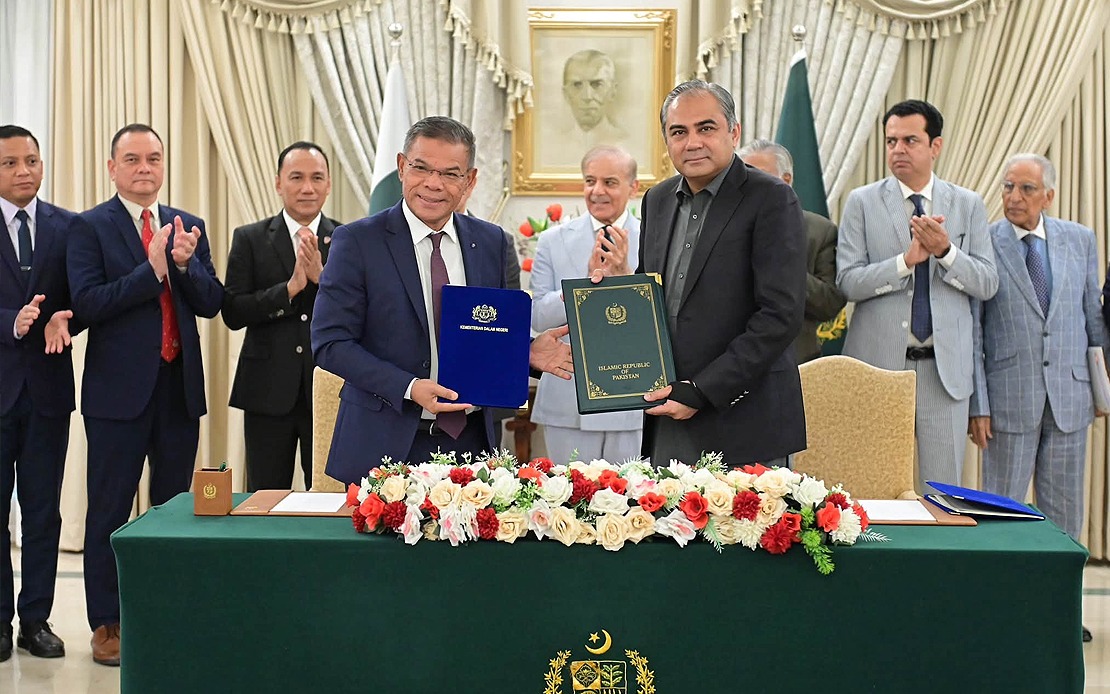
Malaysia and Pakistan have taken a significant step in deepening their bilateral relationship by formalising the International Transfer of Prisoners Treaty, a legal instrument designed to facilitate the repatriation of convicted nationals. Home Minister Datuk Seri Saifuddin Nasution Ismail inked the agreement with Pakistan's Interior and Narcotics Control Minister Syed Mohsin Raza Naqvi during an official visit to Islamabad, with Pakistan Prime Minister Muhammad Shehbaz Sharif witnessing the historic signing at the Prime Minister's Office.
The treaty represents the culmination of intensive diplomatic negotiations spanning five consecutive rounds of talks since September 2025, involving multiple Malaysian agencies working in concert to craft the final terms. The Home Ministry, Foreign Ministry, Attorney General's Chambers, Malaysian Prisons Department, and Royal Malaysia Police all contributed substantially to the negotiating process, reflecting the comprehensive nature of the agreement and its implications for national security and criminal justice administration. The Malaysian Cabinet had already granted its approval for the treaty on May 13, clearing the way for the formal signing ceremony in Islamabad.
Under the bilateral arrangement, Malaysian nationals imprisoned in Pakistan will have the opportunity to be transferred back to Malaysian correctional facilities to complete their remaining sentences. Conversely, Pakistani citizens serving time in Malaysian prisons can similarly be repatriated to Pakistan to fulfil their outstanding prison terms. This mutual arrangement addresses a longstanding gap in the legal frameworks governing the two nations and eliminates the previous constraint that imprisoned citizens had to serve their full sentences far from home, separated from family support systems and cultural contexts.
The humanitarian dimension of this treaty extends beyond simple logistics. Saifuddin Nasution emphasised that the transfer mechanism enables prisoners to access rehabilitation programmes specifically tailored to their cultural backgrounds and national contexts. Individuals undergoing correctional intervention are more likely to benefit from interventions designed within their own cultural framework and delivered in familiar linguistic and social environments. This alignment between rehabilitation programming and cultural appropriateness reflects modern penological thinking that recognises the importance of culturally sensitive prisoner management.
For Malaysia specifically, the agreement carries particular significance given the nation's ongoing challenges with transnational crime and its role as a transit point for narcotics trafficking and human smuggling networks across Southeast Asia. By establishing clearer protocols for managing foreign nationals within the Malaysian penal system, the treaty contributes to more efficient resource allocation and reduces the administrative burden on Malaysian correctional authorities. Pakistani nationals held in Malaysian facilities will have clearer pathways to repatriation, freeing up prison capacity for the management of domestic offenders.
The timing of this agreement coincides with broader patterns of institutional strengthening across South Asia and Southeast Asia, where nations are increasingly formalising legal cooperation mechanisms to address cross-border criminal challenges. The International Transfer of Prisoners framework has been adopted by numerous countries globally and represents best practice in criminal justice administration. Malaysia's signature joins it with a growing constellation of nations committed to principles of prisoner welfare, rehabilitation, and efficient criminal justice resource management.
From a regional perspective, the Malaysia-Pakistan treaty demonstrates how bilateral cooperation can extend beyond trade and diplomatic pleasantries into substantive areas affecting citizens' wellbeing and national security. Pakistan, grappling with its own security challenges and prison system pressures, gains an important partner in managing its citizens abroad, while Malaysia strengthens its capacity to address transnational criminal networks and foreign offender populations. The agreement also signals both nations' commitment to modern, rules-based approaches to criminal justice rather than ad-hoc arrangements that can create complications and inefficiencies.
Saifuddin Nasution characterised the treaty signing as a milestone reflecting the longstanding and multifaceted relationship between Malaysia and Pakistan. The two nations share historical ties rooted in Islamic heritage, possess overlapping strategic interests in maritime security and counterterrorism, and have developed increasingly sophisticated commercial partnerships. The addition of this prisoner transfer mechanism to their existing bilateral architecture demonstrates a willingness to expand cooperation into areas that, while sometimes overlooked in public discourse, carry substantial practical implications for citizens and security establishments.
The treaty's formalisation also has subtle but important implications for regional stability. Clear, transparent mechanisms for managing prisoners from neighbouring countries reduce the potential for diplomatic friction arising from incarceration disputes or claims of mistreatment. By establishing agreed-upon transfer protocols and rehabilitation standards, both nations commit to treating each other's citizens according to internationally recognised humanitarian and legal principles. This transparency and predictability, while seemingly technical, contributes meaningfully to the foundations of stable bilateral relations.
For Malaysian citizens currently imprisoned in Pakistan and Pakistani nationals serving time in Malaysian facilities, the treaty opens pathways they previously lacked. The psychological and practical benefits of serving sentences in one's homeland are substantial, from maintaining family connections to accessing native language services within correctional facilities. These considerations, though human-scale rather than geopolitical, constitute the real-world value proposition of such agreements and explain why treaty-making in this space matters beyond ceremonial international relations.
The broader architecture of Malaysia-Pakistan cooperation now encompasses this new legal instrument alongside existing frameworks for extradition, mutual legal assistance, and law enforcement cooperation. Each addition to this architecture incrementally strengthens the capacity of both nations to address transnational crime and manage shared security challenges. As organised crime, narcotics trafficking, and terrorism increasingly operate across borders, bilateral mechanisms like the ITOP treaty become essential components of effective national and regional security strategies.

