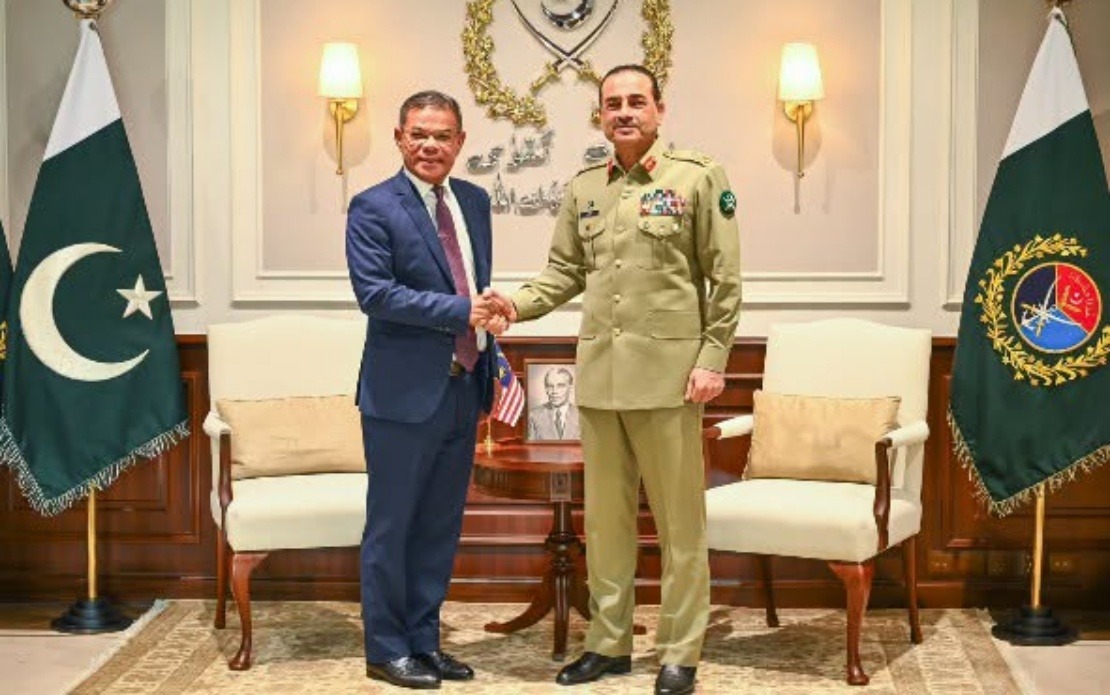
Malaysia and Pakistan have reaffirmed their commitment to multilateral diplomacy as a mechanism for resolving conflicts, following high-level discussions between Home Minister Datuk Seri Saifuddin Nasution Ismail and Pakistan's Chief of Defence Forces and Chief of Army Staff Field Marshal Syed Asim Munir at the General Headquarters in Rawalpindi during an official visit this week.
The bilateral engagement centred on how both nations have employed diplomatic channels and peace-building initiatives to address regional and international security challenges. The meeting provided a platform for both delegations to examine contemporary security developments and assess the effectiveness of dialogue-based approaches in managing geopolitical tensions, particularly in South and Southeast Asia where competing interests have complicated stability efforts.
Saifuddin Nasution highlighted Pakistan's instrumental role in mediating negotiations between the United States and Iran, underscoring Islamabad's standing as a credible interlocutor in multilateral disputes. During their discussions, Field Marshal Syed Asim detailed Pakistan's approach to facilitating peace talks, drawing on decades of experience navigating complex regional dynamics involving multiple state and non-state actors. This experience is particularly relevant given Pakistan's geographical position and its involvement in various diplomatic initiatives addressing tensions in the Middle East and South Asia.
The Malaysian Home Minister reciprocated by sharing experiences from Malaysia's facilitation of negotiations between Thailand and Cambodia, which culminated in a ceasefire agreement. These talks demonstrate Malaysia's evolving role in regional conflict resolution, extending beyond its traditional position within ASEAN. The Thailand-Cambodia case exemplifies how sustained diplomatic engagement can transform protracted disputes into manageable arrangements, offering lessons applicable to other regional friction points where dialogue has stalled or become adversarial.
Both nations recognised that despite operating within distinct geopolitical contexts and facing unique security challenges, the underlying principles of effective conflict resolution remain consistent. Diplomacy, sustained dialogue, and genuine confidence-building measures emerged as the cornerstone of their respective approaches. This convergence of views suggests growing alignment between Malaysian and Pakistani perspectives on how international disputes should be addressed in an era of increasing polarisation and great power competition.
The emphasis on dialogue reflects a broader Southeast and South Asian perspective that prioritises negotiation over confrontation, contrasting with more militaristic or coercive approaches favoured by some global powers. For Malaysia specifically, the meeting reinforces its commitment to positioning itself as a neutral broker and advocate for peaceful resolution mechanisms, a role increasingly important as regional tensions escalate around maritime boundaries, trade routes, and strategic resources.
Malaysia's interest in learning from Pakistan's experience with US-Iran mediation holds particular significance for ASEAN nations monitoring developments in the Middle East. Disruptions in the Strait of Hormuz or broader Middle Eastern instability directly impact trade flows and energy security throughout Southeast Asia. By understanding how Pakistan navigated that sensitive negotiation, Malaysia can develop more sophisticated approaches to protecting its own regional interests when international crises threaten commercial and security stability.
The convergence of perspectives on conflict resolution also reflects both nations' commitment to the United Nations Charter principles and international law, even as their respective regions experience mounting pressure from hegemonic actors. This shared commitment to peaceful resolution creates potential for deeper cooperation on regional security frameworks, counter-terrorism coordination, and maritime security challenges that affect both South and Southeast Asia.
Saifuddin Nasution's visit and subsequent engagement underscore Malaysia's intention to deepen security partnerships beyond traditional ASEAN frameworks. By engaging directly with Pakistan's military and defence establishment, Malaysia signals its interest in bilateral security cooperation while simultaneously maintaining its non-aligned orientation. This balancing act remains critical as Malaysia seeks to preserve strategic autonomy while building relationships with nations that share its commitment to diplomacy as the primary mechanism for addressing international disputes.
The meeting occurs at a juncture when both regions face escalating tensions. Pakistan navigates complex relationships with multiple neighbours and regional powers, while Malaysia contends with South China Sea disputes, maritime border disagreements with neighbouring countries, and broader regional competition. The exchange of conflict resolution experiences provides both nations with analytical frameworks and practical insights for addressing current and emerging security challenges without resorting to military escalation.
Moving forward, Malaysia's emphasis on continuing to champion diplomatic approaches and negotiated settlements reflects strategic calculations about regional stability. The country recognises that military buildups and confrontational rhetoric may satisfy domestic constituencies temporarily but ultimately undermine the conditions necessary for prosperity. By positioning itself as an advocate for dialogue-based conflict resolution, Malaysia contributes to creating international norms that favour negotiation over force, benefiting smaller nations that lack military dominance but possess diplomatic credibility and convening power.

