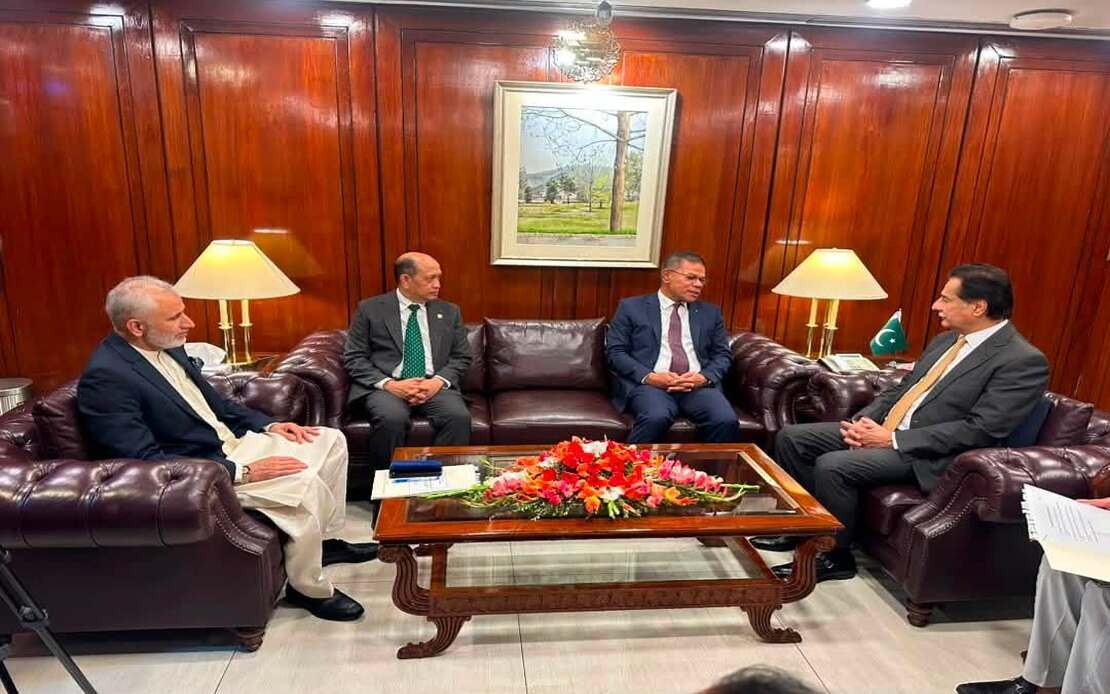
Home Minister Datuk Seri Saifuddin Nasution Ismail has underscored the mutual understanding between Malaysia and Pakistan on pursuing peaceful and diplomatic channels to tackle the mounting geopolitical tensions and security issues confronting the region. This reaffirmation came during his official visit to Islamabad, where he held substantive discussions with Pakistan's parliamentary leadership, including Sardar Ayaz Sadiq, Speaker of the National Assembly, and Syed Yousaf Raza Gilan, chairman of the Senate.
The exchanges between the two delegations reflected a broader recognition of the limitations of military posturing and the necessity for sustained engagement through structured dialogue mechanisms. Both nations appear cognisant that contemporary security challenges—ranging from transnational terrorism to maritime disputes and political instability—demand collaborative frameworks rather than adversarial positioning. The convergence on this principle carries particular significance given the complex security environment in South and Southeast Asia, where competing strategic interests among major powers have intensified underlying tensions.
Saifuddin Nasution articulated Malaysia's own approach to regional stability, emphasising how the country has leveraged ASEAN's institutional architecture to promote constructive engagement and prevent disputes from escalating into open conflict. By sharing this experience with Pakistani counterparts, Malaysia implicitly offered a model of how smaller and medium-sized nations can maintain agency and protect their interests through collective diplomatic frameworks rather than unilateral actions. The ASEAN approach, built on consensus-building and non-interference in internal affairs, contrasts with more confrontational strategies that have characterised parts of South Asian diplomacy.
The bilateral relationship between Malaysia and Pakistan, rooted in shared Islamic heritage and historical ties forged during independence struggles, provides a foundation for cooperation that transcends purely strategic considerations. Both nations have maintained consistent diplomatic engagement, though the relationship has occasionally been overshadowed by Pakistan's closer ties with China and its focus on Afghanistan and Indian relations. The emphasis on trust and mutual respect during these latest talks suggests an attempt to revitalise substantive cooperation beyond ceremonial exchanges.
Parliamentary diplomacy emerged as a focal point in the discussions, with both sides recognising the distinct role legislative bodies play in building people-to-people connections and shaping long-term policy directions. Parliamentary exchanges, often less constrained by executive protocol and more reflective of diverse domestic viewpoints, can facilitate candid conversations on sensitive issues. The commitment to expand parliamentary institution ties indicates an intention to deepen engagement at multiple levels of governance, creating redundancies in the diplomatic relationship that prevent disagreements from derailing overall cooperation.
Saifuddin Nasution's visit to the Parliament Museum of Pakistan underscored a deeper interest in understanding institutional development and constitutional evolution. This engagement reflects a recognition that effective governance and democratic accountability contribute to regional stability. Pakistan's struggle to maintain consistent democratic governance has been well-documented, and Malaysia's own experience navigating constitutional monarchy with parliamentary democracy offers relevant lessons. Such institutional learning, when approached respectfully, can strengthen both nations' capacity to manage internal challenges without externally destabilising effects.
The timing of these discussions carries weight given broader regional developments. The withdrawal from Afghanistan, persisting India-Pakistan tensions, and the shifting great power competition in South Asia have created an environment where nations like Pakistan face genuine security dilemmas. Malaysia, though geographically distant, shares concerns about maritime security, counter-terrorism, and maintaining strategic autonomy amid competing pressure from major powers. The reaffirmation of dialogue as the primary tool for conflict resolution represents a principled stance that distinguishes both nations from those pursuing more transactional or coercive approaches.
For Malaysian policymakers, maintaining strong relations with Pakistan serves multiple strategic purposes. Pakistan remains an important Muslim-majority nation with significant geopolitical weight, and fostering constructive engagement supports broader Malaysian objectives of building a multipolar international order where smaller nations retain influence. Additionally, Pakistan's role in addressing terrorism and extremism—issues of direct concern to Malaysia—makes bilateral cooperation on security matters substantive rather than ceremonial.
The emphasis on constructive engagement and peaceful solutions also implicitly critiques international approaches that prioritise military containment or sanctions regimes as primary policy instruments. Both Malaysia and Pakistan have experienced the limitations of such approaches and have reason to advocate for diplomacy-first strategies. This philosophical alignment, while not representing formal alliance politics, creates space for coordinated positions in multilateral forums where both nations can advocate for similar principles.
Moving forward, the success of this diplomatic engagement will depend on translating high-level rhetoric into concrete cooperation mechanisms. This might include enhanced parliamentary exchanges, joint working groups on security challenges, expanded people-to-people programmes, and coordinated diplomatic positioning on regional issues. The relationship between Malaysia and Pakistan, while historically warm, has often remained underutilised relative to its potential, particularly in addressing shared security concerns and promoting regional stability.
The broader implication for Southeast Asia is that nations in the region can benefit from Pakistan's experience managing complex geopolitical environments while offering their own models of multilateral cooperation and institutional development. As regional tensions persist and global competition intensifies, the dialogue between Malaysia and Pakistan exemplifies how principles of peaceful resolution and diplomatic engagement remain central to responsible statecraft.

