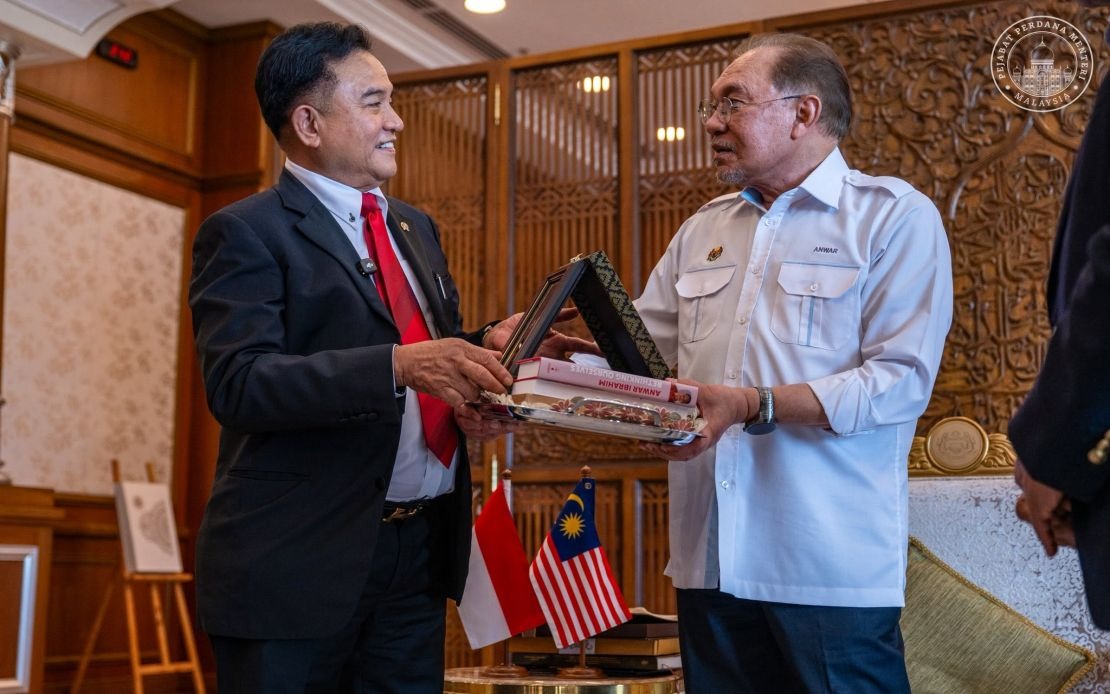
Malaysia and Indonesia have signalled their intention to deepen institutional cooperation across legislative frameworks, governance structures, and several areas of strategic mutual concern. Prime Minister Datuk Seri Anwar Ibrahim made the commitment during a meeting with Indonesia's Coordinating Minister for Legal, Human Rights, Immigration and Correction, Prof Dr Yusril Ihza Mahendra, at the Prime Minister's Office in Putrajaya on June 29.
The discussion between the two senior officials underscores the ongoing diplomatic engagement between Southeast Asia's two largest Muslim-majority democracies. As neighbouring nations with significant trade relationships, maritime boundaries, and shared security challenges, Malaysia and Indonesia have long recognised the importance of coordinated policy-making and institutional alignment. The meeting represents part of a broader pattern of high-level bilateral engagement aimed at ensuring both nations' interests are complementary rather than competitive.
Anwar, who holds the dual portfolios of Prime Minister and Finance Minister, indicated that both delegations exchanged substantive views on concrete measures to advance cooperation across the identified sectors. The focus on legislative and governance matters suggests both governments are keen to harmonise certain regulatory frameworks and administrative practices where applicable. For Malaysia, such alignment with Indonesia carries particular significance given the countries' interconnected financial systems, integrated supply chains, and shared concerns about regional stability.
The emphasis on legislative cooperation reflects a mature understanding that effective bilateral relations require more than diplomatic niceties. Both nations have sophisticated parliamentary systems and complex regulatory environments. Closer coordination in these areas can facilitate smoother cross-border business operations, streamline dispute resolution mechanisms, and enable more effective responses to transnational challenges ranging from corruption and money laundering to human trafficking and organised crime.
Prof Dr Yusril Ihza Mahendra's portfolio in Indonesia's government indicates Jakarta's own prioritisation of institutional strengthening and legal reform. His presence in Kuala Lumpur and the formal nature of the engagement suggest this cooperation framework enjoys high-level political backing from both administrations. This institutional commitment provides continuity and momentum that extends beyond individual political cycles or changes in ministerial appointments.
For Malaysia's regional positioning, enhanced ties with Indonesia carry strategic weight. The two countries share the Strait of Malacca and maintain overlapping exclusive economic zones, making maritime governance and environmental stewardship areas of practical importance. Additionally, both nations are grappling with similar demographic challenges, labour market transitions, and the need to modernise their administrative machinery—areas where shared learning and coordinated approaches can yield mutual benefits.
The reference to "various strategic areas of mutual interest" in Anwar's statement deliberately remains broad, suggesting the scope for cooperation extends beyond the explicitly mentioned legislative and governance domains. This language typically encompasses economic coordination, technological collaboration, educational exchanges, and security matters. The deliberate ambiguity reflects common diplomatic practice, allowing both governments flexibility in determining which sectors merit deepened engagement without precluding options.
Indonesia's coordinating ministerial structure, through which Prof Dr Yusril operates, represents an attempt to create horizontal integration across government agencies that would normally operate in silos. Malaysia's prime minister meeting with such a coordinating minister indicates recognition of the structural sophistication in Indonesia's governance apparatus and a willingness to engage at levels that can translate agreements into whole-of-government implementation.
The timing of this engagement also merits consideration. Both Malaysia and Indonesia have experienced domestic political transitions in recent years. Such meetings serve to reaffirm continuity in bilateral relationships regardless of internal political changes, providing reassurance to business communities and ordinary citizens that regional partnerships remain stable and forward-looking. This predictability reduces uncertainty in cross-border interactions and supports investor confidence.
Anwar's invocation of "close fraternal relations" employs language with deep roots in Malay-Muslim civilisation and regional identity. This choice of terminology signals that the bilateral relationship extends beyond transactional government-to-government business, touching on shared cultural and religious heritage. For both populations, such framing reinforces the notion that cooperation serves not merely state interests but the collective welfare of peoples in both countries.
The commitment to strengthening cooperation in governance mechanisms carries implications for how both nations address common challenges. Climate change adaptation, transnational labour migration, digital economy regulation, and pandemic preparedness all benefit from coordinated legislative and administrative approaches. When Malaysia and Indonesia move in tandem on such matters, they amplify their collective voice in regional forums like ASEAN and carry greater weight in international negotiations.
Looking forward, translating these high-level political commitments into concrete institutional outcomes will require sustained engagement at technical and bureaucratic levels. The success of such cooperation depends on establishing working groups, signing memoranda of understanding, and creating mechanisms for regular dialogue between relevant Malaysian and Indonesian agencies. These mechanisms must be robust enough to survive shifts in ministerial priorities or leadership changes.

