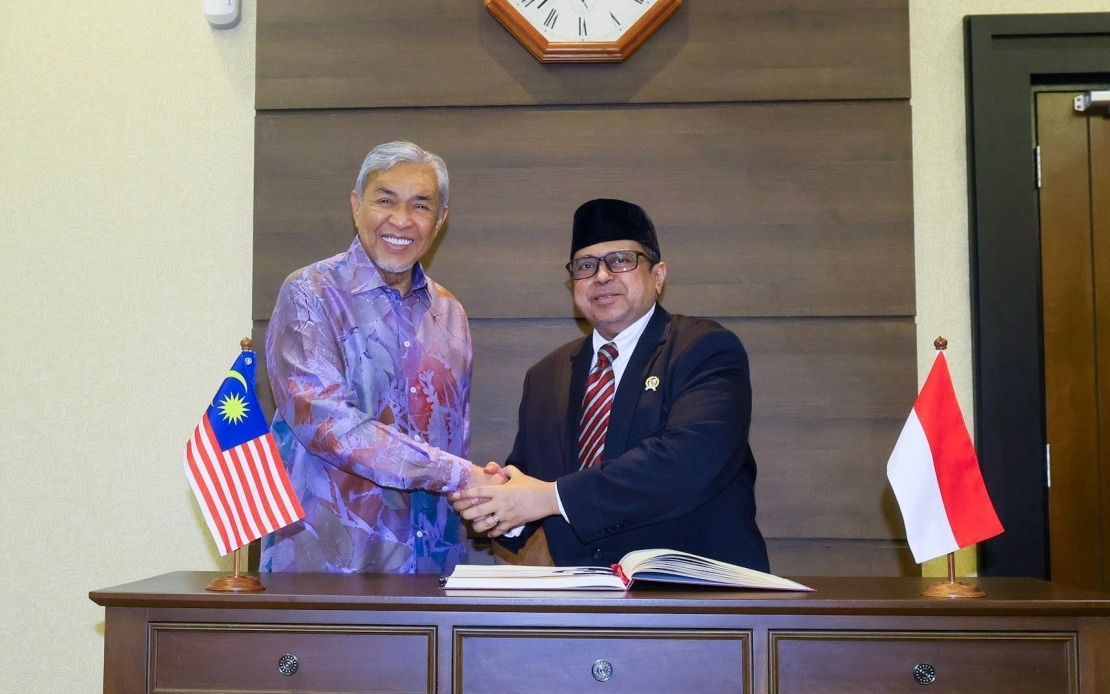
Malaysia and Indonesia are moving to deepen their partnership across the halal industry, trade, rural development, and workforce capacity-building, according to Deputy Prime Minister Datuk Seri Dr Ahmad Zahid Hamidi. The commitment emerged during discussions at Parliament between the Deputy Prime Minister and delegations including Indonesia's Ambassador to Malaysia, Raden Datuk Mohammad Iman Hascarya Kusumo, alongside Dr Ahmad Haikal Hassan, who heads Indonesia's Halal Product Assurance Organising Body (BPJPH).
The bilateral engagement reflects both nations' recognition that coordinated efforts across the halal ecosystem can unlock significant commercial and developmental benefits. Rather than pursuing isolated national strategies, Malaysian and Indonesian policymakers are increasingly convinced that harmonised approaches will enhance competitiveness in global markets where halal certification and standards carry substantial commercial weight. This shift signals a maturing recognition that the halal industry transcends domestic boundaries and demands cross-border institutional frameworks.
Several institutional innovations emerged from the discussions as potential vehicles for advancing this cooperation. Most notably, officials proposed establishing the Malaysia-Indonesia Halal Council (MIHC) to facilitate bilateral coordination, complemented by broader regional and global bodies. The envisaged ASEAN Halal Council would extend collaboration to other Southeast Asian neighbours, positioning the region as a coordinated force in international halal commerce. Beyond that, the proposed World Halal Development Council would represent an ambitious attempt to shape global standards and practices, elevating Southeast Asian perspectives within international discourse on halal certification and trade.
These institutional proposals carry tangible implications for Malaysian businesses and consumers. The harmonisation of halal standards between Malaysia and Indonesia—two of the region's largest Muslim-majority economies—would reduce compliance costs for companies operating across both markets. Currently, businesses navigating different certification regimes face duplicative testing, documentation, and approval processes. Streamlined standards would facilitate smoother trade flows, potentially lowering consumer prices while encouraging greater private-sector investment in halal supply chains. For Malaysian manufacturers, simplified cross-border verification could open Indonesia's vast consumer base more readily.
The halal industry has emerged as a significant economic driver for Malaysia, extending well beyond food and beverages into pharmaceuticals, cosmetics, tourism, and financial services. Indonesia, possessing the world's largest Muslim population and a rapidly expanding middle class, represents a natural market expansion opportunity for Malaysian halal-certified products. The bilateral cooperation framework acknowledges that both countries possess complementary strengths—Malaysia's established halal certification infrastructure and expertise can pair with Indonesia's manufacturing scale and domestic market access to create stronger regional value chains.
Ahmad Zahid, who chairs the Malaysia Halal Industry Development Council, emphasised that the historical ties between Malaysia and Indonesia provide a foundation for accelerated cooperation. Shared cultural, religious, and linguistic affinities have traditionally facilitated people-to-people connections, yet institutional cooperation in the halal sector remains underdeveloped relative to the economic potential. Formalising cooperation through dedicated councils represents an effort to convert goodwill into concrete commercial frameworks that generate measurable outcomes.
The proposed Malaysia-Indonesia Halal Council would likely function as an operational body addressing immediate coordination challenges, while the broader ASEAN framework reflects recognition that halal standards increasingly require regional consensus. As other Southeast Asian nations—notably Thailand, Vietnam, and the Philippines—develop halal-conscious manufacturing sectors to capture Muslim consumer markets, establishing unified regional standards becomes strategically important. A fragmented approach risks creating barriers to intra-ASEAN trade, whereas harmonised standards would strengthen the region's collective market position.
The World Halal Development Council proposal signals even more ambitious aspirations. Global halal trade currently exceeds USD 400 billion annually, with significant growth anticipated as Muslim populations expand and incomes rise in developing markets. By establishing an international body with Malaysian and Indonesian leadership, both nations position themselves to influence how halal standards evolve globally. This carries geopolitical dimensions—the ability to shape international certification norms translates into soft power and regulatory influence that extends beyond commerce into diplomacy.
Rural development and human capital initiatives mentioned alongside halal industry cooperation point toward a comprehensive vision where halal sector growth benefits all segments of society. In Malaysia, many rural communities depend on agricultural and food-processing activities that could integrate into halal value chains with appropriate support. Similarly, workforce development initiatives would create employment opportunities in certification, logistics, and management roles. This multi-dimensional approach reflects understanding that sustainable economic cooperation requires inclusive growth strategies.
The timing of these discussions occurs amid broader regional efforts to strengthen ASEAN economic integration. Both Malaysia and Indonesia have emphasised the importance of leveraging Muslim consumer markets within the framework of the ASEAN Economic Community. Halal industry cooperation aligns with this strategic pivot toward intra-regional commerce and investment. For Malaysian policymakers, deepening ties with Indonesia sidesteps reliance on distant markets and hedges against global supply chain volatility—a lesson underscored by recent international disruptions.
Implementing these cooperative frameworks presents practical challenges. Regulatory alignment requires navigating different institutional structures, compliance methodologies, and bureaucratic procedures across both countries. The proposed councils must move beyond rhetorical commitment to establish binding protocols, dispute resolution mechanisms, and enforcement procedures. Experience with earlier ASEAN initiatives suggests that success depends on dedicated secretariats, adequate funding, and political will to subordinate national interests to collective objectives—hurdles that have occasionally impeded progress on regional initiatives.
For Malaysian businesses, particularly SMEs, the cooperation framework could provide pathways to Indonesian market entry through simplified certification and government support programmes. However, realising these opportunities requires awareness and proactive engagement. Business chambers and industry associations will play crucial roles in translating high-level diplomatic initiatives into practical commercial opportunities. The private sector must complement government efforts by identifying specific supply chain integration possibilities and investment ventures that benefit from the new cooperation architecture.
Looking forward, the Malaysia-Indonesia partnership in halal industry development represents a bellwether for how Southeast Asian nations might approach regional economic cooperation. If successfully implemented, these frameworks could demonstrate that coordinated approaches to sector-specific development generate superior outcomes compared to unilateral strategies. Conversely, if institutional mechanisms stall or fail to deliver tangible benefits, enthusiasm for deeper regional cooperation may diminish. The coming months will reveal whether ambitious proposals translate into substantive commercial outcomes.

